 14 citations
,
June 2014 in “Journal of Pharmaceutical Sciences”
14 citations
,
June 2014 in “Journal of Pharmaceutical Sciences” Formulation P-08-016 better targets hair follicles for baldness treatment.
 10 citations
,
March 2015 in “PubMed”
10 citations
,
March 2015 in “PubMed” Scalp micropigmentation, a cosmetic tattoo technique, is a promising non-surgical treatment for hair and scalp deformities, despite potential complications.
 57 citations
,
July 1987 in “Journal of The American Academy of Dermatology”
57 citations
,
July 1987 in “Journal of The American Academy of Dermatology” Stopping minoxidil treatment resumes balding; continuous use needed for results.
 September 2023 in “The Journal of Steroid Biochemistry and Molecular Biology”
 Stopping finasteride for male pattern hair loss changes neuroactive steroid levels in the brain and blood.
 4 citations
,
May 2019 in “Skin Research and Technology”
4 citations
,
May 2019 in “Skin Research and Technology” Finasteride helps hair growth but stopping it causes faster hair loss.
 2 citations
,
September 2021 in “JAAD case reports”
2 citations
,
September 2021 in “JAAD case reports” Dupilumab helped a woman with severe hair loss regrow her hair quickly and maintain it for six months after stopping treatment.
 26 citations
,
June 2018 in “Australasian Journal of Dermatology”
26 citations
,
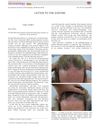
June 2018 in “Australasian Journal of Dermatology” Stopping sunscreen use on the forehead led to hair regrowth in a woman with frontal fibrosing alopecia.
3 citations
,
February 2002 in “The American journal of psychiatry” Stopping birth control pills may have triggered a manic episode in a woman with HAIR-AN syndrome.
 April 2026 in “Journal of Clinical Medicine”
 Stopping finasteride can lead to lasting sexual and psychological issues.

Stopping finasteride and closing PFO can help prevent strokes in young adults.
 November 2022 in “Journal of the Endocrine Society”
 A transman experienced lasting virilization symptoms after stopping testosterone, which were resolved with estradiol treatment.
 9 citations
,
January 1987 in “Journal of The American Academy of Dermatology”
9 citations
,
January 1987 in “Journal of The American Academy of Dermatology” A man lost a lot of scalp hair quickly after stopping minoxidil, but it grew back with mild male pattern baldness.
 September 2018 in “Reactions Weekly”
 Two women had skin reactions from a hair loss treatment and got better after stopping use.
 40 citations
,
May 1987 in “The Lancet”
40 citations
,
May 1987 in “The Lancet” Minoxidil helps some bald men, but most lose hair again when stopping.
 30 citations
,
April 2002 in “Archives of Dermatology”
30 citations
,
April 2002 in “Archives of Dermatology” Finasteride can cause one-sided breast enlargement, which disappears after stopping the drug.
5 citations
,
June 2012 in “PubMed” Valproic acid can cause a skin condition called leukocytoclastic vasculitis, which usually gets better after stopping the drug.
 1 citations
,
December 2022 in “Life”
1 citations
,
December 2022 in “Life” Topical corticosteroids are the main treatment for Erosive Pustular Dermatosis, but recurrence is common after stopping treatment.
 1 citations
,
January 2011 in “Journal of Human Reproductive Sciences”
1 citations
,
January 2011 in “Journal of Human Reproductive Sciences” Finasteride may decrease semen quality but not harm sperm production, and stopping the drug can improve semen quality; hyperprolactinemia can cause infertility but is treatable with medication.
 April 2019 in “Journal of Investigative Dermatology”
 Increasing COX-2 in mouse skin causes bigger sebaceous glands and thinner hair, but stopping COX-2 can reverse hair thinning.
 August 2009 in “Reactions Weekly”
 Finasteride caused breast enlargement in two men, which improved after stopping the medication.
 4 citations
,
January 2009 in “Indian Journal of Dermatology, Venereology and Leprology”
4 citations
,
January 2009 in “Indian Journal of Dermatology, Venereology and Leprology” A patient with granuloma annulare experienced both isotopic and isomorphic responses, with skin lesions responding to steroids but relapsing after stopping treatment.
 3 citations
,
January 2018 in “Annals of Dermatology”
3 citations
,
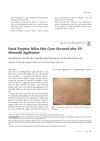
January 2018 in “Annals of Dermatology” A woman developed facial hair cysts after using a 3% minoxidil solution for hair loss, which disappeared after stopping the treatment and removing the cysts surgically.
 2 citations
,
February 2023 in “BJUI”
2 citations
,
February 2023 in “BJUI” Urologists should monitor mental health in patients taking finasteride due to potential links to suicidal thoughts, adjusting dosage or stopping use if necessary. More research is needed to confirm if finasteride causes these thoughts.
 April 2024 in “International journal of impotence research”
 Some men experience persistent sexual, neurological, and psychological symptoms after stopping finasteride, but evidence of permanent damage is inconclusive.
 May 2022 in “Journal of the Egyptian Women's Dermatologic Society (Print)”
 Women's hair loss can be due to hormonal changes and various conditions, with treatments focusing on stopping progression and managing symptoms.
 July 1987 in “Reactions (Auckland)”
 Oral minoxidil may slow male pattern baldness and cause body hair growth, but hair loss can happen after stopping it.
 February 2026 in “Zenodo (CERN European Organization for Nuclear Research)”
 Spironolactone effectively treats female pattern hair loss but requires ongoing use to maintain results.
 February 2026 in “Zenodo (CERN European Organization for Nuclear Research)”
 Spironolactone effectively treats female pattern hair loss but requires ongoing use to maintain results.
 June 2007 in “DOAJ (DOAJ: Directory of Open Access Journals)”
 Female pattern hair loss, common in women, can be treated with oral antiandrogens and topical minoxidil, but these are more effective at preventing further loss than regrowing hair. Other helpful methods include counseling, cosmetic camouflage, and hair transplantation. Treatment must continue for effects to last and it may take up to 2 years to see results.
 December 2024 in “Australasian Journal of Dermatology”
 Topical finasteride can cause breast enlargement and tenderness in men.