Spiny mice have resilient, large mitochondria that help them regenerate tissue.
September 1989 in “PubMed” The method allows detailed observation of hair tissue structures.
 39 citations
,
December 2008 in “Clinics in Dermatology”
39 citations
,
December 2008 in “Clinics in Dermatology” Dermoscopy has improved skin cancer diagnosis and has expanding applications in dermatology, but requires staying updated with new research and techniques.
27 citations
,
January 2016 in “Indian Dermatology Online Journal” Dermoscopy is better than a magnifying lens for examining skin because it shows deeper details.
May 2026 in “Applied Spectroscopy” Humidity affects hair structure changes during stretching.
 1 citations
,
January 2021 in “Dermatologic Therapy”
1 citations
,
January 2021 in “Dermatologic Therapy” Trichobiolight effectively treats hair loss with 82.5% success.
 September 2025 in “bioRxiv (Cold Spring Harbor Laboratory)”
 Non-invasive methods can effectively monitor hair growth cycles, aiding hair loss treatment development.
75 citations
,
March 2007 in “Journal of Biological Chemistry” QSOX enzymes help form protein bonds in cells, especially in tissues with high secretory activity.
A new imaging method helps see and study touch nerve endings in mouse skin.
April 2005 in “Journal of Investigative Dermatology” Vitamin D helps protect skin, PSORS1 gene's risk interval for psoriasis is expanded, hair follicles can be generated from mouse cells, and interferon-γ may cause pigmented skin lesions.
24 citations
,
January 2009 in “International Journal of Trichology” Sunlight exposure ages hair, making it brittle, stiff, and dry.
July 2024 in “Journal of Investigative Dermatology” December 2020 in “Zenodo (CERN European Organization for Nuclear Research)” December 2020 in “Zenodo (CERN European Organization for Nuclear Research)” 150 citations
,
June 1999 in “Oncogene” November 2025 in “Analytical Chemistry” A new method improves protein extraction from hair, helping identify potential biomarkers for fetal growth issues.
 8 citations
,
February 2005 in “British Journal of Haematology”
8 citations
,
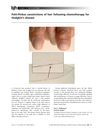
February 2005 in “British Journal of Haematology” Chemotherapy caused the patient's hair to have alternating thick and thin segments.
Loss of the p53 gene alone causes tumors, and losing both p53 and Rb genes speeds up aggressive skin cancer.
 74 citations
,
July 2008 in “Journal of Dermatological Case Reports”
74 citations
,
July 2008 in “Journal of Dermatological Case Reports” Trichoscopy is a quick and easy way to diagnose most genetic hair problems without invasive methods.
5 citations
,
January 1964 in “Naunyn-Schmiedeberg s Archives of Pharmacology” Iodine is absorbed by hair just below the skin surface.
3 citations
,
December 2014 in “Aesthetic dermatology” Radiofrequency is effective for noninvasive wrinkle treatments and body contouring.
September 2023 in “Zenodo (CERN European Organization for Nuclear Research)” The document's conclusion cannot be determined because the content is not available.
 May 2023 in “Experimental Dermatology”
 RCM and OCT are effective for diagnosing and monitoring hair-related skin diseases but lack standardized protocols and need more research.
 December 2023 in “Forensic science international. Genetics”
 The RapidHIT ID system can effectively get DNA profiles from hair roots with enough cells.
January 2011 in “대한피부과학회지” A 7-year-old girl was diagnosed with trichothiodystrophy due to low sulfur levels in her hair.
September 2023 in “Zenodo (CERN European Organization for Nuclear Research)” 144 citations
,
May 1990 in “Journal of the American Academy of Dermatology” 2 citations
,
December 2015 in “Journal of dermatology” β-interferon injections for melanoma can cause excessive hair growth at the injection sites.
2 citations
,
March 2010 in “Acta Biochimica Polonica” Raltitrexed conjugates are less potent than the free drug but more effective at high concentrations.