2 citations
,
February 2025 in “Journal of the American Pharmacists Association” Pharmacy professionals need thorough training and guidelines for safely preparing cytotoxic drugs.
 208 citations
,
July 2001 in “Journal of The American Academy of Dermatology”
208 citations
,
July 2001 in “Journal of The American Academy of Dermatology” Pregnancy can cause various skin changes and diseases, with PUPPP being the most common skin condition specific to pregnancy.
115 citations
,
August 2020 in “International Journal of Molecular Sciences” A PRP concentration of 1.0 × 10^6 plt/μL is best for tissue repair.
 36 citations
,
June 2017 in “Journal of Cutaneous Medicine and Surgery”
36 citations
,
June 2017 in “Journal of Cutaneous Medicine and Surgery” The consensus document recommends a comprehensive treatment plan for Hidradenitis Suppurativa, including various medications, surgery, lifestyle changes, and the need for more research and resources.
 5 citations
,
November 2011 in “Expert Review of Dermatology”
5 citations
,
November 2011 in “Expert Review of Dermatology” The document concludes that early diagnosis and a comprehensive treatment plan are crucial for managing hair loss in children, with a focus on both medical and psychological support.
1 citations
,
January 2025 in “Veterinary Medicine International” PRP shows promise for eye disease in animals but needs more research before being standard care.
1 citations
,
October 2017 JAK inhibitors are effective for hair regrowth in severe alopecia areata.
1 citations
,
January 2023 in “PubMed” PRP might help with hair growth, but the evidence is weak.
January 2026 in “Al-Azhar Assiut Medical Journal” Intralesional pentoxifylline effectively and safely treats alopecia areata, improving hair regrowth.
 December 2025 in “International Journal of Innovative Technologies in Social Science”
 Oral JAK inhibitors effectively treat alopecia areata and are generally well-tolerated.
 October 2024 in “Journal of Education Health and Sport”
 Alopecia areata treatment should be personalized, using topical or systemic therapies based on severity, with promising options like JAK inhibitors needing more research.
 May 2024 in “Journal of Education, Health and Sport”
 Current treatments for folliculitis decalvans include antibiotics, isotretinoin, and potential new therapies like botulinum toxin A and PRP.
 January 2024 in “Dermatologic therapy”
 Tofacitinib is a safe treatment for hair loss in children, but long-term use may be needed for best results.
 73 citations
,
March 2014 in “Journal of The American Academy of Dermatology”
73 citations
,
March 2014 in “Journal of The American Academy of Dermatology” Most dermatologic medications are safe during pregnancy and breastfeeding, but some should be avoided due to potential risks.
23 citations
,
June 1993 in “PubMed” Medication 1 improved hair quality and growth more effectively than medication 2 and the placebo.
23 citations
,
December 1990 in “PubMed” SLE should be considered in horses with immune-related skin issues.
 17 citations
,
June 2016 in “Croatian Medical Journal”
17 citations
,
June 2016 in “Croatian Medical Journal” Patients with chronic graft-versus-host disease often have skin problems like vitiligo and alopecia areata.
 1 citations
,
April 2022 in “Revista Da Associacao Medica Brasileira”
1 citations
,
April 2022 in “Revista Da Associacao Medica Brasileira” COVID-19 can cause different types of hair loss, and proper diagnosis by a specialist may be needed.

The document concludes that dermatology training and grading scales need to better represent dark-skinned individuals to improve diagnosis and assessment of skin conditions.
February 2026 in “Clinical Traditional Medicine and Pharmacology” Both Unani treatments effectively reduced hair shedding in Telogen Effluvium.
 January 2024 in “Pan African Medical Journal”
 Non-scarring hair loss is common in lupus patients and can be diagnosed with specific hair and tissue tests.
March 2023 in “Nigerian Journal of Clinical Practice” The main difference in hair loss for lupus patients is smaller and fewer sebaceous glands.
 January 2019 in “Elsevier eBooks”
 Different hair disorders have specific treatments and outcomes, with some resolving on their own and others requiring medication or emotional support.
October 2017 in “Data Archiving and Networked Services (DANS)” Current SLE classifications need refinement, and the complement system is a key therapeutic target.
 May 2014 in “Clinical and Experimental Dermatology”
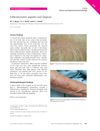
 A 70-year-old woman with a rare skin condition improved after treatment with topical steroids and acitretin.
 4 citations
,
March 2017 in “Journal of evolution of medical and dental sciences”
4 citations
,
March 2017 in “Journal of evolution of medical and dental sciences” Older adults often have dry skin and itching, with high blood pressure frequently linked to skin problems.
 218 citations
,
April 2012 in “British Journal of Dermatology”
218 citations
,
April 2012 in “British Journal of Dermatology” Guidelines suggest various treatments for alopecia areata, but leaving it untreated is also an option as 80% cases may recover on their own.
 95 citations
,
November 2018 in “Australasian journal of dermatology”
95 citations
,
November 2018 in “Australasian journal of dermatology” Alopecia areata treatment varies, with no optimal method established yet.
 44 citations
,
November 1998 in “Australasian Journal of Dermatology”
44 citations
,
November 1998 in “Australasian Journal of Dermatology” Accurate diagnosis is key for treating different kinds of hair loss, and immune response variations may affect the condition and treatment results.
 27 citations
,
March 2013 in “Social Semiotics”
27 citations
,
March 2013 in “Social Semiotics” Commercial hair loss websites promote Propecia by making men feel insecure about baldness and suggesting it's a medical issue needing treatment.