32 citations
,
August 2016 in “Journal of the American Academy of Dermatology” Temporal triangular alopecia is a non-scarring hair loss in children, often linked to other health conditions.

Certain gene variations in sheep are linked to stronger wool.
344 citations
,
May 2018 in “EMBO journal” Phosphorylation controls TFEB's location in the cell, affecting cell metabolism and stress response.
 January 2019 in “Clinical neuropharmacology”
 A girl's hair-pulling condition improved greatly after she started vitamin D treatment.
3 citations
,
August 2024 in “Clinical Cosmetic and Investigational Dermatology” The 1927 nm fractional thulium laser effectively treats acne by targeting and improving affected skin areas.
118 citations
,
June 1993 in “Journal of Biological Chemistry” Human and mouse TGase3 enzymes are similar but differ near the activation site, crucial for their function in skin and hair development.
5 citations
,
January 2016 in “Indian dermatology online journal” A 25-year-old man with multiple skin tumors was successfully treated with acitretin and methotrexate.
 2 citations
,
January 2022 in “BioMed Research International”
2 citations
,
January 2022 in “BioMed Research International” LED light therapy at 863 nm wavelength can slow down skin tumor growth and reduce inflammation in mice.
 April 2026 in “Diagnostics”
 PRP treatment improves chronic tendinopathy, and imaging biomarkers can track tendon changes.
 March 2025 in “Nepal Journal of Dermatology Venereology & Leprology”
 A standardized guideline would improve Telogen Effluvium management.
 2 citations
,
October 2000
2 citations
,
October 2000 The investigation found no work-related causes for employee hair loss at Equifax Payment Services, and the environment was not hazardous.
January 2003 in “Papyrus : Institutional Repository (Université de Montréal)”  April 2018 in “Journal of Investigative Dermatology”
 The new protocol using Cellutome™ and RCM safely assesses wound healing in detail.
January 2015 in “International journal of current research and review” The document's conclusion cannot be provided because the content is not accessible.
 April 2017 in “The journal of investigative dermatology/Journal of investigative dermatology”
 QMSI is a valuable method for studying drug penetration in skin tissues.
January 2016 in “프로그램북(구 초록집)” The thulium laser and PDRN injections effectively improved hair thickness in patients with pattern hair loss.
 1 citations
,
October 2022 in “Molecular therapy”
1 citations
,
October 2022 in “Molecular therapy” The FDA approved the first gene therapy for a blood disorder after overcoming early challenges and demonstrating patient benefits.
August 2024 in “Skin Research and Technology” TAF can be identified by excessive skin thickening and clogged hair follicles, helping distinguish it from similar skin conditions.
 4 citations
,
January 2014 in “BioMed Research International”
4 citations
,
January 2014 in “BioMed Research International” Engineering the cell microenvironment is key for advancing tissue engineering and regenerative medicine.
 67 citations
,
January 2013 in “Indian Journal of Dermatology, Venereology and Leprology”
67 citations
,
January 2013 in “Indian Journal of Dermatology, Venereology and Leprology” Chronic Telogen Effluvium may resolve after years and is diagnosed by examining the patient's history and clinical signs, with treatment aimed at underlying causes and possibly minoxidil.
November 2025 in “Journal of Investigative Dermatology” TEC kinases may help cause inflammation in vitiligo and could be targeted for treatment.
 10 citations
,
June 2005 in “Small ruminant research”
10 citations
,
June 2005 in “Small ruminant research” Melatonin treatment may increase cashmere production in Spanish goats.
 1 citations
,
January 2013 in “International Journal of Trichology”
1 citations
,
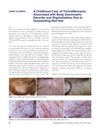
January 2013 in “International Journal of Trichology” A girl with red hair developed hair-pulling and body image disorders after being bullied for her hair color.
October 2006 in “Urology” The study found that different criteria led to different patient groups in the CombAT study compared to the MTOPS study.
1 citations
,
May 2020 in “bioRxiv (Cold Spring Harbor Laboratory)” The fer-ts mutation in plants prevents root hair growth at high temperatures.
 April 2024 in “Cellular signalling”
 Activating TRPMLs helps human cells important for hair growth and increases hair growth in mice.
 April 2023 in “Journal of Investigative Dermatology”
 An automated system can predict death risk in thin melanoma by analyzing immune cells.
2 citations
,
January 1989 Tay syndrome is a unique genetic disorder causing skin, hair, and developmental issues.
31 citations
,
November 2015 in “PloS one” Reducing Tyrosinase prevents mature color pigment cells from forming in mouse hair.
 101 citations
,
March 2019 in “Cell Stem Cell”
101 citations
,
March 2019 in “Cell Stem Cell” Certain immune cells in the skin release a protein that stops hair growth by keeping hair stem cells inactive.