May 2010 in “Europe PMC (PubMed Central)” Near-infrared probes can safely and effectively image cysteine protease activity for disease diagnosis.
 10 citations
,
June 2018 in “Journal of visualized experiments”
10 citations
,
June 2018 in “Journal of visualized experiments” The document concludes that the technique allows for the detection of LDH activity in various tissues, showing where cells are actively metabolizing glucose.
August 1994 in “Journal of Dermatological Science” 21 citations
,
January 2000 in “Fetal Diagnosis and Therapy” Prenatal diagnosis of trichothiodystrophy is possible in the second trimester using fetal eyebrow biopsy, with sulfur content analysis being more reliable.
2 citations
,
November 2025 in “Pharmaceutics” Moderately lipophilic dyes penetrate skin deeply, while highly hydrophobic or lipophilic dyes stay on the surface.
3 citations
,
March 2013 in “QScience Connect” Photodynamic therapy with methylene blue and a laser effectively destroys hair follicles better than traditional laser hair removal.
36 citations
,
February 1998 in “Journal of Anatomy” Fibre optic confocal imaging can visualize skin layers, blood vessels, and nerves in live mice.
June 2015 in “The American journal of dermatopathology/American journal of dermatopathology” The study found that a one-step antibody method is better than the LSAB method for accurately studying hair follicle structures without false positives.
 17 citations
,
November 2017 in “PLoS ONE”
17 citations
,
November 2017 in “PLoS ONE” Transplanted bone marrow cells actively move, form clusters, and grow after transplantation.
Methylene blue helps hair growth by protecting hair stem cells from stress.
17 citations
,
March 2005 in “Journal of Investigative Dermatology” Autofluorescence in hair follicle stem cells can interfere with studies but may help isolate these cells.
A new method using stamps improves symmetry in hair restoration surgery.
August 2000 in “Microscopy and Microanalysis” The method successfully visualizes iodine in biological tissues.
 January 2024 in “Current research in toxicology”
 Thallium is highly toxic, causing severe health issues, and Prussian blue is the best antidote.
 May 2023 in “Authorea (Authorea)”
 Levofloxacin may cause skin discoloration and hair loss as side effects.
21 citations
,
November 1969 in “Journal of Investigative Dermatology” A new staining method clearly shows nerves around eyebrow hair follicles.
 October 2023 in “Spectrochimica acta. Part A, Molecular and biomolecular spectroscopy”
 New, eco-friendly methods accurately measure TDF and FNS in a new urologic medication.
 71 citations
,
March 1995 in “Journal of The American Academy of Dermatology”
71 citations
,
March 1995 in “Journal of The American Academy of Dermatology” Using both vertical and transverse sections for alopecia biopsies improves diagnosis without extra cost.
June 2025 in “OPAL (Open@LaTrobe) (La Trobe University)” A new hair dye method uses polyphenols and oxidation to create a long-lasting brown color on gray hair.
 August 2018 in “Journal of Investigative Dermatology”
 The conclusion is that using light-sheet fluorescence microscopy with a special solution can effectively create detailed 3D images of human skin for dermatological research.
 July 2018 in “Journal of The American Academy of Dermatology”
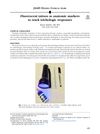
 Fluorescent tattoos are a good way to mark the scalp for hair treatments because they're accurate, invisible in normal light, and have low risk.
 162 citations
,
August 2005 in “The journal of investigative dermatology/Journal of investigative dermatology”
162 citations
,
August 2005 in “The journal of investigative dermatology/Journal of investigative dermatology” The new "differential stripping" method effectively measures how much substance gets into hair follicles.
7 citations
,
June 2019 in “Coloration Technology” Translucent keratin films are better for testing hair dyes.
26 citations
,
June 2023 in “International Journal of Bioprinting” The hydrogel effectively heals infected wounds and kills bacteria.
 18 citations
,
May 2013 in “Journal of The American Academy of Dermatology”
18 citations
,
May 2013 in “Journal of The American Academy of Dermatology” EVG staining is the most reliable method for diagnosing alopecia.
April 2018 in “Dermatologic Surgery” 2 citations
,
June 2020 in “Journal of Investigative Dermatology” 3D imaging of skin biopsies offers better accuracy but is time-consuming and can't clear melanin.
A new imaging method helps see and study touch nerve endings in mouse skin.
May 1988 in “Journal of Forensic Sciences” A new method accurately determines hair blood type and can be used on dust samples.