 3 citations
,
July 2018 in “Journal of Oral and Maxillofacial Surgery”
3 citations
,
July 2018 in “Journal of Oral and Maxillofacial Surgery” Hair loss can occur after oral surgery, likely due to stress and pressure on the scalp, and usually gets better on its own.
3 citations
,
January 2009 in “Medical Hypotheses” Topical iodine can regenerate and control human scar tissue.
 2 citations
,
January 2023 in “Annals of Dermatology”
2 citations
,
January 2023 in “Annals of Dermatology” A hairless patch on a boy's scalp from birth injury improved with minoxidil treatment.
 2 citations
,
July 2021 in “Dermatologic Therapy”
2 citations
,
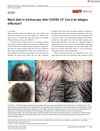
July 2021 in “Dermatologic Therapy” A woman's hair loss after COVID-19 was likely due to a mix of pressure-induced alopecia and acute telogen effluvium.
1 citations
,
November 2022 in “International journal of trichology” A woman's premature gray hair turned mostly black again after using Greyverse solution and hair supplements for 5 months.
1 citations
,
May 2022 in “International journal of trichology” Most patients were happy with the hair fiber filler and had no serious side effects.
 1 citations
,
April 2018 in “Our Dermatology Online”
1 citations
,
April 2018 in “Our Dermatology Online” Trichoscopy can detect early signs of steroid overuse on the scalp, suggesting a need for non-steroidal treatments.
 1 citations
,
July 2015 in “European Journal of Dermatology”
1 citations
,
July 2015 in “European Journal of Dermatology” CO₂ laser treatment is fast and effective for some benign skin tumors with minimal side effects.
 April 2026 in “Brazilian Journal of Hair Health”
 Combining exosomes with microneedling may improve hair growth in androgenetic alopecia.

Oral minoxidil may have more cardiovascular risks than topical minoxidil.
January 2026 in “Dermatologic Therapy” Human foreskin fibroblast–conditioned medium improved hair growth in androgenetic alopecia patients.
 December 2025 in “International Journal of Research in Dermatology”
 A multidisciplinary approach is crucial for effectively managing hair loss linked to endocrine and gynecological disorders.
September 2025 in “Frontiers in Pharmacology” The gel shows strong potential for effectively treating pressure ulcers.
 September 2025 in “OBM Genetics”
 Early diagnosis and comprehensive management improve life quality for Netherton syndrome patients.

Continuous treatment is essential to manage male pattern baldness effectively.

The treatment showed promising hair regrowth in advanced-stage hair loss.

Frontal fibrosing alopecia can be managed with personalized combination therapies, but no cure exists yet.
 January 2025 in “Journal of Drugs in Dermatology”
 Oral minoxidil is easier to use and more satisfying for hair loss treatment than topical minoxidil.
 April 2024 in “MRIMS journal of health sciences”
 Using growth factor injections and minoxidil together can significantly improve hair growth in people with hair loss.
 September 2023 in “Cureus”
 Topical finasteride might be a good alternative for hair loss treatment with fewer side effects, but more research is needed.
 September 2023 in “Archives of Dermatological Research”
 Using minoxidil with microneedling increases hair count for hair loss without serious side effects.
 August 2023 in “Indian Journal of Pharmaceutical Education and Research”
 Nanoemulgel is a promising method for applying topical drugs effectively, but safety must be evaluated due to new administration techniques.
 August 2022 in “Revista de la Universidad Industrial de Santander/Salud UIS”
 Stress-related hair loss was reversed with a special medication.
 January 2022 in “Clinical dermatology open access journal”
 Early-stage Alopecia Areata was effectively treated in less than six months.
 September 2021 in “Farmacja Polska”
 Scalp needle mesotherapy can effectively treat hair loss and improve hair growth.
 April 2021 in “International Journal of Research in Dermatology”
 A child with a rare scalp condition regrew hair after treatment.
 February 2020 in “International research journal of pharmacy”
 The emulsion made from tea plant and onion extracts shows promise for treating hair loss.
 April 2019 in “The journal of investigative dermatology/Journal of investigative dermatology”
 Keloids significantly reduce quality of life, and treating symptoms should be prioritized.
 March 2019 in “Applied sciences”
 Laser therapy might help regrow hair in alopecia totalis better than steroids alone.
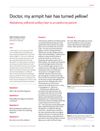
A 15-year-old boy's smelly, yellow armpit hair improved with clindamycin treatment.