 6 citations
,
July 2013 in “Experimental and Therapeutic Medicine”
6 citations
,
July 2013 in “Experimental and Therapeutic Medicine” Ginsenoside Rg1 protects mouse skin from UVB damage and helps control inflammation.
 6 citations
,
May 2013 in “PloS one”
6 citations
,
May 2013 in “PloS one” The Foxn1(-/-) nude mouse shows disrupted and expanded skin stem cell areas due to high Lhx2 levels.
 2 citations
,
December 2022 in “Scientific Data”
2 citations
,
December 2022 in “Scientific Data” The study maps how genes are regulated during mouse hair growth.
 2 citations
,
October 2010 in “Journal of dermatological treatment”
2 citations
,
October 2010 in “Journal of dermatological treatment” External treatments can change hair growth patterns in nude mice.
 January 2018 in “bioRxiv (Cold Spring Harbor Laboratory)”
 Researchers found key regions in the mouse hairless gene that control its activity in skin and brain cells, affecting hair follicle function.
 829 citations
,
May 2007 in “Nature”
829 citations
,
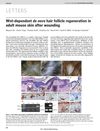
May 2007 in “Nature” Hair follicles can regrow in wounded adult mouse skin using a process like embryo development.
 49 citations
,
August 2004 in “The FASEB Journal”
49 citations
,
August 2004 in “The FASEB Journal” Mice with human skin protein K8 had more skin problems and cancer.
Dual TCR Treg cells are common in mouse tissues and vary by location.
 127 citations
,
December 2005 in “Experimental Dermatology”
127 citations
,
December 2005 in “Experimental Dermatology” Stress can stop hair growth in mice, and treatments can reverse this effect.
 116 citations
,
September 2020 in “Nature Communications”
116 citations
,
September 2020 in “Nature Communications” The research identified various cell types in mouse and human teeth, which could help in developing dental regenerative treatments.
 77 citations
,
February 2017 in “Stem Cell Reports”
77 citations
,
February 2017 in “Stem Cell Reports” SHISA6 helps maintain certain stem cells in mouse testes by blocking signals that would otherwise cause them to differentiate.
 25 citations
,
June 2017 in “Scientific reports”
25 citations
,
June 2017 in “Scientific reports” Stress worsens Tourette symptoms by increasing allopregnanolone levels.
 24 citations
,
April 2012 in “Developmental Biology”
24 citations
,
April 2012 in “Developmental Biology” Dermal papillae cells, important for hair growth, come from multiple cell lines and can be formed by skin cells, regardless of their origin or hair cycle phase. These cells rarely divide, but their ability to shape tissue may contribute to their efficiency in inducing hair growth.
 22 citations
,
October 2012 in “Journal of Investigative Dermatology”
22 citations
,
October 2012 in “Journal of Investigative Dermatology” Altered retinoid metabolism in cicatricial alopecia suggests a balanced vitamin A diet may prevent the condition.
 12 citations
,
November 2003 in “Journal of the American Academy of Dermatology”
12 citations
,
November 2003 in “Journal of the American Academy of Dermatology” Topical diphencyprone helped regrow hair in mice and rats with a condition similar to human hair loss.

Dual TCR Treg cells are common in various mouse tissues and show diverse characteristics.
 16 citations
,
March 2016 in “The journal of investigative dermatology/Journal of investigative dermatology”
16 citations
,
March 2016 in “The journal of investigative dermatology/Journal of investigative dermatology” The Notch signaling pathway helps in mouse hair development through a noncanonical mechanism that does not rely on RBPj or transcription.
 108 citations
,
July 2002 in “Molecular and cellular biology”
108 citations
,
July 2002 in “Molecular and cellular biology” Overexpressing Dsg3 in mice skin causes excessive cell growth and abnormal skin development.
 9 citations
,
December 2023 in “Journal of Neuroimmune Pharmacology”
9 citations
,
December 2023 in “Journal of Neuroimmune Pharmacology” NDP-MSH protects brain cells and reduces inflammation in Parkinson's disease by activating MC1R and involving Tregs.
A new imaging method helps see and study touch nerve endings in mouse skin.
 363 citations
,
March 2017 in “Nature Communications”
363 citations
,
March 2017 in “Nature Communications” Stem cells help heal wounds by rapidly dividing and migrating to the wound edge.
 82 citations
,
May 2009 in “Development”
82 citations
,
May 2009 in “Development” EGF and KGF signalling prevent hair follicle formation and promote skin cell development in mice.
 81 citations
,
January 2006 in “Journal of cellular physiology”
81 citations
,
January 2006 in “Journal of cellular physiology” Mice without the vitamin D receptor gene lose hair due to disrupted hair follicle cycles.
 34 citations
,
April 2014 in “Psychopharmacology”
34 citations
,
April 2014 in “Psychopharmacology” Stress and alcohol affect brain chemicals differently in rats, mice, and humans, influenced by genetic differences.
 15 citations
,
June 2019 in “Journal of Neuroendocrinology”
15 citations
,
June 2019 in “Journal of Neuroendocrinology” Isoallopregnanolone may be a safe and effective treatment for reducing tics in a mouse model of Tourette syndrome.
 7 citations
,
August 2022 in “Nature communications”
7 citations
,
August 2022 in “Nature communications” A specific group of slow-growing stem cells marked by Thy1 is crucial for skin maintenance and healing in mice.
 6 citations
,
August 2014 in “Toxicologic pathology”
6 citations
,
August 2014 in “Toxicologic pathology” Blocking DGAT1 reduces oil gland size in mice and dogs, but only mice experience hair loss.
 2 citations
,
August 2023 in “Development”
2 citations
,
August 2023 in “Development” Hair follicles in the back of the rosette fancy mouse have reversed orientations due to a gene mutation.
 150 citations
,
August 1992 in “Genes & Development”
150 citations
,
August 1992 in “Genes & Development” TNF alpha in skin cells causes weight loss, hair and fat issues, and skin inflammation in mice.
 37 citations
,
February 2019 in “Experimental Dermatology”
37 citations
,
February 2019 in “Experimental Dermatology” Spiny mice are better at regenerating hair after injury than laboratory mice and could help us understand how to improve human skin repair.