Search
for
Sort by
Research
630-660 / 1000+ resultsresearch Hypotrichosis with juvenile macular dystrophy: a case report with molecular study
A rare genetic disorder causes sparse hair and vision loss due to a CDH3 gene mutation.
research Bilateral Temporal Triangular Alopecia Associated with Phakomatosis Pigmentovascularis Type IV Successfully Treated with Follicular Unit Transplantation
Hair transplant surgery effectively treated a specific type of hair loss and is recommended as a primary treatment option.
research Dermpath Quiz: Which alopecia does the patient have?
The patient has frontal fibrosing alopecia (FFA).
research Postcast hypertrichosis in a patient with frontal fibrosing alopecia
A patient with hair loss condition grew excessive hair in areas covered by a cast.
research Hair Anomalies in a 6-Year-Old Girl
A 6-year-old girl was diagnosed with a rare hair disorder called monilethrix.
research Rapidly progressive diffuse fibrosing alopecia
These hair loss conditions might be part of a spectrum, not separate issues.
research Homozygous Nonsense Mutation in DSC3 Resulting in Skin Fragility and Hypotrichosis
A boy's skin fragility and sparse hair were caused by a genetic mutation affecting skin cell adhesion.
research BH03: Systemic sclerosis and frontal fibrosing alopecia: a novel combination of scarring alopecia
A woman with systemic sclerosis developed a unique scarring hair loss combining features of systemic sclerosis and frontal fibrosing alopecia.
research Clinical characteristics, trichoscopy, histopathology and treatment outcomes of frontal fibrosing alopecia in an Asian population: A retro‐prospective cohort study
Asian patients with Frontal Fibrosing Alopecia often lose eyebrow hair and respond well to combined antiandrogen or antimalarial and topical treatments.

research Steroidogenic Factor-1 Lineage Origin of Skin Lesions in Carney Complex Syndrome
Skin lesions in Carney Complex are caused by a gene change in some skin cells that leads to increased pigmentation and may lead to tumors.
research Palmoplantar pustulosis–like eruption following tofacitinib therapy for juvenile idiopathic arthritis
Tofacitinib can cause skin eruptions similar to palmoplantar pustulosis.

research Multifocal Malignant Proliferating Trichilemmal Tumour: A Diagnostic Imitator Beyond the Scalp
Recognizing specific markers is crucial for correctly diagnosing and treating rare multifocal MPTT in males.
research 420 Alopecia in children and adults with cystic fibrosis on elexacaftortezacaftor-ivacaftor
research Temporal Triangular Alopecia: Report of Five Cases in Asian Children
Temporal triangular alopecia is a non-scarring hair loss seen in some Asian children.
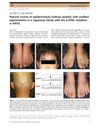
research Natural course of epidermolysis bullosa simplex with mottled pigmentation in a Japanese family with the p.P25L mutation in KRT 5
The p.P25L mutation in the KRT5 gene causes a rare skin condition that worsens over time and may lead to hair loss starting in young adulthood.

research A Case of Basal Cell Carcinoma Arising in Congenital Triangular Alopecia
A woman with a rare hair loss condition developed skin cancer in the bald area.
research TRICHOSTASIS SPINULOSA
Trichostasis spinulosa mainly affects the nose, with many tiny hairs in one follicle, possibly influenced by hormones and sunlight.
research Trichoscopic Findings of Frontal Fibrosing Alopecia
Trichoscopy is useful for diagnosing Frontal Fibrosing Alopecia.
research Frontal Fibrosing Alopecia in a Man: Results of Follicular Unit Test Grafting
Hair transplantation may not work for Frontal Fibrosing Alopecia as transplanted hair was lost when the disease came back.
research Monilethrix: a keratin hHb6 mutation is co‐dominant with variable expression
A keratin hHb6 mutation causes a hair disorder with varying severity, influenced by other factors.
research 1270 Fibroproliferative genes are preferentially expressed in central centrifugal cicatricial alopecia
CCCA may be a fibroproliferative disorder, and anti-fibrotic therapies could help.
research Mandibulofacial dysostosis with alopecia results from ETAR gain-of-function mutations via allosteric effects on ligand binding
Specific mutations in a receptor cause facial abnormalities and hair loss.
research A boggy swelling of the scalp
A rare calcium deposit condition was found on a man's scalp.
research Trichodiscoma. A Benign Tumor Related to Haarschibe (Hair Disk)
research Trichoscopy: A Useful Tool in Diagnosing Temporal Triangular Alopecia
Trichoscopy effectively diagnoses temporal triangular alopecia in children.
research An eruption of numerous spiny papules in a pediatric transplant patient
Early recognition and treatment of VATS in transplant patients improve outcomes.
research Clinical and genetic investigation of ichthyosis in familial and sporadic cases in south of Tunisia: genotype–phenotype correlation
Different gene mutations cause different types of ichthyosis, with some new mutations found.
research 865 Frontal fibrosing alopecia is associated with dysregulation of cholesterol biosynthesis pathways, fibrosis and mast cells
Frontal Fibrosing Alopecia involves disrupted cholesterol pathways, fibrosis, and increased mast cells.
research Trichorrhexis Nodosa
Trichorrhexis nodosa is mainly caused by hair trauma and improves with gentler hair care.