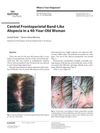
 January 2018 in “Skin appendage disorders”
 A woman's hair loss was correctly diagnosed as Lichen planopilaris after initial misdiagnosis, highlighting the usefulness of trichoscopy in diagnosing hair disorders.
 January 2026 in “Preprints.org”
 Posaconazole effectively treated a resistant fungal infection in a Spitz dog.
July 2019 in “Indian dermatology online journal” Alopecia areata can show unusual red-dotted vessels and dithranol treatment may mask typical patterns.
 February 2026 in “JOURNAL OF CLINICAL AND DIAGNOSTIC RESEARCH”
 Trichoscopy effectively detects early hair follicle changes before visible baldness in men under 40.
1 citations
,
June 2023 in “Cosmoderma” Trichoscopy is better than the hair pull test for tracking alopecia areata.
June 2025 in “British Journal of Dermatology” A rare skin condition in a boy is likely due to a specific genetic mutation pattern.
 67 citations
,
February 2009 in “Journal of Dermatology”
67 citations
,
February 2009 in “Journal of Dermatology”  November 2025 in “Zenodo (CERN European Organization for Nuclear Research)”
 Dermatophytosis in cats is a common fungal infection that usually resolves itself but can be severe in vulnerable animals.
30 citations
,
January 1963 in “PubMed” 1 citations
,
September 1986 in “Journal of the Forensic Science Society” Hair root sheaths can be used to accurately analyze genetic markers.
3 citations
,
November 2024 in “Electrochimica Acta” A new, quick method accurately detects minoxidil in drugs and cosmetics.
 September 1997 in “Journal of the European Academy of Dermatology and Venereology”
 People with acne have more CD4+ immune cells in their skin than healthy people.

A neck lesion misdiagnosed as benign was later treated successfully with Mohs Micrographic Surgery.
 1 citations
,
January 2014 in “Sen'i Gakkaishi”
1 citations
,
January 2014 in “Sen'i Gakkaishi” The new method reliably identifies and measures different animal hair fibers in textiles.
 96 citations
,
January 2013 in “International Journal of Trichology”
96 citations
,
January 2013 in “International Journal of Trichology” Trichoscopy is a useful, non-invasive way to diagnose different types of hair loss.
10 citations
,
January 1997 in “Dermatology” Two siblings were diagnosed with Trichothiodystrophy, identified by brittle hair and low sulfur content.
 September 2024 in “Indian Journal of Dermatology”
 Trichoscopy effectively diagnoses and assesses the severity of androgenetic alopecia.
 1 citations
,
September 2013 in “The Journal of Dermatology”
1 citations
,
September 2013 in “The Journal of Dermatology” An 8-year-old girl developed a rare skin condition in a linear pattern on one side of her body after a lung infection, which improved with treatment.
 September 2022 in “Anais Brasileiros de Dermatologia”
 Dermoscopy helped diagnose a rare skin disease which slightly improved with treatment.
 1 citations
,
January 2015 in “Indian journal of dermatology, venereology, and leprology”
1 citations
,
January 2015 in “Indian journal of dermatology, venereology, and leprology” A woman's scalp infection caused by a fungus led to permanent hair loss and was hard to treat but responded to a specific antifungal.
45 citations
,
December 2004 in “Forensic Science International” Laser microdissection helps get DNA from single hair follicles for better forensic analysis.
 July 2023 in “Biomolecules”
 The new "whisker follicle microinjection assay" can test how different biomolecules affect hair growth and color.
January 2022 in “Clinical Cases in Dermatology” A 7-year-old girl's scalp infection was cured with oral medication and medicated shampoo.
14 citations
,
January 2014 in “Dermatology Research and Practice” Many infants in Northern Ethiopia have zinc deficiency.
 41 citations
,
December 2015 in “Journal of the European Academy of Dermatology and Venereology”
41 citations
,
December 2015 in “Journal of the European Academy of Dermatology and Venereology” The conclusion is that a new biopsy technique and humidity chamber help study skin mites better and suggest mite overpopulation may cause skin diseases.
13 citations
,
December 1983 in “Canadian journal of zoology” Heterotypic cell contacts likely help hair matrix cells differentiate during mouse hair follicle development.
 17 citations
,
January 2011 in “Skin Research and Technology”
17 citations
,
January 2011 in “Skin Research and Technology” Hair from people with seborrheic dermatitis is thicker scaled, more damaged, and thinner than healthy hair, and atomic force microscopy can help monitor the condition.
July 2000 in “The Pediatric Infectious Disease Journal” Tinea faciei should be considered in neonatal vesicular lesions and confirmed with KOH examination and culture.
12 citations
,
May 2012 in “Journal of Biomedical Optics” Trichoscan® is best for measuring hair growth, RCM for analyzing hair follicles, and OCT is useful for both.
 April 2023 in “The journal of investigative dermatology/Journal of investigative dermatology”
 Folliculotropic mycosis fungoides has unique molecular features and cell interactions that could guide targeted therapy.