Low-level laser therapy is a safe, painless method that effectively treats acne and improves skin without post-treatment care.
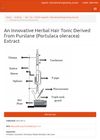
Portulaca-based hair tonics are promising eco-friendly and effective cosmetic alternatives.
 15 citations
,
May 2016 in “Archives of Dermatological Research”
15 citations
,
May 2016 in “Archives of Dermatological Research” ULBP3 could be a marker for diagnosing alopecia areata incognita and may be linked to its cause and development.
7 citations
,
March 2025 in “Aesthetic Plastic Surgery”  150 citations
,
April 1999 in “Dermatologic Clinics”
150 citations
,
April 1999 in “Dermatologic Clinics” Laser hair removal effectiveness depends on targeting hair structures without harming the skin, and improvements require more research and expert collaboration.
June 2023 in “Zenodo (CERN European Organization for Nuclear Research)” January 2026 in “Updates in clinical dermatology”  July 2024 in “Journal of Education For Sustainable Innovation”
 Visualizing data helps guide future androgenetic alopecia research and policies.
85 citations
,
November 2004 in “Journal of the American Academy of Dermatology” The 308-nm excimer laser helps hair regrowth in some alopecia areata cases but not all.
The research found that people's hair proteins vary, especially by ethnicity and body part, which could help identify individuals in forensic science.
September 2025 in “Journal of lasers in medical sciences” Thulium laser therapy is a safe and effective short-term treatment for hair regrowth.
1 citations
,
April 2022 in “Clinical Cosmetic and Investigational Dermatology” Topical treatment improved rare scalp lichen amyloidosis.
12 citations
,
September 2020 in “Nanomaterials” The new drug delivery system improves vitiligo treatment by enhancing melanocyte activity and viability.
June 2009 in “Faculty Opinions – Post-Publication Peer Review of the Biomedical Literature” Lrig1 marks a unique group of stem cells in mouse skin that can become different skin cell types.
22 citations
,
May 2004 in “Tissue Engineering” PGA fiber-reinforced collagen sponges improve hair growth and skin structure.
September 1998 in “Journal of the European Academy of Dermatology and Venereology” PUVA-turban therapy can help some people with severe alopecia areata regrow hair.
August 2022 in “Frontiers in Pharmacology” Ultrasound can improve targeted drug delivery, making treatments more effective with fewer side effects.
 January 2025 in “Journal of Plastic Reconstructive & Aesthetic Surgery”
 Two L-PRP treatments improve hair density in mild to moderate alopecia.
 2 citations
,
January 2006 in “Technical report”
2 citations
,
January 2006 in “Technical report” The document concludes that better tools are needed to measure skin disease severity in dermatomyositis and cutaneous lupus erythematosus, and introduces the DSSI and CLASI as reliable instruments.
 April 2023 in “Journal of Investigative Dermatology”
 Wildfire air pollution is linked to more online searches and clinic visits for psoriasis in adults after a delay.
A new method can quickly and accurately detect illegal chemicals in hair loss products.
June 2021 in “eScholarship (California Digital Library)” September 2024 in “Journal of the American Academy of Dermatology” Subcision is the most efficient, cost-effective, and safest treatment for post-acne boxcar scarring in skin of color.
 February 2025 in “Journal of Biophotonics”
 Dual-wavelength laser therapy promotes better hair regrowth than single-wavelength treatments.
 21 citations
,
January 2013 in “Annals of dermatology/Annals of Dermatology”
21 citations
,
January 2013 in “Annals of dermatology/Annals of Dermatology” The combination of cyclosporine and PUVA might help treat severe alopecia areata.
Dental procedures and treatments show promise but need more research for conclusive results.
1 citations
,
July 2023 in “International Journal of Pharmaceutical Sciences and Drug Research” The HPTLC method is effective and accurate for measuring linoleic and oleanolic acid in Eclipta alba.
 July 2003 in “Journal of Cutaneous Medicine and Surgery”
 Various skin conditions can be treated effectively with different methods, such as discontinuing certain drugs, using specific vaccines, applying creams, and changing lifestyle habits like smoking and drinking.