1 citations
,
January 2013 in “China Animal Husbandry & Veterinary Medicine” VEGF increases in goat hair follicles during fetal development, boosting skin blood vessel density.
 12 citations
,
July 2016 in “British journal of dermatology/British journal of dermatology, Supplement”
12 citations
,
July 2016 in “British journal of dermatology/British journal of dermatology, Supplement” Different hair fiber development might explain why hair loss severity varies in patients with a specific genetic mutation, and treatments that thicken hair could help.
30 citations
,
October 2014 in “Experimental Dermatology” Leptin from skin fat can slow hair growth during certain phases.
18 citations
,
June 1992 in “Acta Histochemica” Human hair follicles have a unique cell distribution and differentiation pattern during growth.
 18 citations
,
August 2018 in “The FASEB journal”
18 citations
,
August 2018 in “The FASEB journal” Rabbits lacking the Hoxc13 gene show similar hair and skin issues to humans with ECTD-9, making them good for research on this condition.
4 citations
,
January 1981 in “PubMed” Hair medullary cells in mammals vary in complexity, with humans having more structured cells similar to inner root sheath cells.
 April 2025 in “Ukrainian Journal of Veterinary and Agricultural Sciences”
 Adding a water-soluble fatty acid complex to sheep diets improves wool growth by increasing primary hair follicle size and density.
December 2025 in “International Journal of Advanced Biochemistry Research” Malvi cattle hair varies in color and pattern across different body regions.
13 citations
,
January 2002 in “Clinics in dermatology” A mushroom extract might reduce hair loss and liver damage caused by certain chemotherapy drugs in animals.
 9 citations
,
October 2013 in “Journal of Investigative Dermatology”
9 citations
,
October 2013 in “Journal of Investigative Dermatology” The OVOL1 gene, controlled by β-catenin, is crucial for creating hair follicles.
 2 citations
,
January 2000 in “Journal of Toxicologic Pathology”
2 citations
,
January 2000 in “Journal of Toxicologic Pathology” A single recessive gene causes sparse hair in certain Japanese White rabbits.
 520 citations
,
February 2001 in “Journal of Clinical Investigation”
520 citations
,
February 2001 in “Journal of Clinical Investigation” VEGF helps hair grow and determines follicle size by increasing blood vessel growth.
 31 citations
,
October 2016 in “PLoS ONE”
31 citations
,
October 2016 in “PLoS ONE” The ubiquitin-mediated proteolysis pathway is crucial for hair follicle development in cashmere goats.

Wavy sinus hairs in cats are linked to feline leukemia virus infection.
2 citations
,
January 1989 in “The Nishinihon Journal of Dermatology” Seborrheic keratosis likely originates from the upper regions of hair follicles.
9 citations
,
May 2021 in “JEADV. Journal of the European Academy of Dermatology and Venereology/Journal of the European Academy of Dermatology and Venereology” Topical minoxidil may help treat a rare genetic hair condition with no fully effective treatments yet.
Hair follicles influence blood vessels during hair growth, suggesting potential treatments for hair growth issues.
 2 citations
,
December 2019 in “Cureus”
2 citations
,
December 2019 in “Cureus” A patient with a scalp condition and benign skin tumor experienced hair loss and did not improve with treatment, choosing not to have surgery despite a small cancer risk.
January 2005 in “Chinese Journal of Veterinary” Hairless mice lose hair by 3-4 weeks, develop thicker, folded skin, and show pigmentation differences.
 January 1957 in “Nihon Chikusan Gakkaiho”
 Rabbit hair color is influenced by the shape and distribution of pigment granules.
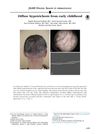 September 2016 in “Journal of The American Academy of Dermatology”
 The girl has a genetic hair condition causing thin hair since childhood.
May 2025 in “Journal of the Egyptian Womenʼs Dermatologic Society” Hair follicles in nonsegmental vitiligo are better protected from immune attacks than in alopecia areata.
25 citations
,
October 1962 in “Journal of Ultrastructure Research” The hair follicle structure is more complex than thought, with new findings on protein formation.
10 citations
,
September 1994 in “International Journal of Dermatology” Three Iranian men had reddish-brown facial pigmentation with no effective treatment.
 January 2012 in “Journal of the Dermatology Nurses’ Association”
 The document explains hair growth, hair loss types, and other hair-related terms.
2 citations
,
September 2004 in “Experimental Dermatology” VR1 signaling can inhibit hair growth by affecting cell processes and increasing hair growth inhibitors.
14 citations
,
January 2010 in “Dermatology” Some people with congenital triangular alopecia have a central tuft of hair in the bald patch, but the cause is unknown.
 September 2021 in “Mağallaẗ al-Muẖtar li-l-ʿulūm”
 Two sisters have rare hair disorders causing short, fragile, kinky hair.
20 citations
,
September 2004 in “Journal of Anatomy” The inner root sheath evolved to help hair grow safely through the skin in mammals.
 April 2008 in “Expert review of dermatology”
 Mutations in the P2RY5 gene cause hereditary woolly hair.