2 citations
,
May 2023 in “Indian Journal of Dermatology Venereology and Leprology” A new genetic mutation in the CAST gene may link PLACK syndrome to alopecia areata.
10 citations
,
June 2024 in “Frontiers in Genetics” Different sheep breeds share similar genetic factors affecting wool fineness.
The curly mutation in SELH/Bc mice affects hair and may help study human genetic disorders.
January 2009 in “OhioLink ETD Center (Ohio Library and Information Network)” p63 and p73 regulate the vitamin D receptor, affecting cancer cell behavior and vitamin D sensitivity.
82 citations
,
January 2011 in “New Phytologist” VILLIN4 helps root hair growth by organizing actin with calcium.
 December 2023 in “Animal research and one health”
 Certain circular RNAs are crucial for wool growth and curvature in goats.
July 2025 in “Clinical Case Reports” A new genetic mutation in the TRPS1 gene causes Trichorhinophalangeal Syndrome, leading to specific hair, dental, and bone issues.
 February 2023 in “JAAD case reports”
 Reducing immunosuppression and using antiviral creams improved the woman's skin condition.
July 2024 in “Journal of Investigative Dermatology” A KLK5 inhibitor effectively improved skin symptoms in a mouse model of Netherton Syndrome.
 December 2024 in “Frontiers in Veterinary Science”
 Dorper sheep's wool shedding is linked to specific genes and pathways, which may help understand human hair growth.
100 citations
,
November 1997 in “Human Genetics” A new mutation in the hHb1 keratin gene is linked to the hair disorder monilethrix.
21 citations
,
December 1994 in “Journal of Investigative Dermatology”  16 citations
,
January 2012 in “European Journal of Endocrinology”
16 citations
,
January 2012 in “European Journal of Endocrinology” The study suggests certain ACE gene variations are more common in women with PCOS and may be linked to increased insulin resistance.
 4 citations
,
December 2012 in “Human Biology”
4 citations
,
December 2012 in “Human Biology” The most different genetic segment between Africans and East Asians is the EDA2R/AR region, with two main types influenced by population changes and natural selection, and linked to baldness.
 June 2026 in “arXiv (Cornell University)”
 The new method improves SNP analysis in genetic studies by combining tests, enhancing accuracy and cost-effectiveness.
 7 citations
,
September 2024 in “BMC Genomics”
7 citations
,
September 2024 in “BMC Genomics” Two genes, ERBB4 and ROR1, may cause the unique pigmentation in Lanping black-boned sheep.
2 citations
,
May 2023 in “Biology” New mouse models of Pemphigus show severe symptoms and need better treatments.
2 citations
,
February 2025 Merkel cell polyomavirus can infect and persist in skin cells, evading the immune system, but certain treatments can control it.
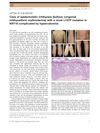 October 2011 in “Journal of dermatology”
 A man with a rare skin condition and a new gene mutation developed high calcium levels due to his treatment.
1 citations
,
January 2012 The CRABP I gene in cashmere goats is highly conserved but has unique features at specific amino sites.
 April 2018 in “Journal of Investigative Dermatology”
 IL-17C is important in inflammatory skin diseases and could be a target for treatment.
August 2009 in “Mechanisms of Development”  1 citations
,
June 2022 in “Chinese medical journal/Chinese Medical Journal”
1 citations
,
June 2022 in “Chinese medical journal/Chinese Medical Journal” Two new mutations in the CDH3 gene cause hair loss and vision problems in a young girl.
11 citations
,
February 2023 in “British Journal of Pharmacology” Isoxazole 9 (ISX9) may help regrow hair by activating certain cell signals.
 15 citations
,
January 2024 in “The AAPS Journal”
15 citations
,
January 2024 in “The AAPS Journal” 50-mg ritlecitinib capsules are bioequivalent to 100-mg capsules.
 September 2016 in “Journal of Dermatological Science”
 Björnstad syndrome causes twisted hair from birth.
2 citations
,
July 2021 in “Genes” A specific genetic change in the KRT71 gene causes a hair loss condition in Hereford cattle.
 February 2026 in “BMC Genomics”
 MEG3-miRNAs help control wool traits in young Tan sheep by regulating immune responses, but their decline with age leads to wool changes.
 December 2022 in “Research Square (Research Square)”
 The QuantAnts machines can find cancer markers and create CRISPR targets for them.
 March 2018 in “Suez Canal University Medical Journal”
 NKG2D gene polymorphism doesn't affect SLE risk but may influence symptoms like rash and hair loss.