Optimized Polycystic Ovarian Disease Prognosis and Classification Using AI-Based Computational Approaches on Multi-Modality Data

    Kogilavani Shanmugavadivel, Murali Dhar M S, T R Mahesh, Taher Al‐Shehari, Nasser A Alsadhan, Temesgen Engida Yimer
    TLDR AI can improve early diagnosis and classification of PCOS, aiding in prevention of related health issues.
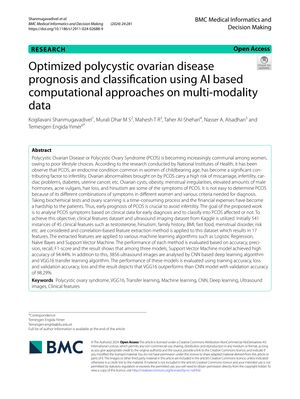
    The study focuses on improving the prognosis and classification of Polycystic Ovary Syndrome (PCOS) using AI-based computational approaches on multi-modality data. It utilizes a dataset of 541 instances with 45 clinical features, which are reduced to 17 through correlation-based feature extraction. Machine learning algorithms, including Logistic Regression, Naïve Bayes, and Support Vector Machine (SVM), are applied, with SVM achieving the highest accuracy of 94.44%. Additionally, 3,856 ultrasound images are analyzed using CNN and VGG16 transfer learning algorithms, with VGG16 achieving superior validation accuracy of 98.29%. The study highlights the potential of these AI approaches in early diagnosis and classification of PCOS, which is crucial for preventing infertility and other health issues associated with the condition.

    Discuss this study in the Community →

    Research cited in this study

    1 / 1 results

    Related Community Posts Join

    6 / 22 results

      community PCOS Hair Loss: What’s Helped Me (and What Didn’t)

      in Treatment  11 upvotes 6 months ago
      OP shares their experience with PCOS-related hair loss, highlighting that addressing vitamin D and ferritin deficiencies, managing hormones with spironolactone, and using gentle hair care products helped improve their condition. They advise against relying on "miracle" hair oils and emphasize the importance of medical evaluation and a combined approach to treatment.

      community Female, 30, PCOS diagnosis, MPB Norwood 2. Endo refuses to give anything other than Spironolactone. Feel like I’m at my wit’s end here.

      in Female  54 upvotes 2 years ago
      A 30-year-old female with PCOS and male pattern baldness is frustrated with her endocrinologist's recommendation of only Spironolactone and minoxidil, feeling that dutasteride, finasteride, and progesterone would be more effective. Other users suggest various online sources for treatments, warn against self-medicating due to potential risks, and recommend seeking a specialized endocrinologist or considering additional treatments like Inositol, Berberine, and dermaneedling.

      community Sugar and Hair loss connections

      in Research/Science  41 upvotes 10 months ago
      High sugar diets may worsen hair loss by increasing 5α-reductase activity and androgen levels, especially in women with PCOS. A low sugar diet might reduce scalp DHT levels, similar to finasteride, but genetics also significantly influence hair loss.

      community How does hair loss and recovery work?

      in Chat  12 upvotes 1 year ago
      Hair loss varies due to genetic sensitivity to DHT and other factors. Treatments discussed include finasteride, minoxidil, RU58841, and microneedling.

    Similar Research

    5 / 1000+ results