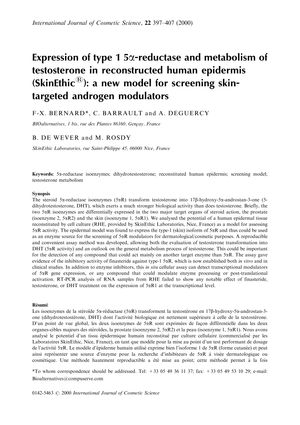
Expression of Type 1 5α-Reductase and Metabolism of Testosterone in Reconstructed Human Epidermis: A New Model for Screening Skin-Targeted Androgen Modulators

    François-Xavier Bernard, C. Barrault, Alain Deguercy, Bart De Wever, Martin Rosdy
    Image of study
    TLDR The study created a new method to test drugs that affect hormone processing in skin.
    The 2000 study developed a new assay method using a reconstructed human epidermis (RHE) model to screen for skin-targeted androgen modulators. The RHE was confirmed to express type 1 5α-reductase (5αR1), which is involved in converting testosterone into the more potent androgen dihydrotestosterone (DHT). The study showed that testosterone was metabolized in the RHE, with significant diffusion and metabolism occurring within 21 hours. Finasteride, a known 5α-reductase inhibitor, was tested and found to not significantly affect epidermal cell viability up to 10 µM concentration and to inhibit testosterone metabolism in a dose-dependent manner. The assay was convenient, reproducible, and effective in demonstrating the activity of potential modulators on 5αR enzyme activity. The RHE model was deemed suitable for evaluating the general metabolism of testosterone and for detecting compounds that might act on enzymes other than 5αR.

    Discuss this study in the Community →

    Research cited in this study

    1 / 1 results

    Related Community Posts Join

    6 / 1000+ results
      FCE 28260: A Forgotten 5α-Reductase Inhibitor

      community FCE 28260: A Forgotten 5α-Reductase Inhibitor

      in Research  330 upvotes 1 year ago
      FCE 28260 (PNU 156765), an under-explored 5α-reductase inhibitor, showcases promising results in research by Giudici et al., outperforming well-known treatments like Finasteride in reducing the conversion of testosterone to DHT. Its superior efficacy, demonstrated through lower IC50 values in both natural and human recombinant enzyme studies, suggests it could offer more effective management of DHT-related conditions. Additionally, its lower molecular weight hints at better potential for topical application, potentially offering advantages in treating conditions such as androgenic alopecia. Despite its potential, it has not advanced in development, possibly due to financial limitations, leaving its therapeutic prospects and side effect profile largely unexplored.
      Can I still save my hairline at age of 15?

      community Can I still save my hairline at age of 15?

      in General  532 upvotes 4 months ago
      A 15-year-old is concerned about hair loss, possibly at Norwood 2 or 3, and is using shampoos and conditioners recommended by a trichologist. Suggestions include considering topical minoxidil and consulting a doctor about topical anti-DHT treatments like finasteride or RU58841, but avoiding 5-alpha-reductase inhibitors at this age.

      community Sugar and Hair loss connections

      in Research/Science  41 upvotes 10 months ago
      High sugar diets may worsen hair loss by increasing 5α-reductase activity and androgen levels, especially in women with PCOS. A low sugar diet might reduce scalp DHT levels, similar to finasteride, but genetics also significantly influence hair loss.

    Related Research

    1 / 1 results