A Systematic Approach to Afro-Textured Hair Disorders

    April 2014 in “ Dermatologic Clinics
    Natalie Yin, Antonella Tosti
    Image of study
    TLDR Dermatoscopy helps diagnose hair and scalp disorders in people with Afro-textured hair, but more research is needed for better understanding and treatment.
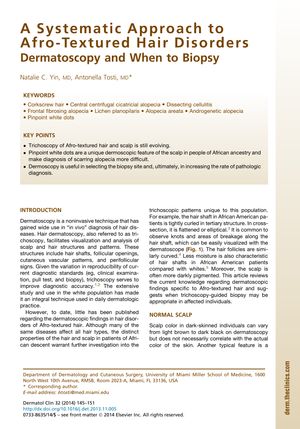
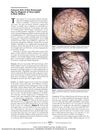
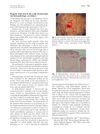
    The document reviews the application of dermatoscopy for diagnosing hair and scalp disorders in individuals with Afro-textured hair, noting the lack of research compared to white populations. It details dermatoscopic findings for various conditions such as CCCA, alopecia areata, androgenetic alopecia, traction alopecia, DLE, LPP, FFA, DCS, and PA, and discusses the challenges in diagnosing scarring alopecia due to unique features like pinpoint white dots in African ancestry individuals. The document emphasizes that while trichoscopy has reduced the need for biopsies in nonscarring alopecias and aids in differential diagnosis, biopsies are still essential for confirming scarring alopecias. Dermatoscopy is highlighted as a tool for selecting biopsy sites and improving pathologic diagnosis rates, with a call for more research to enhance understanding of scalp diseases in patients with Afro-textured hair. The document appears to be a general review without a specific study population.

    Discuss this study in the Community →

    Research cited in this study

    10 / 10 results

    Related Community Posts Join

    6 / 15 results
      If You Have DUPA, PLEASE READ THIS: Everyone Should Be Scalp Biopsied

      community If You Have DUPA, PLEASE READ THIS: Everyone Should Be Scalp Biopsied

      in Research  830 upvotes 1 year ago
      Scalp biopsies are crucial for diagnosing hair loss conditions like Diffuse Unpatterned Alopecia (DUPA) and retrograde hair loss, as treatments like finasteride and dutasteride may not be effective if other conditions are present. Combining PPAR-GAMMA agonists with retinoids could improve treatments for conditions like Lichen Planopilaris.

      community Post op day 1, My 10 year journey and thoughts about hair loss, advice

      in Transplants  6 upvotes 1 month ago
      The user shared their 10-year hair loss journey, discussing treatments like oral minoxidil, oral finasteride, and LLLT, and ultimately deciding on a hair transplant. They also explored the possibility of having alopecia areata incognita and advised seeking multiple opinions before surgery.

      community Highly recommend buying a microscope (see pictures)

      in Treatment  40 upvotes 2 days ago
      A user recommends using a microscope to assess hair density and track hair loss progress, finding it useful for evaluating treatment effectiveness, particularly with dutasteride and minoxidil. They advise against obsessing over hair loss and emphasize focusing on other meaningful life aspects.

      community Unexpected Progress from Head Massage and Minoxidil

      in Treatment  20 upvotes 4 months ago
      The user experienced unexpected hair volume increase after combining scalp massages with topical minoxidil and oral finasteride. They plan to continue this regimen, noting a reduction in hair shedding.

      community Can't afford 2.5mg dutasteride, any alternative?

      in Finasteride/Dutasteride 7 months ago
      The user is struggling with hair loss despite using topical minoxidil, finasteride, and oral dutasteride, and is seeking affordable alternatives to 2.5mg dutasteride. Suggestions include checking for scalp inflammation, considering oral minoxidil, using rosemary oil, and possibly trying saw palmetto, though results may vary.

      community Losing Hair on Dutasteride? You might have LPP

      in Research/Science  94 upvotes 10 months ago
      Men with hair loss might have lichen planopilaris (LPP), which can mimic androgenetic alopecia, leading to misdiagnosis and ineffective treatment with finasteride or dutasteride. Proper diagnosis, including biopsies, is crucial to distinguish between androgenetic alopecia and conditions like LPP.

    Related Research

    1 / 1 results