Search
for
Sort by
Research
330-360 / 1000+ results
research Clinicopathological characteristics of fibrosing alopecia in a pattern distribution: a single‐center, retrospective study
Younger people are at a higher risk for Fibrosing Alopecia in a Pattern Distribution than previously thought, with common symptoms and possible involvement of mast cells in its development.

research Frontal fibrosing alopecia: state of the art and future directions
The review suggests more research is needed to understand Frontal fibrosing alopecia, a condition causing hairline recession in postmenopausal women.

research Increased Preauricular Wrinkles in Frontal Fibrosing Alopecia Compared to Age-Matched Controls: A Prospective Study of 64 Patients
Women with Frontal Fibrosing Alopecia have more wrinkles near their ears than similar aged women without the condition.
research Frontal fibrosing alopecia presenting with rapidly spreading facial papules in a premenopausal woman: Case report and review
A young woman developed facial bumps before hair loss, which is unusual for her condition.
research Dermatologic adverse events associated with afatinib: an oral ErbB family blocker
Afatinib often causes skin problems that need proactive management.
research Matrix Stiffness-driven FAK Splicing Tunes Cell Mechanosensing
FAKΔe4 helps cells sense and respond to different stiffness levels in their environment.
research Frontal Fibrosing Alopecia Part II: Etiopathogenesis and Management
Early diagnosis and a multidisciplinary approach are crucial for managing Frontal Fibrosing Alopecia.

research Fractional microneedle radiofrequency for photoaging and atrophic acne scar: a split-face clinical observation of two devices
Fractional microneedle radiofrequency is effective and safe for skin rejuvenation and acne scars.
research Double-wavelength laser scanning microphotometer (DWLSM) for in-vitro hair shaft and surrounding tissue imaging
The DWLSM provides detailed imaging of hair shafts and follicles with high accuracy.
research Frontal Fibrosing Alopecia. An Example of Disrupted Aryl Hydrocarbon Receptor-Mediated Immunological Homeostasis in the Skin?
Excessive sun protection might cause frontal fibrosing alopecia by disrupting skin immune balance.

research Hair’s the Question: Frontal Fibrosing Alopecia (FFA)
The document's conclusion cannot be provided because the content is not available.
research Quantitative mapping of melanin in hair fibers using fluorescence lifetime imaging microscopy

research 261 Tissue and circulating microRNA co-expression analysis reveals potential involvement of miRNAs in the pathobiology of frontal fibrosing alopecia
Certain miRNAs might be involved in a hair loss condition called frontal fibrosing alopecia and could possibly help in its diagnosis.
research Early Diagnosis and Prompt Treatment Improves Quality of Life in Patients with Frontal Fibrosing Alopecia
Early diagnosis and quick treatment improve life quality for FFA patients.
research The proportion of male and female editors in women’s health journals: An analysis and review
Early diagnosis and treatment of frontal fibrosing alopecia are crucial for preserving hair and reducing inflammation.

research Fractional microneedle radiofrequency - mechanism of action and assessment of safety, effectiveness in the treatment, and possible side effects based on a review of scientific literature
Fractional microneedle radiofrequency is a safe and effective skin treatment with minimal serious side effects.
research Serum-Based Assessment of Alopecia Areata Response to Treatment Using ATR-FTIR Spectroscopy
ATR-FTIR spectroscopy could help monitor alopecia areata treatment response non-invasively.

research The feasibility and utility of hair follicle sampling to measure FMRP and FMR1 mRNA in children with or without fragile X syndrome: a pilot study
Hair follicle sampling is a practical method for measuring biomarkers in children with and without Fragile X syndrome.

research ARTIFICIAL INTELLIGENCE DERMOSCOPY AND A-T ADVANCEMENT FLAP FOR BASAL CELL CARCINOMA OF THE SCALP
The A-T advancement flap is a safe and effective method for scalp reconstruction after basal cell carcinoma removal.
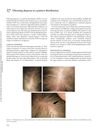
research Fibrosing alopecia in a pattern distribution
Fibrosing alopecia in a pattern distribution is a unique hair loss condition with inflammation and scarring, resembling but distinct from common balding.

research Alopecia Areata Mimicking Frontal Fibrosing Alopecia
A woman's hair loss was initially misdiagnosed as scarring hair loss but was actually a treatable autoimmune hair loss.

research Sindrom Fahr: Kalsifikasi Intraserebral Patologis
Fahr syndrome causes brain calcification and is managed by treating symptoms and underlying issues.
research Extra-follicular cutaneous manifestations of frontal fibrosing alopecia
Recognizing skin symptoms helps diagnose and treat frontal fibrosing alopecia.

research Frontal Fibrosing Alopecia: A Review
Frontal Fibrosing Alopecia's cause is unclear, affects mainly postmenopausal women, and current treatments focus on stopping hair loss rather than regrowth.

research Prepubertal Fibrosing Alopecia in a Pattern Distribution
FAPD in children may not depend on androgens and should be treated with anti-inflammatory measures and minoxidil.
research Fourier Transform Infrared Attenuated Total Reflection Analysis of Human Hair: Comparison of Hair from Breast Cancer Patients with Hair from Healthy Subjects
Hair from breast cancer patients shows changes in structure and composition, and a test using these changes detected cancer but also falsely identified some healthy samples as cancerous.
research Ablative Fractional Resurfacing in Topical Drug Delivery: An Update and Outlook
Ablative fractional resurfacing could improve how well topical drugs penetrate the skin, but more research is needed to fine-tune the method.
research DRUG POLYMORPHISM IDENTIFICATION USING FOURIER TRANSFORM-RAMAN SPECTROSCOPY: A COMPARATIVE STUDY OF LAMIVUDINE AND FINASTERIDE DRUGS
FT-Raman spectroscopy is effective for identifying drug polymorphs, ensuring quality and stability.

research Frontal fibrosing alopecia: A new autoimmune entity?
Frontal Fibrosing Alopecia might be an autoimmune disease.