 1 citations
,
June 2025 in “Journal of Materials Science Materials in Medicine”
1 citations
,
June 2025 in “Journal of Materials Science Materials in Medicine” AgVO₃-HAp/GO@PCL scaffolds improve wound healing and tissue regeneration effectively.
 1 citations
,
March 2024 in “International Journal of Applied Pharmaceutics”
1 citations
,
March 2024 in “International Journal of Applied Pharmaceutics” Propylene glycol concentration improves rice water gel shampoo's thickness and foam, extending its shelf life.
 1 citations
,
February 2022 in “Online journal of biological sciences”
1 citations
,
February 2022 in “Online journal of biological sciences” The document does not determine if adults with aphallia are fertile.
 1 citations
,
December 2018 in “International Journal of Modern Computation Information and Communication Technology”
1 citations
,
December 2018 in “International Journal of Modern Computation Information and Communication Technology” AI can greatly improve healthcare by enhancing disease prevention, detection, diagnosis, and treatment.
 1 citations
,
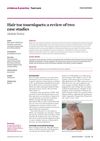
May 2018 in “Emergency Nurse”
1 citations
,
May 2018 in “Emergency Nurse” Educating healthcare workers and parents about hair toe tourniquets can help prevent serious complications.
 February 2026 in “International Research Journal of Modernization in Engineering Technology and Science”
 Protect lips from aging with sunscreen, repair barriers, and boost collagen.
 January 2026 in “Frontiers in Materials”
 Metal-organic frameworks help heal wounds by effectively delivering medicine.
 October 2025 in “Current Pharmaceutical Research”
 The herbal shampoo effectively cleans hair and scalp while being environmentally friendly.

Dual TCR Treg cells are common in mouse tissues and vary by location.
 June 2025 in “Samarra Journal of Pure and Applied Science”
 A new method accurately measures minoxidil in tablets.
The model explains how mammal ear hair cells respond to sound and adapt.
 March 2025 in “Dental Journal (Majalah Kedokteran Gigi)”
 The sponge effectively controls bleeding and prevents infection after tooth extraction.
 March 2025 in “GSC Biological and Pharmaceutical Sciences”
 Wood tar could be useful for skin care in dermatology and cosmetics.
 March 2025 in “Journal of Neonatal Surgery”
 Robotic surgery and AI improve precision and recovery in medicine but face cost and training challenges.
 January 2025 in “Bright Sky Publications eBooks”
 Aesthetic medicine is rapidly advancing with new technologies for safer, personalized, and less invasive treatments.

Dual TCR Treg cells are common in various mouse tissues and show diverse characteristics.
 September 2024 in “Journal of the Pakistan Medical Association”
 A 589 nm laser increases IL-2 and IFN-y gene expression in human T-cells.
 June 2024 in “Frontiers in pharmacology”
 2-deoxy-D-ribose gel may help regrow hair in cases of hair loss.
 January 2024 in “Applied Mathematics and Nonlinear Sciences”
 The model helps understand alopecia areata and suggests better treatment strategies.
 November 2023 in “Berkala Ilmu Kesehatan Kulit dan Kelamin/Berkala ilmu kesehatan kulit dan kelamin (Periodical of dermatology and venerology)”
 Addressing skin changes during pregnancy is important to reduce stress for expectant mothers.
 November 2023 in “Borneo Journal of Pharmacy”
 Sappan wood hair tonic helps protect and repair damaged hair.
 May 2023 in “Current Applied Science and Technology”
 Higher power CO2 laser causes more severe skin burns and damage.
 August 2019 in “Regenerative Medicine”
 In June 2019, the stem cell research field saw major progress, including new clinical trials, FDA approvals, and industry collaborations.
 January 2017 in “Nihon Keshouhin Gijutsushakaishi/Journal of S C C./Nihon Keshouhin Gijutsushakai kaishi”
 Sunlight and chemical treatments change hair's internal structure differently, needing specific care.
5 citations
,
May 2024 in “Journal of Allergy and Clinical Immunology Global” Upadacitinib effectively improved severe atopic dermatitis and alopecia universalis in a 29-year-old man.
 September 2015 in “Journal of Steroids & Hormonal Science”
 Inositol and folic acid treatment significantly reduced hair loss and other symptoms in patients with androgenetic alopecia, but more research is needed for confirmation.
February 2025 in “Diagnostics” Most patients improved in both atopic dermatitis and alopecia areata with certain treatments, but some had worsened symptoms, suggesting personalized care is needed.
 April 2023 in “Journal of Investigative Dermatology”
 The research developed methods to test drugs that could protect and restore hair follicle protection in a hair loss condition.
24 citations
,
February 2011 in “The American journal of pathology” AIRE protein, defective in APECED patients, is found in skin and hair cells and interacts with cytokeratin 17.
Nutrition plays a key role in managing skin disorders, with specific dietary changes helping improve conditions like acne, dermatitis, psoriasis, alopecia, and skin cancer.