 5 citations
,
July 2018 in “The Egyptian Journal of Hospital Medicine”
5 citations
,
July 2018 in “The Egyptian Journal of Hospital Medicine” The conclusion is that antibiotics are not the best acne treatment and early treatment is important to prevent scarring, especially for those with a family history of acne.
8 citations
,
August 2015 in “Experimental Dermatology” Hidradenitis suppurativa may involve gut and oral bacteria, suggesting targeted treatments could help.
 8 citations
,
October 2022 in “Cold Spring Harbor perspectives in biology”
8 citations
,
October 2022 in “Cold Spring Harbor perspectives in biology” The document concludes that better understanding the wound microbiome can improve chronic wound care by preserving helpful bacteria and targeting harmful ones.
January 2025 in “Bali Medical Journal” Certain bacteria are linked to female hair loss.
2 citations
,
July 2022 in “bioRxiv (Cold Spring Harbor Laboratory)” Certain gut bacteria can lower androgen levels in male mice.
 June 2023 in “Benha Journal of Applied Sciences”
 Acne is caused by multiple types of bacteria.
June 2026 in “Clinical and Experimental Dermatology” Certain bacteria levels change in hair follicle diseases, but their role is unclear.
 1 citations
,
September 2024 in “Jurnal Ilmiah JKA (Jurnal Kesehatan Aeromedika)”
1 citations
,
September 2024 in “Jurnal Ilmiah JKA (Jurnal Kesehatan Aeromedika)” Red galangal rhizome extract is effective against acne-causing bacteria.
 July 2024 in “Journal of Bioscience and Bioengineering”
 Different conditions affect how easily hair bacteria can be isolated.
 January 2019 in “Advances in Environmental Biology”
 Propionibacterium acnes contributes to acne and antibiotic resistance, needing new treatments.
 December 2023 in “Urogenital tract infection”
 Seminal bacteria can lower sperm quality in subfertile men.
 January 2023 in “Fundamental toxicological sciences”
 Mozuku seaweed fucoidan can inhibit harmful skin bacteria growth.
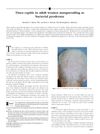 32 citations
,
August 2003 in “Journal of the American Academy of Dermatology”
32 citations
,
August 2003 in “Journal of the American Academy of Dermatology” Tinea capitis can be misdiagnosed as bacterial infection in adult women but is treatable with antifungal medication.
 93 citations
,
November 2018 in “Carbohydrate Polymers”
93 citations
,
November 2018 in “Carbohydrate Polymers” New nanocomposites with copper show promise for healing burn wounds and regenerating skin.
 3 citations
,
January 2010 in “Actas Dermo-Sifiliográficas”
3 citations
,
January 2010 in “Actas Dermo-Sifiliográficas” Immunization and throat bacteria may increase the risk of a hair loss condition called alopecia areata.
 January 2023 in “Discovery immunology”
 T cells and bacteria in the gut and skin help maintain health and protect against disease.
 4 citations
,
April 2025 in “Scientific Reports”
4 citations
,
April 2025 in “Scientific Reports” Platelet-rich plasma can temporarily inhibit some drug-resistant bacteria in diabetic foot infections.
 39 citations
,
October 2013 in “Plastic and Reconstructive Surgery”
39 citations
,
October 2013 in “Plastic and Reconstructive Surgery” Human alpha defensin 5 helps heal wounds, reduce bacteria, and grow hair on burned skin.
37 citations
,
February 2023 in “Gut Microbes” Gut bacteria can lower androgen levels in male mice.
 57 citations
,
March 2019 in “Immunity”
57 citations
,
March 2019 in “Immunity” The document concludes that the skin's immune system is complex, involving interactions with hair follicles, nerves, and microbes, and can protect or cause disease, offering targets for new treatments.
48 citations
,
April 2019 in “PloS one” Alopecia areata patients have more Propionibacterium acnes and less Staphylococcus epidermidis on their scalps.
 1 citations
,
December 2023 in “npj biofilms and microbiomes”
1 citations
,
December 2023 in “npj biofilms and microbiomes” Single-cell engineered biotherapeutics show promise for skin treatment but need more research and trials.
 82 citations
,
August 2017 in “Cell Reports”
82 citations
,
August 2017 in “Cell Reports” An imbalanced gut and lack of biotin can cause hair loss in mice.
 47 citations
,
March 2019 in “Journal of immunology research”
47 citations
,
March 2019 in “Journal of immunology research” Valproic Acid could potentially be used to treat immune-related conditions due to its ability to modify immune cell functions.
 38 citations
,
June 2018 in “Archives of Toxicology”
38 citations
,
June 2018 in “Archives of Toxicology” Different species and human skin models vary in their skin enzyme activities, with pig skin and some models closely matching human skin, useful for safety assessments and understanding the skin's protective roles.
 9 citations
,
November 2018 in “Journal of cosmetic dermatology”
9 citations
,
November 2018 in “Journal of cosmetic dermatology” Orobanche rapum extract rejuvenates skin and protects skin bacteria, leading to healthier skin.
 8 citations
,
April 1965 in “Archives of biochemistry and biophysics”
8 citations
,
April 1965 in “Archives of biochemistry and biophysics” Sheep wool follicles can metabolize both glucose and acetate using different pathways important for wool growth.
 June 2026 in “Frontiers in Marine Science”
 Codium sp. seaweed fractions can enhance skincare and be used for biochar, promoting sustainability.
 2 citations
,
October 2021 in “Egyptian Journal of Chemistry”
2 citations
,
October 2021 in “Egyptian Journal of Chemistry” Iron nanoparticles made from pumpkin extract effectively treated burns and promoted healing in mice.
 29 citations
,
January 2007 in “Dermatologic Clinics”
29 citations
,
January 2007 in “Dermatologic Clinics” Photodynamic Therapy is an effective treatment for mild to severe acne.