 1744 citations
,
August 2006 in “The Journal of Clinical Endocrinology and Metabolism”
1744 citations
,
August 2006 in “The Journal of Clinical Endocrinology and Metabolism” Polycystic Ovary Syndrome should be seen mainly as a condition of excess male hormones, with a focus on this in its definition.
 5 citations
,
May 2008 in “Nature Precedings”
5 citations
,
May 2008 in “Nature Precedings” Trichoscopy is a useful non-invasive method to diagnose female hair loss with high accuracy.
 March 2024 in “Skin research and technology”
 New dermoscopic criteria accurately diagnose and grade the severity of hair loss in androgenetic alopecia.
 1540 citations
,
October 2008 in “Fertility and Sterility”
1540 citations
,
October 2008 in “Fertility and Sterility” The report concludes that PCOS is mainly a condition of excess male hormones and its definition may change as new information is discovered.
 129 citations
,
January 2009 in “International Journal of Trichology”
129 citations
,
January 2009 in “International Journal of Trichology” Trichoscopy can diagnose female hair loss with high accuracy by looking for specific patterns in hair and scalp appearance.
January 2020 in “Proyecto de investigación:” Longer anogenital distance may indicate a higher chance of having polycystic ovary syndrome, and measuring this distance along with hormone levels could improve diagnosis.
 45 citations
,
January 2006 in “Endocrine journal”
45 citations
,
January 2006 in “Endocrine journal” To diagnose Polycystic Ovarian Syndrome, two out of three signs—irregular periods, high male hormone levels, or cysts on the ovaries—are needed.
 38 citations
,
May 2006 in “Archives of Gynecology and Obstetrics”
38 citations
,
May 2006 in “Archives of Gynecology and Obstetrics” Women with only irregular periods or excess hair have a better hormone profile than those with full PCOS, but both groups are similar, indicating a need for better PCOS diagnosis methods.
 4 citations
,
June 2019 in “Revista brasileira de ginecologia e obstetrícia”
4 citations
,
June 2019 in “Revista brasileira de ginecologia e obstetrícia” Using only hyperandrogenism to diagnose PCOS can lead to overdiagnosis.
 2 citations
,
June 2017 in “Journal of The American Academy of Dermatology”
2 citations
,
June 2017 in “Journal of The American Academy of Dermatology” The type of PCOS a woman has doesn't strongly predict her skin or metabolic symptoms; obesity is a more important factor.
September 2014 in “Tehran University Medical Journal TUMS Publications” Type II diabetes is not linked to hair loss in women.
The document concludes that accurate diagnosis and management of PCOS are crucial due to its associated health risks.
 February 2009 in “Journal of The American Academy of Dermatology”
 Female hair loss can be diagnosed using specific trichoscopy criteria.
22 citations
,
September 2024 in “Human Reproduction Update” Androgen measurement helps diagnose PCOS, but accuracy varies, needing standard methods.
 62 citations
,
April 2016 in “Best Practice & Research in Clinical Obstetrics & Gynaecology”
62 citations
,
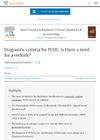
April 2016 in “Best Practice & Research in Clinical Obstetrics & Gynaecology” The conclusion is that there's a need for a new conference to establish stricter guidelines for diagnosing Polycystic Ovary Syndrome (PCOS).
 4025 citations
,
December 2003 in “Human Reproduction”
4025 citations
,
December 2003 in “Human Reproduction” The 2003 consensus updated PCOS diagnosis criteria and linked PCOS to higher risks of diabetes and heart problems, recommending lifestyle changes to lower these risks.
 85 citations
,
June 2006 in “Best Practice & Research Clinical Endocrinology & Metabolism”
85 citations
,
June 2006 in “Best Practice & Research Clinical Endocrinology & Metabolism” The document concludes that hirsutism is the main sign for diagnosing hyperandrogenism, which requires a detailed patient history and physical exam.
 77 citations
,
June 2006 in “Best Practice & Research Clinical Endocrinology & Metabolism”
77 citations
,
June 2006 in “Best Practice & Research Clinical Endocrinology & Metabolism” The document concludes that accurate measurement of serum androgens is crucial for diagnosing hyperandrogenism.
 9 citations
,
November 2015 in “Gynecological Endocrinology”
9 citations
,
November 2015 in “Gynecological Endocrinology” Different types of PCOS in Chinese Han women show varying levels of male hormone and metabolic issues.
 4 citations
,
June 2021 in “Wounds-a Compendium of Clinical Research and Practice”
4 citations
,
June 2021 in “Wounds-a Compendium of Clinical Research and Practice” Chronic scalp lesions with crusts and pus that heal with strong topical steroids suggest Erosive Pustular Dermatosis, confirmed by biopsy showing specific immune cells.
 2 citations
,
June 2021 in “PubMed”
2 citations
,
June 2021 in “PubMed” Chronic scalp lesions with crusts and pus indicate Erosive Pustular Dermatosis, which is confirmed by biopsy and effectively treated with strong topical steroids.
 2 citations
,
January 2018 in “Open Journal of Obstetrics and Gynecology”
2 citations
,
January 2018 in “Open Journal of Obstetrics and Gynecology” A significant number of Nigerian women struggling with infertility have Polycystic Ovary Syndrome, with the exact percentage varying based on the diagnostic criteria used.
 118 citations
,
February 2009 in “Fertility and Sterility”
118 citations
,
February 2009 in “Fertility and Sterility” Most women with PCOS have high levels of male hormones, and free testosterone is the best marker for this.
 March 2013 in “Endocrine Abstracts”
 Ethnicity affects how polycystic ovary syndrome shows up in women, with white women having higher metabolic risks but less diabetes, and South Asian women showing more androgenic symptoms and being younger at presentation.
 1265 citations
,
October 2013 in “The Journal of Clinical Endocrinology and Metabolism”
1265 citations
,
October 2013 in “The Journal of Clinical Endocrinology and Metabolism” The guideline suggests using specific criteria to diagnose PCOS, recommends various treatments for its symptoms, and advises screening for related health issues.
 215 citations
,
January 2011 in “Reproductive Biology and Endocrinology”
215 citations
,
January 2011 in “Reproductive Biology and Endocrinology” About 7% to 15% of Iranian women have polycystic ovary syndrome, depending on the criteria used to diagnose it.
 42 citations
,
January 2006 in “Obstetrical & Gynecological Survey”
42 citations
,
January 2006 in “Obstetrical & Gynecological Survey” The document concludes that correct diagnosis and management of PCOS are important, and more research is needed on its risks and treatments.
 16 citations
,
November 2018 in “Singapore Medical Journal”
16 citations
,
November 2018 in “Singapore Medical Journal” Primary care for PCOS focuses on lifestyle changes, medication based on symptoms, and mental health, with diabetes screening and specialist referral for severe cases.
 5 citations
,
March 2015 in “Women's Health”
5 citations
,
March 2015 in “Women's Health” The document concludes that diagnosing PCOS requires a thorough approach, considering various symptoms and risks, and calls for improved methods to identify PCOS types and prevent diabetes.
 3 citations
,
January 2012 in “Hanyang Medical Reviews”
3 citations
,
January 2012 in “Hanyang Medical Reviews” The document concludes that more research is needed to create suitable diagnostic criteria and understand PCOS in Korean women, and genetics may allow for personalized treatment.