6 citations
,
March 2017 in “Journal of the European Academy of Dermatology and Venereology” Identical twins with a rare KRT 86 gene mutation both have the hair disorder monilethrix.
13 citations
,
July 2004 in “Pediatric dermatology” A new severe form of monilethrix syndrome includes hair loss, scalp itching, cataracts, and distinct facial features.
January 2006 in “DOAJ (DOAJ: Directory of Open Access Journals)” Loose anagen hair syndrome causes easily pulled, thin hair in kids but is harmless and temporary.
 3 citations
,
January 2022 in “Medical Mycology Journal”
3 citations
,
January 2022 in “Medical Mycology Journal” Malassezia fungi in healthy noses can form a "spaghetti-and-meatballs" structure.
January 1996 in “Studia iuridica” Two new gene mutations cause a rare hair disorder.
10 citations
,
March 1997 in “Pediatric Dermatology” A rare case of trichothiodystrophy was found with autism, seizures, and mental retardation.
3 citations
,
January 2020 in “JAAD Case Reports” A girl had two rare hair conditions that helped understand their overlap.
October 2019 in “European Journal of Dermatology” The boy's hair and skin color differences are due to a pigmentation disorder.
January 2011 in “대한피부과학회지” A 7-year-old girl was diagnosed with trichothiodystrophy due to low sulfur levels in her hair.
 5 citations
,
December 1964 in “Australasian journal of dermatology”
5 citations
,
December 1964 in “Australasian journal of dermatology” Congenital atrichia is a rare condition where children are born without hair, and treatment is often ineffective.
 January 2023 in “International journal of medical science and health research”
 Anovulatory PCOS patients are younger with longer cycles and higher blood pressure and hormone levels.
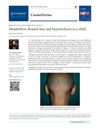 January 2026 in “Cosmoderma”
 A 9-year-old girl has a rare hair disorder causing beaded, sparse hair.
5 citations
,
October 2012 in “Australian veterinary journal” Two Australian Poll Hereford calves had severe anaemia, abnormal red blood cells, and skin issues.
29 citations
,
February 2019 in “Pediatric dermatology” Trichotillomania shows specific signs like black dots and uneven hair lengths but lacks certain features of alopecia areata.
3 citations
,
January 2021 in “Veterinary dermatology” A litter of cats had a hair condition similar to a mouse mutation, leading to hair loss and abnormal hair and skin.
28 citations
,
June 1998 in “Clinical Genetics” Ambras syndrome's genetic cause is unknown, as it isn't linked to androgen levels.
May 2026 in “Journal of International Medical Research” Atrichia with papular lesions causes irreversible hair loss from infancy and is often misdiagnosed.
 July 2025 in “Journal of the American Academy of Dermatology”
 Hair diameter diversity helps assess hair loss, but its standard measure varies by individual and ethnicity.
Recognizing bamboo hair helps diagnose Netherton’s syndrome.
 3 citations
,
January 2018 in “Dermatology”
3 citations
,
January 2018 in “Dermatology” Scalp biopsies help tell apart androgenetic alopecia and alopecia areata.
61 citations
,
April 1980 in “Journal of the American Academy of Dermatology” A new syndrome may link skin, growth, mental, and hair issues.
10 citations
,
May 2017 in “Symmetry” Higher androgen levels are linked to less asymmetry in !Kung San males.
 December 2023 in “Portuguese journal of dermatology and venereology”
 Trichoscopy can reliably distinguish between alopecia areata and trichotillomania.
1 citations
,
January 2018 in “Jornal Brasileiro de Patologia e Medicina Laboratorial” Monilethrix causes brittle hair and hair loss, and it runs in families.
May 2025 in “VETERINARY SCIENCE TECHNOLOGIES OF ANIMAL HUSBANDRY AND NATURE MANAGEMENT” Poor-quality feed and low vitamin A cause reproductive issues in nutrias.
 6 citations
,
December 2004 in “Anais Brasileiros de Dermatologia”
6 citations
,
December 2004 in “Anais Brasileiros de Dermatologia” Some family members had a condition with both loose hair and unique eye changes, possibly indicating a new type of ectodermal dysplasia.
September 1973 in “Primates” 27 citations
,
June 2020 in “Genes” Lykoi cats' unique sparse hair is linked to specific genetic variants in the Hairless gene.
December 2025 in “Al-Azhar International Medical Journal /Al-Azhar International Medical Journal” 4 citations
,
January 2009 in “PubMed” A mutation in the KRT86 gene causes hair fragility in a Turkish family.