 8 citations
,
June 2012 in “Australasian Journal of Dermatology”
8 citations
,
June 2012 in “Australasian Journal of Dermatology” A rare form of alopecia causes hair thinning without bald spots and may be more common than thought, responding well to steroid treatment.
162 citations
,
October 2014 in “Autoimmunity reviews” Alopecia areata is caused by the immune system attacking hair follicles.
December 2025 in “JEADV Clinical Practice” A woman with hair loss condition experienced rare hair color return, suggesting it might help diagnose the condition.
 1 citations
,
January 2009 in “Elsevier eBooks”
1 citations
,
January 2009 in “Elsevier eBooks” Combining proper shaving, topical treatments, and laser therapy effectively reduces Pseudofolliculitis Barbae.
14 citations
,
February 2003 in “Journal of the American Academy of Dermatology” Folliculotropic mycosis fungoides can affect the central nervous system in advanced stages.
12 citations
,
April 2017 in “Experimental and Therapeutic Medicine” Patients with severe active alopecia areata have lower CD200 expression and an imbalance in their immune system.
 April 2016 in “Journal of The American Academy of Dermatology”
 Certain scalp tissue features can predict how well alopecia areata responds to steroid injections.

Tofacitinib significantly improved symptoms in a patient with overlapping autoimmune disorders.
 148 citations
,
December 2018 in “Journal of autoimmunity”
148 citations
,
December 2018 in “Journal of autoimmunity” Alopecia areata is an autoimmune disease causing patchy hair loss, often with other autoimmune disorders, but its exact causes are unknown.
July 2022 in “Journal of Investigative Dermatology” Inhibiting TYK2 can restore hair growth in alopecia areata.
 February 2011 in “Annales de dermatologie et de vénéréologie”
 Tofacitinib shows promise for treating severe alopecia areata with good safety and effectiveness.
November 2025 in “Journal of Clinical Medicine” Baricitinib significantly improved hair regrowth and quality of life in severe alopecia areata patients.
 March 2025 in “Journal of the European Academy of Dermatology and Venereology”
 Baricitinib effectively reduces hair loss in alopecia areata and is well-tolerated.
30 citations
,
October 1994 in “Journal of Cutaneous Pathology” Multiple perifollicular fibromas may actually be unrecognized cases of Birt-Hogg-Dubé syndrome.
 March 2023 in “Human Pathology”
 Hair follicle counts and ratios are helpful in diagnosing hair loss types, but should be used with other specific features for accurate diagnosis.
 21 citations
,
April 2019 in “Clinical, cosmetic and investigational dermatology”
21 citations
,
April 2019 in “Clinical, cosmetic and investigational dermatology” The document concludes that stopping shaving or removing affected hair can alleviate Pseudofolliculitis barbae (PFB).
3 citations
,
September 1998 in “International Journal of Dermatology” Acitretin effectively improved the woman's skin condition.
 8 citations
,
January 2015 in “International journal of trichology”
8 citations
,
January 2015 in “International journal of trichology” A woman's total hair loss was linked to a Borrelia infection and was reversed with appropriate treatment.
 November 2021 in “Elsevier eBooks”
 Antiandrogens are used to manage polycystic ovary syndrome by reducing androgen levels or controlling their effects, often combined with lifestyle changes and other treatments.
 5 citations
,
April 2014 in “European Journal of Obstetrics & Gynecology and Reproductive Biology”
5 citations
,
April 2014 in “European Journal of Obstetrics & Gynecology and Reproductive Biology” AMH levels can't reliably tell the difference between LOCAH and all types of PCOS in women with excessive hair growth.
 222 citations
,
September 2016 in “JCI insight”
222 citations
,
September 2016 in “JCI insight” Tofacitinib is safe and effective for severe alopecia areata, but hair loss may return 2 months after stopping treatment.
January 2026 in “Dermatologic Therapy” Female pattern hair loss can signal hormone issues and should be part of health checks for personalized treatment.
January 2026 in “Dermatologic Therapy” This cross-sectional study examined 100 patients with alopecia in a dermatology outpatient setting, focusing on the prevalence of thyroid dysfunction. The study found that alopecia was more common in younger individuals, with a mean age of 34.42 years, and a female predominance. Noncicatricial alopecia, particularly alopecia areata (37.03%), was more prevalent than cicatricial alopecia, with lichen planopilaris being the most common type (47.3%). Trichoscopic findings frequently included yellow dots and miniaturized hairs. Thyroid dysfunction was observed in 33.3% of noncicatricial and 42.1% of cicatricial alopecia patients, with subclinical hypothyroidism being the most common thyroid abnormality.
 17 citations
,
November 2018 in “Dermatology”
17 citations
,
November 2018 in “Dermatology” Most patients with frontal fibrosing alopecia had facial bumps, with Hispanic/Latino and premenopausal women being more affected, suggesting a more severe condition.
July 2026 in “The Journal of Immunology” This study investigates the role of CD8 T cell-derived molecules in Alopecia Areata (AA) using a C3H/HeJ murine model. The research demonstrates that interferon gamma (IFNg) is a crucial effector molecule for CD8 T cells to induce AA, as IFNg-deficient CD8 T cells failed to transfer the disease. In contrast, perforin was found to be dispensable, as perforin-deficient CD8 T cells could still transfer the disease. Additionally, mice lacking the IFNg receptor (IFNgrKO) were unable to develop AA, highlighting the importance of IFNg sensing by the immune system in disease pathogenesis. These findings suggest that targeting IFNg pathways could be a potential therapeutic strategy for AA.
 September 2016 in “Journal of Dermatological Science”
 Plasmacytoid dendritic cells, which overproduce IFN-α, may play a crucial role in starting alopecia areata, an autoimmune disease causing hair loss.
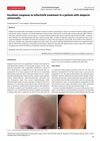 16 citations
,
January 2017 in “Acta dermatovenerologica Alpina, Pannonica et Adriatica (Tiskana izd.)”
16 citations
,
January 2017 in “Acta dermatovenerologica Alpina, Pannonica et Adriatica (Tiskana izd.)” A patient with complete hair loss regrew all her hair using tofacitinib.
1 citations
,
October 2021 in “Journal of Investigative Dermatology” 9 citations
,
November 2004 in “SKINmed Dermatology for the Clinician” A man with hair loss developed a condition causing scarring and inflammation in both bald and non-bald areas of his scalp.
Hormonal treatments can help with hair loss, acne, and excess hair growth, but it takes 3-6 months to see results and patients should know the possible side effects.