December 2020 in “Galen Medical Journal” Alopecia patients have more mast cells in their scalps, especially in severe cases and older age, with alopecia areata showing the highest increase.
14 citations
,
September 2017 in “General and comparative endocrinology” Barn owls with smaller black spots have higher testosterone levels, which might be due to genetic effects on hormone regulation rather than hormone effects on coloration.
 13 citations
,
April 1994 in “Journal of Investigative Dermatology”
13 citations
,
April 1994 in “Journal of Investigative Dermatology” Androgen receptors found in monkey scalps, similar to humans, affect hair growth.
7 citations
,
March 2023 in “Gynecological Endocrinology” After tumor removal, the woman regained normal hormone levels, menstruated, and had a healthy baby.
Androgen receptors significantly affect hair loss in women with androgenetic alopecia.
1 citations
,
August 2024 in “Journal of Morphology” Mammary glands evolved from hair organs in Monodelphis domestica.
February 2013 in “Journal of the American Academy of Dermatology” Follicular red dots can appear where alopecia areata and vitiligo overlap.
37 citations
,
December 2017 in “Journal of Investigative Dermatology Symposium Proceedings” Black and Hispanic women are more likely to have alopecia areata than white women.
 2 citations
,
August 2011 in “Revista Medica De Chile”
2 citations
,
August 2011 in “Revista Medica De Chile” A postmenopausal woman's high testosterone levels and symptoms improved after removing a tumor from her ovary.
7 citations
,
July 1981 in “Clinical and Experimental Dermatology” The normalized androgen ratio can help manage conditions with excess androgen activity in women.
 6 citations
,
January 2013 in “Genetics and Molecular Research”
6 citations
,
January 2013 in “Genetics and Molecular Research” Women with hair loss have more androgen receptors in certain hair follicles.
 January 2025 in “Acta Dermato Venereologica”
 Mothers with alopecia areata have a higher risk of adverse birth outcomes.
83 citations
,
September 1993 in “Endocrinology and Metabolism Clinics of North America” 3 citations
,
April 2024 in “Molecular Human Reproduction” Paxillin may help manage androgen-related disorders like PCOS by stabilizing androgen receptor proteins.
9 citations
,
December 2009 in “Cancer Research” Both vaginal testosterone cream and Estring effectively manage vaginal dryness in women with early-stage breast cancer on aromatase inhibitors.
1 citations
,
November 2024 in “Archives of Dermatological Research”  November 2022 in “Journal of the Endocrine Society”
 Removing the ovarian tumor improved the woman's hormonal symptoms.
53 citations
,
January 1986 in “Endocrinology” Blocking a specific enzyme in male rat fetuses leads to the development of nipples and feminized genitalia.
 October 2024 in “Journal of the Endocrine Society”
 A rare ovarian tumor caused high testosterone in a postmenopausal woman, resolved by surgery.
April 2026 in “BMJ Case Reports” Leydig cell tumors can cause high testosterone in women and are treated by removing the ovaries.
2 citations
,
July 2024 in “Indian Journal of Dermatology” Adults with alopecia areata often have empty follicular openings, while children show more honeycomb pigment patterns.
July 2021 in “Plastic and reconstructive surgery. Global open” Radiation therapy in breast cancer patients changes gene expression related to DNA damage, fibroblast growth, and hair follicle development, which could help improve treatment for radiation-induced fibrosis.
22 citations
,
October 1996 in “Dermatologic clinics” Understanding intermediate filaments helps explain hair health and related diseases.
September 2023 in “International Journal of Trichology” A rare hair regrowth pattern can occur in some people with alopecia areata.
6 citations
,
April 2010 in “The American Journal of Surgical Pathology” Trichoblastoma in the breast can be mistaken for cancer, so expert review is crucial to avoid misdiagnosis.
June 2026 in “Iraqi Journal of Pharmaceutical Sciences ( P-ISSN 1683 - 3597 E-ISSN 2521 - 3512)” Androgen receptor expression in Iraqi women with breast cancer has limited prognostic value.
 19 citations
,
January 2011 in “Clinics”
19 citations
,
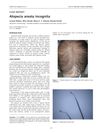
January 2011 in “Clinics” A young woman with a rare hair loss condition improved with steroid and biotin treatment.
 February 2025 in “Dermatology and Therapy”
 Alopecia areata incognita causes sudden hair loss but usually improves with topical steroids.
 October 2024 in “Journal of the Endocrine Society”
 Leydig cell tumors can cause high testosterone and symptoms in postmenopausal women, and removing them improves symptoms.