 September 2018 in “Cosmetics”
 Inositol and arginine solutions improve hair follicle health and turnover.
 April 2018 in “bioRxiv (Cold Spring Harbor Laboratory)”
 A gene variant causes patched hair loss in mice, similar to alopecia areata in humans.
 April 2017 in “Journal of Investigative Dermatology”
 A boy with Oculodentodigital syndrome had a unique GJA1 gene mutation causing his symptoms.
 December 2016 in “British Journal of Dermatology”
 The meeting highlighted the importance of genetic testing and multidisciplinary approaches in pediatric dermatology.
 July 2015 in “Actas Dermo-Sifiliográficas”
 A young woman with a rare fungal infection showed significant improvement after treatment with antifungal medication.
 November 2014 in “Elsevier eBooks”
 Gene mutations can cause problems in male genital development.
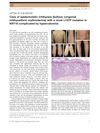 October 2011 in “Journal of dermatology”
 A man with a rare skin condition and a new gene mutation developed high calcium levels due to his treatment.
 December 2010 in “Jurnal Natural (Faculty of Mathematics and Natural Science, Syiah Kuala University)”
 Age, race, family history, and certain genetic factors increase prostate cancer risk.
 November 2009 in “Medical & surgical dermatology”
 The document concludes that Borrelia afzelii causes a skin condition in France, a gene is linked to hair loss in Caucasian women, and various genetic mutations affect skin diseases.
 January 2009 in “Nihon Keshouhin Gijutsushakaishi/Journal of S C C./Nihon Keshouhin Gijutsushakai kaishi”
 Curved human hair has different structures on each side, which might cause its shape and is similar to wool.

The vitamin D receptor has many roles in the body beyond managing calcium, affecting the immune system, hair growth, muscles, fat, bone marrow, and cancer cells.
 October 2005 in “Nature reviews. Molecular cell biology (Print)”
 Hairless protein is key for hair growth, cell differences cause gene expression variation, and the N-end rule pathway senses nitric oxide for protein breakdown.
 July 2002 in “Australasian Journal of Dermatology”
 Maintaining anticoagulation is crucial for patients with antiphospholipid syndrome.
 July 2002 in “Australasian Journal of Dermatology”
 A woman with lupus had hair loss and skin issues that were successfully treated with medications.
 August 1994 in “Molecular Endocrinology”
 Changing protein kinase levels in pituitary cells affects calcium flow and beta-endorphin release.
 November 2015 in “Springer eBooks”
 Hair loss treated with minoxidil, finasteride, laser/light, hair transplant, and scalp prostheses; more research needed for skin of color.
 1 citations
,
October 2025 in “Scientific Reports”
1 citations
,
October 2025 in “Scientific Reports” Mandarin duck sail feathers change with seasons due to hormones and genetic regulation.
 September 2024 in “Journal of the American Academy of Dermatology”
 AH-001 could be a safer and more effective treatment for hair loss.
 28 citations
,
March 2010 in “British Journal of Dermatology”
28 citations
,
March 2010 in “British Journal of Dermatology” Genetic marker rs12558842 strongly linked to male hair loss.
April 2023 in “Journal of Investigative Dermatology” A new treatment for hair loss shows promise with fewer side effects.
 July 2023 in “Developmental medicine and child neurology/Developmental medicine & child neurology”
 DFMO treatment improves hair growth, muscle tone, and development in Bachmann-Bupp syndrome patients.
 October 2025 in “International Wound Journal”
 Gamma-irradiated amniotic fluid improves healing and reduces thickness of hypertrophic scars.
 November 2023 in “The journal of investigative dermatology/Journal of investigative dermatology”
 ARQ-234, a protein designed to treat atopic dermatitis, shows increased effectiveness in early testing.
May 2026 in “Journal of Medicinal Chemistry” dAR-6–1 is a promising new treatment for hair loss that works better than minoxidil.
August 2022 in “Dermatologic Therapy” September 2023 in “Journal of the American Academy of Dermatology” Dermatologists should consider alpha-gal syndrome in patients with unexplained chronic skin issues.
 April 2018 in “Journal of Investigative Dermatology”
 High amphiregulin in the skin is a bad sign for acute graft-versus-host disease.
 June 2026 in “Archives of Dermatological Research”
 The rs4541843 variant is linked to higher risk and severity of alopecia areata.
 11 citations
,
June 2017 in “Journal of cell science”
11 citations
,
June 2017 in “Journal of cell science” AGD1's PH domain is essential for its role in root hair growth and polarity.