
Taller men are seen as more attractive, and hair loss negatively affects attractiveness.

Men with hair loss are seen as less attractive and shorter, and height is a key factor in attractiveness ratings.
7 citations
,
January 2016 in “Dermatology online journal” Persistent pulling on hair can cause permanent hair loss.
 December 2024 in “Asian Journal of Medical Sciences”
 Low iron levels may be linked to hair loss in women.

Topical Minoxidil is effective for hair loss after COVID-19.
 March 2017 in “Journal of Dermatology”
 Different hair loss patterns may be linked to varying male hormone levels.
January 2023 in “Indian Dermatology Online Journal” A 23-year-old man has a benign, non-progressive hair loss patch that doesn't respond to treatment but can be cosmetically treated.
 20 citations
,
February 1991 in “The Journal of Dermatologic Surgery and Oncology”
20 citations
,
February 1991 in “The Journal of Dermatologic Surgery and Oncology” Scalp flaps are used for reconstruction, considering factors like inelasticity, hair growth, and blood supply, with techniques adapting to age-related changes in vascularity.
November 2023 in “Neurosurgical Review” The incision along the superior temporal line is safe and looks good for bald male patients.
 2 citations
,
May 2005 in “Seminars in Plastic Surgery”
2 citations
,
May 2005 in “Seminars in Plastic Surgery” The Juri Temporo-Parieto-Occipital Flap is a good option for scalp reconstruction and hairline restoration with a natural look, despite some risk of necrosis and scarring.
 2 citations
,
March 2023 in “Skin research and technology”
2 citations
,
March 2023 in “Skin research and technology” Temporal triangular alopecia in infants is mostly seen in males at birth, with unique features that help with diagnosis.
 5 citations
,
January 2020 in “Journal of Dermatology”
5 citations
,
January 2020 in “Journal of Dermatology” Temporal hair loss relates to overall scalp hair loss in women.
 4 citations
,
May 2015 in “Indian Journal of Dermatology, Venereology and Leprology”
4 citations
,
May 2015 in “Indian Journal of Dermatology, Venereology and Leprology” Congenital triangular alopecia can occur outside the typical fronto-temporal region.
Scalp reconstruction uses different methods to restore hair and skin, depending on the defect size.
October 2025 in “Diagnostics” Temporal triangular alopecia is a harmless, non-progressive hair loss condition.
15 citations
,
February 2015 in “Anais brasileiros de dermatologia/Anais Brasileiros de Dermatologia” Dermoscopy helps accurately diagnose temporal triangular alopecia, avoiding unnecessary treatments.
January 2025 in “Surgical & Cosmetic Dermatology” Temporal triangular alopecia causes permanent hair loss and can be managed with treatments like minoxidil or hair transplantation.
October 2022 in “Hair Transplantation” Temporary scalp trichopigmentation creates a shaved hair look on the scalp using pigments that fade over time.
1 citations
,
January 2016 in “Dermatology Online Journal” Triangular temporal alopecia can occur in adults and should be correctly identified to prevent misdiagnosis.
1 citations
,
March 2023 in “Journal of the Turkish Academy of Dermatology” Temporal triangular alopecia may be linked to sebaceous nevus and shows a new pinkish background feature.
 8 citations
,
April 2001 in “Dermatologic Surgery”
8 citations
,
April 2001 in “Dermatologic Surgery” Michael L. Beehner proposed a standardized way to describe balding areas on the scalp to help hair restoration experts communicate better.
 17 citations
,
May 2013 in “Oral and Maxillofacial Surgery Clinics of North America”
17 citations
,
May 2013 in “Oral and Maxillofacial Surgery Clinics of North America” The document concludes that careful surgical methods and choosing the right materials are key for successful scalp, skull, and frontal sinus reconstruction.
 9 citations
,
June 2014 in “Journal of Craniofacial Surgery”
9 citations
,
June 2014 in “Journal of Craniofacial Surgery” The method for sideburn reconstruction was safe and effective, giving natural-looking hair with minimal scarring.
 January 2022 in “Plastic and Aesthetic Research”
 Choose the simplest, most fitting scalp reconstruction method for each patient's unique needs.
 December 2020 in “TURKDERM”
 A 3-year-old boy was diagnosed with a rare, non-scarring hair loss condition called temporal triangular alopecia.
 2 citations
,
February 2018 in “Journal of dermatology & cosmetology”
2 citations
,
February 2018 in “Journal of dermatology & cosmetology” Triangular temporal alopecia is a benign hair loss pattern best diagnosed with dermoscopy, with limited treatment options like surgery and hair transplantation.
 January 2022 in “Consultant”
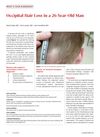
 The man's occipital hair loss was due to temporal triangular alopecia, not alopecia areata.

The conclusion is that closing scalp wounds is possible, but restoring hair without donor material is still a major challenge.
2 citations
,
November 2020 in “Chirurgia” Scalp reconstruction is complex and aims to restore function and appearance after damage.
 13 citations
,
March 2002 in “Pediatric Dermatology”
13 citations
,
March 2002 in “Pediatric Dermatology” A child was initially wrongly diagnosed with a fungal scalp infection but actually had a non-scarring hair loss condition called Temporal Triangular Alopecia.