 November 2025 in “Indian Journal of Nephrology”
 Hair dye may trigger anti-GBM disease relapse, and rituximab can help manage it.
1 citations
,
March 2023 in “Anais Brasileiros de Dermatologia” 2 citations
,
January 1989 Tay syndrome is a unique genetic disorder causing skin, hair, and developmental issues.
November 2025 in “International Journal of Biological Macromolecules” This eco-friendly hair dye method improves hair health and color durability.
2 citations
,
January 2025 in “Journal of Clinical Immunology” The curly mutation in SELH/Bc mice affects hair and may help study human genetic disorders.
 December 2023 in “Materials Today Sustainability”
 Scientists made glow-in-the-dark dots from human hair that can detect iron, prevent counterfeiting, and reveal fingerprints.
2 citations
,
December 1988 in “PubMed” C.I. Acid Orange 3 caused cancer in female rats but not in male rats or mice.
 4 citations
,
July 2018 in “International Journal of Research -GRANTHAALAYAH”
4 citations
,
July 2018 in “International Journal of Research -GRANTHAALAYAH” Human hair has a natural biomagnetic field.
 November 2025 in “Zenodo (CERN European Organization for Nuclear Research)”
 Polyherbal hair dye creams are safer, effective, eco-friendly, and economical alternatives to synthetic dyes.
March 2026 in “Mendeley Data” March 2026 in “Mendeley Data” January 2016 in “ACG Case Reports Journal” A girl with Rapunzel syndrome had surgery to remove a hairball, and addressing mental health is important to prevent it from happening again.
 3 citations
,
July 2018 in “International Journal of Research -GRANTHAALAYAH”
3 citations
,
July 2018 in “International Journal of Research -GRANTHAALAYAH” Human hair and mouse whiskers emit similar biomagnetic fields.
 4 citations
,
October 2020 in “Animal Bioscience”
4 citations
,
October 2020 in “Animal Bioscience” Using cans with beans improves Rex rabbits' growth, meat quality, and hair follicle density.
3 citations
,
January 2013 in “Journal of cosmetics, dermatological sciences and applications” HAIRCARECUBE TM (HCC) helps hair products work better by getting active ingredients deeper into the hair.
 1 citations
,
March 2015 in “Journal of Cutaneous Medicine and Surgery”
1 citations
,
March 2015 in “Journal of Cutaneous Medicine and Surgery” Eyebrow hair transplants can regrow after high-dose radiation therapy.
3 citations
,
August 2013 in “Journal of the American Academy of Dermatology” A new method quickly detects hair changes from EGFR inhibitors using a microscope.
14 citations
,
November 1979 in “Pediatric Research” 29 citations
,
January 2003 in “Genomics” A new mouse mutation causes skin and hair issues, influenced by another gene.
 1 citations
,
June 2023 in “Pharmacognosy Research”
1 citations
,
June 2023 in “Pharmacognosy Research” Bacopa monnieri, or Brahmi, is a traditional herb that may improve memory and treat various conditions, but more research is needed.
2 citations
,
March 2017 in “Sultan Qaboos University medical journal” An infant had two different natural hair colors on the scalp with no health issues.
May 2010 in “Europe PMC (PubMed Central)” Near-infrared probes can safely and effectively image cysteine protease activity for disease diagnosis.
October 2021 in “Journal of Investigative Dermatology” Pink berry extract effectively treats scalp issues from frequent head covering.
 8 citations
,
February 2005 in “British Journal of Haematology”
8 citations
,
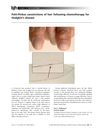
February 2005 in “British Journal of Haematology” Chemotherapy caused the patient's hair to have alternating thick and thin segments.
October 2019 in “European Journal of Dermatology” The boy's hair and skin color differences are due to a pigmentation disorder.
December 2025 in “eTheses of Maulana Malik Ibrahim State Islamic University (Maulana Malik Ibrahim State Islamic University)” A traditional herbal mix from East Nusa Tenggara may help hair regrowth after chemotherapy.
 November 2025 in “Zenodo (CERN European Organization for Nuclear Research)”
 Polyherbal hair dye cream is safe, effective, and eco-friendly, offering better color and no side effects.
 January 2026 in “International Journal of Science and Research Methodology”
 Bhangra may help treat premature greying of hair by boosting melanin and improving scalp health.
2 citations
,
January 2015 in “Chinese Medical Journal” Lithium can cause skin discoloration even at normal levels, so monitor for signs of intoxication.