24 citations
,
February 2007 in “Laser Physics Letters” Caffeine shampoo penetrates hair follicles deeply and stays for up to 48 hours.
 May 2024 in “Journal of cosmetic dermatology”
 A shampoo with caffeine and adenosine may help prevent hair loss and thicken hair.
26 citations
,
December 2009 in “Laser Physics” Caffeine from shampoo penetrates hair follicles quickly and stays for at least 24 hours.
 1 citations
,
July 2023 in “Cosmetics”
1 citations
,
July 2023 in “Cosmetics” The new shampoo effectively delivers caffeine to hair follicles to help keep hair, especially as people age.
The caffeine shampoo for hair loss is stable and suitable for use.
93 citations
,
January 2007 in “Skin Pharmacology and Physiology” Caffeine in shampoo quickly enters the body through hair follicles.
5 citations
,
October 2020 in “Giornale italiano di dermatologia e venereologia” The phyto-caffeine shampoo reduced hair loss and improved hair strength in women with hair thinning.
 November 2025 in “Cosmetics”
 Most trichological shampoo ingredients lack strong evidence for effectiveness against hair loss.
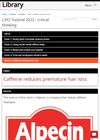
Caffeine in Alpecin shampoo may help prolong hair root activity and reduce hair loss.

Most ingredients in hair loss shampoos lack strong evidence of effectiveness.
 January 2024 in “Estetologia Medyczna i Kosmetologia”
 Most hair loss shampoos have unproven active ingredients.
 8 citations
,
January 2020 in “Skin Pharmacology and Physiology”
8 citations
,
January 2020 in “Skin Pharmacology and Physiology” Caffeine improves hair growth, thickness, and reduces shedding.
1 citations
,
February 2018 in “Psicologia e Saúde em Debate” The caffeine shampoo formulation is stable and suitable for treating hair loss.
 December 2020 in “Journal of Cosmetic Science”
 The caffeine content in anticellulite gels is 0.7-1.7% and in hair-care products is about 1.0%.
Removing follicular plugging is crucial for effective alopecia treatment.
 December 2024 in “Skin Appendage Disorders”
 Non-prescription products can help manage androgenic alopecia.
 August 2025 in “Journal of Cosmetic Dermatology”
 The shampoo with DMG-Na and caffeine effectively reduces hair loss and improves hair density in men.
May 2026 in “Revista Iluminart” Coffee bomb shampoo has more caffeine after 7 days than commercial products.
 August 2025 in “Drug Design Development and Therapy”
 Current treatments for androgenetic alopecia are complex and promising, but more research is needed.
 3 citations
,
January 2018 in “International Journal of Cosmetic Science”
3 citations
,
January 2018 in “International Journal of Cosmetic Science” Hair stiffness increased by 13.2% after caffeine treatment, validating the Stiffness-Angle Law as an effective measurement method.
 1 citations
,
March 2025 in “Biomedical Journal of Scientific & Technical Research”
1 citations
,
March 2025 in “Biomedical Journal of Scientific & Technical Research” Caffeine can effectively treat hair loss and skin issues.
6 citations
,
August 2021 in “International Journal of Cosmetic Science” Using antioxidants on the scalp can make it healthier and decrease hair loss.
 1 citations
,
July 2023 in “Cureus”
1 citations
,
July 2023 in “Cureus” Some treatments for hereditary hair loss are effective but vary in results and side effects; new therapies show promise but need more research.
 May 2025 in “International Journal of Cosmetic Science”
 Caffeine and adenosine in shampoo may boost hair growth and change scalp microbes and lipids.
Nanoparticles with caffeine can be used for slow, continuous hair growth stimulation.
 153 citations
,
October 2012 in “Skin Pharmacology and Physiology”
153 citations
,
October 2012 in “Skin Pharmacology and Physiology” Caffeine in cosmetics may reduce cellulite, protect skin, and stimulate hair growth, but more research is needed on its use and effects.

Cinchona succirubra extract with caffeine reduces hair loss and strengthens hair.
 April 2023 in “Journal of Investigative Dermatology”
 Cinchona succirubra extract with caffeine improves hair growth and reduces hair loss.
12 citations
,
May 2013 in “International Journal of Dermatology” Ethosomes improve black tea extract absorption in hair dye.
 1 citations
,
July 2017 in “Journal der Deutschen Dermatologischen Gesellschaft”
1 citations
,
July 2017 in “Journal der Deutschen Dermatologischen Gesellschaft” Topical caffeine improves hair loss intensity, speed, and shedding, and works better with minoxidil/azelaic acid.