 2 citations
,
July 2013 in “Veterinary dermatology”
2 citations
,
July 2013 in “Veterinary dermatology” Dog skin with hair loss, when transplanted to mice, regrew hair, suggesting the hair loss cause is likely body-wide, not skin-specific.
 3 citations
,
September 2022 in “Veterinary Dermatology”
3 citations
,
September 2022 in “Veterinary Dermatology” Melatonin implants did not effectively prevent hair loss in dogs.
January 2014 in “Ghent University Academic Bibliography (Ghent University)” FGF18 may influence hair loss in dogs.
 28 citations
,
May 2012 in “Veterinary Dermatology”
28 citations
,
May 2012 in “Veterinary Dermatology” Different types of dog hair loss are linked to problems starting the hair growth phase and early hair cycle ending.
 1 citations
,
January 2006 in “Elsevier eBooks”
1 citations
,
January 2006 in “Elsevier eBooks” The conclusion is that different types of hair loss in dogs and cats can be cosmetic or serious, and affected animals should not be bred.
 1 citations
,
December 2010 in “The journal of small animal practice/Journal of small animal practice”
1 citations
,
December 2010 in “The journal of small animal practice/Journal of small animal practice” The book helps veterinarians understand and treat hair loss in animals.
1 citations
,
October 2024 in “Canine Medicine and Genetics” The MLPH gene is not linked to seasonal hair loss in Rhodesian Ridgeback dogs.
2 citations
,
April 2022 in “Genes” The study found that the hair loss condition in Cesky Fousek dogs is influenced by multiple genes affecting skin and muscle structure, fat metabolism, and immunity.
 January 2014 in “HAL (Le Centre pour la Communication Scientifique Directe)”
 Sex hormones affect dog skin conditions, but more data is needed.
 January 2007 in “Acta Veterinaria Brno”
 Trilostane treatment successfully restored hair growth in a dog with alopecia X.
 March 2024 in “Brazilian Journal of Veterinary Pathology”
 The dog likely has a canine alopecia X-like disorder.
 January 2024 in “Brazilian journal of veterinary pathology”
 The dog likely has a condition similar to Canine alopecia X.
 September 2016 in “Elsevier eBooks”
 Different types of hair loss in dogs and cats have various causes and treatments, with outcomes ranging from good to uncertain.
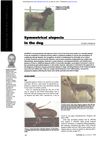 7 citations
,
July 1999 in “In Practice”
7 citations
,
July 1999 in “In Practice” The conclusion is that a systematic approach is key for treating symmetrical alopecia in dogs, but treatment may not always be necessary.
 1 citations
,
January 2008 in “Elsevier eBooks”
1 citations
,
January 2008 in “Elsevier eBooks” The document concludes that various disorders can cause hair loss in dogs, each requiring different treatments, and some may heal on their own.
 9 citations
,
June 2003 in “Veterinary dermatology”
9 citations
,
June 2003 in “Veterinary dermatology” Boxer dogs may have a genetic skin condition that worsens seasonally and can be treated with certain medications.
 January 2024 in “Jurnal Ilmu Kesehatan Hewan”
 A mixed breed dog with skin issues improved significantly after treatment and needs to avoid dampness and certain bath products to prevent it from coming back.
 1 citations
,
April 2024 in “Veterinary Science and Medicine Journal”
1 citations
,
April 2024 in “Veterinary Science and Medicine Journal” The dog's skin condition improved with treatment, and prevention includes keeping it dry, clean, and away from stray dogs.
 15 citations
,
September 2005 in “The Journal of the American Animal Hospital Association/Journal of the American Animal Hospital Association”
15 citations
,
September 2005 in “The Journal of the American Animal Hospital Association/Journal of the American Animal Hospital Association” Trilostane effectively treated hair loss in Alaskan Malamutes with no adverse effects.
 August 2015 in “Advances in Small Animal Medicine and Surgery”
 Low-level laser therapy may help regrow hair in dogs with non-inflammatory hair loss.

The document concludes that non-endocrine alopecia in pets varies in treatment effectiveness and often has a poor prognosis, especially in cats.
 January 2011 in “Elsevier eBooks”
 Alopecia in animals can be hereditary, congenital, or acquired, with treatments and outcomes varying widely.
 22 citations
,
September 2014 in “Veterinary Dermatology”
22 citations
,
September 2014 in “Veterinary Dermatology” Low-level laser therapy seems to help dogs with noninflammatory alopecia grow hair back.
Accurate diagnosis and tailored treatments are crucial for managing hair loss in humans and animals.
 9 citations
,
July 1995 in “Veterinary Clinics of North America: Small Animal Practice”
9 citations
,
July 1995 in “Veterinary Clinics of North America: Small Animal Practice” The document concludes that hair loss in cats is caused by various factors, including allergies, mites, infections, and hormonal issues, with treatments varying accordingly.
 June 2022 in “Veterinary evidence”
 Clomipramine alone does not reduce overgrooming in cats with psychogenic alopecia.
 3 citations
,
May 2018 in “The Journal of the American Animal Hospital Association/Journal of the American Animal Hospital Association”
3 citations
,
May 2018 in “The Journal of the American Animal Hospital Association/Journal of the American Animal Hospital Association” Deslorelin implants successfully treated hair loss in two male Keeshonden dogs.
 24 citations
,
January 2008 in “KARGER eBooks”
24 citations
,
January 2008 in “KARGER eBooks” The document concludes that ongoing research using animal models is crucial for better understanding and treating Alopecia Areata.
 3 citations
,
January 2013
3 citations
,
January 2013 Hypothyroidism in dogs is usually caused by immune system issues or gland atrophy, affects middle-aged purebreds most, and is treatable with medication.
 6 citations
,
January 2013
6 citations
,
January 2013 Hyperadrenocorticism in ferrets is linked to neutering and indoor housing, and is best treated with surgery and a deslorelin implant.