298 citations
,
June 2019 in “Marine Drugs” Chitosan is a sustainable, versatile ingredient in cosmetics, enhancing skin hydration and anti-aging while promoting eco-friendly practices.
238 citations
,
December 2022 in “Frontiers in Public Health” Combining ciprofloxacin with other treatments may improve its effectiveness against resistant bacteria.
 80 citations
,
April 2006 in “Clinical Interventions in Aging”
80 citations
,
April 2006 in “Clinical Interventions in Aging” Minoxidil and Finasteride are effective for male baldness; more research is needed for hair aging treatments.
40 citations
,
November 2021 in “International Journal of Molecular Sciences” Mutant keratins cause inflammation in Epidermolysis Bullosa Simplex, suggesting targeting them could help treat the disorder.
 5 citations
,
February 2022 in “Acta Biomaterialia”
5 citations
,
February 2022 in “Acta Biomaterialia” Nanomaterials can improve hair care products and treatments, including hair loss and alopecia, by enhancing stability and safety, and allowing controlled release of compounds, but their safety in cosmetics needs more understanding.
2 citations
,
December 2025 in “Cosmetics” Proper scalp care can improve hair health and delay ageing signs.
 1 citations
,
July 2023 in “Cosmetics”
1 citations
,
July 2023 in “Cosmetics” The new shampoo effectively delivers caffeine to hair follicles to help keep hair, especially as people age.
 February 2026 in “Phycology”
 Microalgae can sustainably improve nutrition and cosmetics with their diverse beneficial compounds.
 August 2025 in “International Journal of Nanomedicine”
 Metal-organic frameworks can help heal wounds, reduce scars, and promote hair growth, but more research is needed.
April 2025 in “Cosmetics” Clinopodium bolivianum essential oil boosts antioxidant activity in hair products, especially in combing cream.
 April 2025 in “BMC Chemistry”
 Thiadiazole chitosan conjugates improve hair manageability, moisture, and protection in conditioners.

Nanocarriers with plant extracts show promise for safe and effective hair growth treatment.
16 citations
,
October 2021 in “Trends in biotechnology” Future hair products will use ecofriendly proteins and peptides to improve hair health and appearance.
10 citations
,
February 2018 in “Royal Society Open Science” Modified wheat protein in shampoo repairs and smooths damaged hair effectively.
5 citations
,
November 2025 in “Biomolecules” Hyaluronic acid hydrates and benefits skin and hair safely.
1 citations
,
January 2025 in “Molecules” More research is needed to effectively measure how well GHK–Cu in liposomes penetrates the skin.
September 2025 in “International Journal of Cosmetic Science” A balanced mix of cationic guar gum and anionic surfactants improves hair conditioning and protection.
12 citations
,
July 2017 in “International Journal of Cosmetic Science” N‐AOHPA is a promising alternative to traditional surfactants for better hair conditioning.
 September 2023 in “International Journal of Cosmetic Science”
 The shampoo improves hair conditioning without using silicone.
October 2025 in “International Journal of Cosmetic Science” Conditioners improve hair manageability but don't repair damage.
 January 2014 in “University of the Arts London Research Online (University of the Arts London)”
 Certain ingredients can help protect hair color.
 43 citations
,
September 2001 in “Scanning”
43 citations
,
September 2001 in “Scanning” Hair treatments like bleaching increase friction by exposing tiny pores on the hair surface.
 10 citations
,
November 1984 in “Journal of Colloid and Interface Science”
10 citations
,
November 1984 in “Journal of Colloid and Interface Science” The study found that the Marangoni effect causes the uneven wetting of surfactant-coated hair due to the surfactant moving into the water.
3 citations
,
January 2002 in “Springer eBooks” Alkaline hair relaxers damage hair, but cationic and non-ionic polymers can help reduce this damage.
44 citations
,
November 2012 in “International journal of nanomedicine” A new method improves silicone oil coating on hair, enhancing moisture and lubrication.
51 citations
,
March 2001 in “Clinics in dermatology” Bleaching damages hair, making it rougher and weaker.
 11 citations
,
January 2006 in “International Journal of Cosmetic Science”
11 citations
,
January 2006 in “International Journal of Cosmetic Science” Some oils can penetrate hair and reduce the stickiness between fibers, but mineral oil cannot.
 1 citations
,
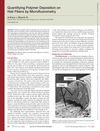
July 2019 in “Microscopy Today”
1 citations
,
July 2019 in “Microscopy Today” Microfluorometry effectively measures how much polymer coats and penetrates hair, useful for evaluating hair products.
 5 citations
,
September 2017 in “Colloids and surfaces. B, Biointerfaces”
5 citations
,
September 2017 in “Colloids and surfaces. B, Biointerfaces” Tying a knot can measure hair friction, useful for medical applications.
 1 citations
,
January 2004 in “Fashion business”
1 citations
,
January 2004 in “Fashion business” Hair color affects how people perceive personality traits.