 April 2024 in “Cosmetics”
 Different oils affect hair flexibility and strength, with their impact varying on whether hair is virgin or bleached.
 12 citations
,
February 2019 in “Skin research and technology”
12 citations
,
February 2019 in “Skin research and technology” White hair has less lipid content and absorbs water differently than brown hair.
 21 citations
,
March 2017 in “Skin research and technology”
21 citations
,
March 2017 in “Skin research and technology” Removing external lipids from hair reduces moisture and increases strength, while removing internal lipids decreases water permeability.
May 2025 in “Journal of Photochemistry and Photobiology B Biology” Blue LED light improves hair treatments for Caucasian and Asian hair but not for African hair.
January 2026 in “Brazilian Journal of Pharmaceutical Sciences” Conditioners with jojoba and coconut oils improve hair feel and reduce damage perception.
 2 citations
,
September 2004 in “International Journal of Cosmetic Science”
2 citations
,
September 2004 in “International Journal of Cosmetic Science” Hair quality is genetically determined and linked to its composition and strength.
 January 2006 in “Seibutsu Butsuri”
 Curly and straight hair differ in how their internal fibers are arranged.
 September 2001 in “PubMed”
 The new X-ray technique allows for precise and non-destructive measurement of elements in hair, creating the first database of its kind for a specific ethnic group.
 2 citations
,
March 2005 in “International Journal of Cosmetic Science”
2 citations
,
March 2005 in “International Journal of Cosmetic Science” Human hair structure varies by ethnicity, and certain treatments can improve hair condition and appearance.
65 citations
,
May 2006 in “Journal of Structural Biology” Hair curliness is due to uneven distribution of different cortices within the hair fiber.

Caucasian and Mediterranean hair is denser and varies in color and texture compared to African and Asian hair.
 January 2003 in “Research Portal (King's College London)”
 Hair color affects light reflection, with black hair having higher cuticle angles and lighter hair showing less specular reflection.
 August 2018 in “Journal of The American Academy of Dermatology”
 Aging significantly affects the hair and scalp of nonbalding Caucasian women, with changes that differ from male pattern baldness.
 2 citations
,
August 2019 in “International Journal of Cosmetic Science”
2 citations
,
August 2019 in “International Journal of Cosmetic Science” Older age and certain lifestyles are linked to thinner, weaker hair, while how you see your hair relates to its thickness.
2 citations
,
July 2019 in “Cosmetics” Beautiful hair is flexible and elastic due to its unique double-layered structure and can be enhanced with succinic acid treatment.
2 citations
,
January 1986 in “PubMed” PIXE is an effective method to analyze hair's elemental composition.
117 citations
,
August 2005 in “Ultramicroscopy” Human hair's strength and flexibility vary by ethnicity, damage, and treatment.
 13 citations
,
January 2019 in “Skin appendage disorders”
13 citations
,
January 2019 in “Skin appendage disorders” FAPD is a possible diagnosis for hair loss in patients of color and requires multiple evaluations for accurate diagnosis.
 6 citations
,
December 2018 in “International Journal of Cosmetic Science”
6 citations
,
December 2018 in “International Journal of Cosmetic Science” Mexican women's hair is between Asian and Caucasian hair in thickness and shape, with varied strength and some damage.
 42 citations
,
April 2008 in “Acta materialia”
42 citations
,
April 2008 in “Acta materialia” Different ethnicities and treatments affect human hair strength and structure.
September 2025 in “Cosmetics” Lipid content and structure affect water absorption in different hair types.
 April 2025 in “Pharmaceuticals”
 APA is a promising new compound for repairing damaged hair, outperforming Olaplex® in strength and elasticity.
January 2023 in “SSRN Electronic Journal” The fibroin-based formulation strengthens and repairs chemically damaged hair.
 24 citations
,
December 2011 in “Journal of The American Academy of Dermatology”
24 citations
,
December 2011 in “Journal of The American Academy of Dermatology” Caucasian hair is denser, but Asian hair is thicker in female pattern hair loss patients.
 47 citations
,
June 1996 in “International Journal of Legal Medicine”
47 citations
,
June 1996 in “International Journal of Legal Medicine” Hair analysis for drugs needs a better understanding of how drugs enter hair, considering factors like hair structure and pigmentation.
 16 citations
,
April 2017 in “ACM Transactions on Graphics”
16 citations
,
April 2017 in “ACM Transactions on Graphics” Light scatters differently from elliptical hair fibers than from circular ones, and a new model better predicts this behavior, especially for shiny highlights.
 52 citations
,
August 1978 in “Journal of Applied Polymer Science”
52 citations
,
August 1978 in “Journal of Applied Polymer Science” Human hair's ability to get wet is complex and can change with treatments, damage, and environment.
 5 citations
,
January 2015 in “Skin appendage disorders”
5 citations
,
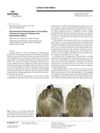
January 2015 in “Skin appendage disorders” Colored hair-thickening fibers can help hide hair loss in some people with Epidermolysis Bullosa but may cause scalp irritation.
 61 citations
,
April 2012 in “British Journal of Dermatology”
61 citations
,
April 2012 in “British Journal of Dermatology” Caucasian women's hair appears thickest in their 20s, with perceived thinning after mid-30s due to both decreasing density and diameter.
 63 citations
,
August 1996 in “Forensic Science International”
63 citations
,
August 1996 in “Forensic Science International” Cosmetic treatments like bleaching and perming can greatly reduce opiate levels in hair, possibly leading to false-negative drug tests.