 3 citations
,
July 2018 in “Cureus”
3 citations
,
July 2018 in “Cureus” A breast cancer patient had lasting hair loss after chemotherapy, which improved with minoxidil treatment.
Activating certain cells in hair follicles can prevent hair loss caused by cancer treatments.
 32 citations
,
August 2019 in “Nature Communications”
32 citations
,
August 2019 in “Nature Communications” Chemotherapy causes permanent hair follicle damage by triggering stem cell loss.
October 2025 in “Journal of Drug Delivery Science and Technology” Resveratrol-loaded carriers may help reduce hair loss from chemotherapy when used with scalp cooling.

Chemotherapy for breast cancer often causes significant and lasting hair loss.
September 2011 in “European journal of cancer”  47 citations
,
April 2000 in “The American journal of pathology”
47 citations
,
April 2000 in “The American journal of pathology” Bcl-2 overexpression protects against UVB damage but worsens hair loss from chemotherapy.
45 citations
,
July 2006 in “Journal of Investigative Dermatology” Chemotherapy affects blood vessels in hair follicles, not stem cells, allowing hair regrowth.
7 citations
,
January 2013 in “Supportive care in cancer” Hair mass index is a precise way to measure hair loss in chemotherapy patients.
 June 2024 in “British Journal of Dermatology”
 Permanent hair loss from chemotherapy significantly impacts patients' mental health and social life, highlighting the need for better patient education and support.
 November 2019 in “Actas Dermo-Sifiliográficas”
 Oral minoxidil helps treat hair loss and has reversible side effects.
Certain chemicals and drugs can cause hair loss.
 8 citations
,
February 2005 in “British Journal of Haematology”
8 citations
,
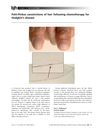
February 2005 in “British Journal of Haematology” Chemotherapy caused the patient's hair to have alternating thick and thin segments.
 3 citations
,
October 1982 in “Postgraduate Medicine”
3 citations
,
October 1982 in “Postgraduate Medicine” Most types of hair loss can regrow naturally, but there are no effective cures for male pattern or age-related hair loss, and only limited options for females.
January 2026 in “EJC Skin Cancer” The serum effectively improves hair growth and is well-tolerated for post-cancer hair loss.
November 2024 in “Journal of Investigative Dermatology” Paclitaxel chemotherapy causes premature aging and damage to hair follicles, potentially leading to permanent hair loss.
 1 citations
,
March 2015 in “Journal of Visualized Experiments”
1 citations
,
March 2015 in “Journal of Visualized Experiments” Researchers developed a new, precise method to measure hair loss in mice using image analysis.
 July 2021 in “Open access journal of biomedical science”
 A lotion with natural extracts significantly sped up hair growth in women with hair loss from chemotherapy.
 39 citations
,
December 2001 in “JNCI: Journal of the National Cancer Institute”
39 citations
,
December 2001 in “JNCI: Journal of the National Cancer Institute” Using a gene therapy with the Sonic Hedgehog gene helps mice regrow hair faster after losing it from chemotherapy.
 24 citations
,
November 2013 in “British Journal of Dermatology”
24 citations
,
November 2013 in “British Journal of Dermatology” Chemotherapy causes hair loss starting soon after treatment begins and recovers about 3 months after ending, while tamoxifen does not significantly affect hair growth.
 20 citations
,
November 2013 in “The Open Cancer Journal”
20 citations
,
November 2013 in “The Open Cancer Journal” Hair loss from cancer treatment is very distressing for women due to its impact on self-image and social stigma.
18 citations
,
August 2008 in “Journal of Investigative Dermatology” 17-β estradiol and prednisolone may speed up hair regrowth after chemotherapy.
 15 citations
,
January 2015 in “Skin Pharmacology and Physiology”
15 citations
,
January 2015 in “Skin Pharmacology and Physiology” Parathyroid hormones are important for hair growth, but their use in treating hair loss from chemotherapy is still uncertain.
13 citations
,
April 2010 in “Journal of dermatological science” Chemotherapy-induced hair loss is partly due to decreased laminin-511 and increased laminin-332.
 12 citations
,
July 2014 in “Journal of Investigative Dermatology”
12 citations
,
July 2014 in “Journal of Investigative Dermatology” Chemotherapy causes complex changes in hair follicle cells that can lead to hair loss.
12 citations
,
January 2004 in “International Journal of aromatherapy/International journal of aromatherapy” Ocimum oil may promote hair growth and reduce hair loss from cyclophosphamide.
 10 citations
,
July 2007 in “PubMed”
10 citations
,
July 2007 in “PubMed” Chemotherapy causes hair loss in cancer patients by affecting both growing and resting hair.
 3 citations
,
May 2023 in “International Journal of Molecular Sciences”
3 citations
,
May 2023 in “International Journal of Molecular Sciences” A new treatment using nanoparticles can effectively prevent and reduce hair loss caused by chemotherapy.
 3 citations
,
April 2021 in “Biomolecules & Therapeutics”
3 citations
,
April 2021 in “Biomolecules & Therapeutics” The protein ER71/ETV2 helps regrow hair after chemotherapy by improving the growth of new blood vessels.
 2 citations
,
August 2019 in “Asian journal of pharmaceutical and clinical research”
2 citations
,
August 2019 in “Asian journal of pharmaceutical and clinical research” Cinnamon bark extract may help prevent weight loss and hair loss in breast cancer patients during chemotherapy and is safe to use.