 3 citations
,
January 2015 in “Indian journal of burns”
3 citations
,
January 2015 in “Indian journal of burns” The document discusses how to restore hair in areas like eyebrows, eyelashes, moustache, beard and scalp after burns.
September 2011 in “대한미용학회지” Bear oil promotes hair growth and increases hair density.
 February 2019 in “bioRxiv (Cold Spring Harbor Laboratory)”
 The gene Prss53 affects hair shape and bone development in rabbits.
 March 2023 in “International Journal of Dermatology”
 COVID-19 can cause hair to become progressively kinked.
 16 citations
,
May 2017 in “American Journal of Clinical Dermatology”
16 citations
,
May 2017 in “American Journal of Clinical Dermatology” The document concludes that more research is needed to understand and treat Beard Alopecia Areata due to limited current knowledge and evidence.
 2 citations
,
July 2021 in “JAAD Case Reports”
2 citations
,
July 2021 in “JAAD Case Reports” Trichoscopy of the beard is useful for diagnosing frontal fibrosing alopecia in men.
Early baldness and little chest hair may indicate higher prostate cancer risk.
9 citations
,
January 1989 in “Journal of Small Animal Practice” Abyssinian cats can have a hair abnormality that makes their coat look rough and dull.
Facial hair transplants now look very natural due to improved techniques.
 April 2016 in “Journal of Aesthetic Nursing”
 Men are increasingly removing body hair for looks and cleanliness, and while hair loss can cause distress, it doesn't affect their self-esteem as much as it does in women.
Frizzy hair is fragile and can lead to hair loss and damage if not properly cared for.
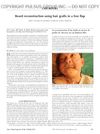 5 citations
,
December 2011 in “Canadian Journal of Plastic Surgery”
5 citations
,
December 2011 in “Canadian Journal of Plastic Surgery” Hair grafts can successfully reconstruct a beard on reconstructed jaw skin, improving appearance and patient satisfaction.
1 citations
,
January 2018 in “International Journal of Trichology” Circle hairs are harmless, spiral-shaped body hairs that don't need medical treatment.
March 2010 in “Faculty Opinions – Post-Publication Peer Review of the Biomedical Literature” Beard hair medulla cells have a unique and varied keratin pattern.
January 2025 in “Conservation Physiology” Bear hair grows 0.10 to 1.05 mm per day, varying by individual and season.
62 citations
,
December 2008 in “Journal of structural biology” Hair curvature in Japanese people is linked to specific cell types and filament arrangements in the hair cortex.
33 citations
,
September 1987 in “American Journal of Medical Genetics” Uncombable hair is inherited dominantly with complete penetrance.
67 citations
,
August 2005 in “Journal of Investigative Dermatology Symposium Proceedings” Androgens promote beard growth but cause hair loss in androgenetic alopecia, with TGF-β1 as a potential treatment target.
4 citations
,
January 2014 in “Bone marrow transplantation” Alopecia areata can be transferred through stem cell transplants from affected siblings.
3 citations
,
October 2024 in “The Journal of Clinical Endocrinology & Metabolism” Potential androgen excess signs vary by demographics and health, needing inclusive evaluation.
48 citations
,
July 1993 in “Archives of Dermatological Research” Merkel cells are abundant in facial vellus hair follicles, especially during the anagen phase.
 November 2025 in “SKIN The Journal of Cutaneous Medicine”
 Baricitinib significantly regrows hair in nasal, genital, and beard areas for severe alopecia areata.
 November 2023 in “Facial Plastic Surgery”
 Beard hair is the best for body hair transplants, but the procedure is hard and should be done by experts.
4 citations
,
July 2006 in “British journal of dermatology/British journal of dermatology, Supplement” Testosterone increases hair follicle cell growth when beard or axillary skin cells are present together.
12 citations
,
March 2004 in “Journal of Investigative Dermatology”  16 citations
,
April 2017 in “ACM Transactions on Graphics”
16 citations
,
April 2017 in “ACM Transactions on Graphics” Light scatters differently from elliptical hair fibers than from circular ones, and a new model better predicts this behavior, especially for shiny highlights.
 January 2020 in “Nasza Dermatologia Online”
 A mixture of Dijon mustard, turmeric powder, and linseed oil can effectively treat alopecia barbae.
1 citations
,
June 2022 in “Tidsskrift for Den norske legeforening” A young boy's uncombable hair is due to a rare genetic condition that usually improves over time.
173 citations
,
July 1995 in “Biochemical and biophysical research communications” Male hormones promote hair cell growth by using a growth factor from nearby skin cells.
25 citations
,
July 1994 in “Journal of dermatological science” Testosterone affects hair follicles differently across body sites, with beard hair follicles showing more activity of a specific enzyme and presence of androgen receptors compared to scalp hair.