25 citations
,
January 1983 in “Archives of dermatology” The conclusion is that Darier-White disease was accurately described by White but he missed the key feature of dyskeratotic cells which Darier identified.
Pseudopelade is likely an independent disease due to its distinct features.
19 citations
,
July 2004 in “Clinical and experimental dermatology” Acneiform follicular mucinosis can be controlled with systemic corticosteroids.
1 citations
,
January 2016 in “Revista Brasileira de Higiene e Sanidade Animal” Combining lab tests with clinical observations is crucial for diagnosing hormonal skin issues in dogs.
January 2011 in “The Chinese Journal of Dermatovenereology” The woman's skin condition improved with specific oral and topical treatments.
25 citations
,
January 2004 in “The International Journal of Developmental Biology” Research on skin disorders in humans and mice has improved understanding of hair and skin development.
7 citations
,
February 2002 in “Veterinary Dermatology” Intracorneal vacuoles are common in parakeratotic skin diseases in dogs, especially with more parakeratosis.
 2 citations
,
July 2022 in “Dermatology Reports”
2 citations
,
July 2022 in “Dermatology Reports” EPDS and MS might share an immune-related cause.
 12 citations
,
November 2011 in “International Journal of Dermatology”
12 citations
,
November 2011 in “International Journal of Dermatology” A woman developed a scalp condition from using minoxidil, which improved with a different treatment but left scarring.
 June 2025 in “Veterinární Medicína”
 Uveodermatological syndrome in dogs is hard to manage and can lead to blindness despite treatment.
34 citations
,
July 2013 in “Clinical Cosmetic and Investigational Dermatology” Erosive pustular dermatosis is a rare skin disease that's hard to treat and affects the scalp or legs.
 36 citations
,
June 2018 in “Journal of The American Academy of Dermatology”
36 citations
,
June 2018 in “Journal of The American Academy of Dermatology” Dermoscopy is useful for diagnosing various skin, hair, and nail disorders and can reduce the need for biopsies.
 April 2012 in “Journal of the American Academy of Dermatology”
 Dermoscopy can help diagnose tinea capitis in children by looking for comma hairs, black dots, and broken hairs with white bands.
21 citations
,
April 2004 in “Australasian Journal of Dermatology” A 3-year-old girl has a rare condition causing sparse hair and nail issues, with minimal improvement from treatment.
9 citations
,
September 1977 in “Journal of Small Animal Practice” Mange in guinea pigs can be cured with gamma benzene hexachloride washes.
 October 2023 in “Jurnal Ilmu Kesehatan Hewan”
 The kitten's skin condition improved significantly after 4 weeks of treatment.
189 citations
,
May 1991 in “Medical Entomology and Zoology” March 2025 in “International Journal of Clinical Dermatology” Psychodermatosis is reclassified based on brain-skin interaction, dividing conditions into psychogenic and psychosomatic categories.
 2 citations
,
February 2019 in “Anais brasileiros de dermatologia/Anais Brasileiros de Dermatologia”
2 citations
,
February 2019 in “Anais brasileiros de dermatologia/Anais Brasileiros de Dermatologia” Tufted folliculitis is common in patients with folliculitis decalvans.
1 citations
,
January 2023 in “International journal of molecular sciences” Rabbits with Sarcoptes scabiei had thicker skin, cell death, and skin hardening.
2 citations
,
September 2021 in “JAAD case reports” A man with a weakened immune system was diagnosed with a rare skin condition called trichodysplasia spinulosa using skin examination techniques.
44 citations
,
January 1999 in “Dermatology” Nevus comedonicus is a rare skin condition with grouped open pores, sometimes linked to other body issues.
1 citations
,
October 2020 in “Cermin Dunia Kedokteran” A boy's scalp rash and baldness were cured using oral medication and medicated shampoo.
20 citations
,
February 2015 in “Anais brasileiros de dermatologia/Anais Brasileiros de Dermatologia” A 6-year-old girl was diagnosed with a rare hair disorder and started treatment with topical minoxidil.
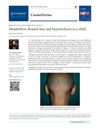 January 2026 in “Cosmoderma”
 A 9-year-old girl has a rare hair disorder causing beaded, sparse hair.
 August 2020 in “Egyptian Veterinary Medical Society of Parasitology Journal (EVMSPJ)”
 10.5% of sheep in Ismailia, Egypt, had Sarcoptes scabiei, causing skin issues.
January 2005 in “Veterinarski glasnik” The dog's hair discoloration was due to low zinc and hypothyroidism, not the medication.
 108 citations
,
July 2002 in “Molecular and cellular biology”
108 citations
,
July 2002 in “Molecular and cellular biology” Overexpressing Dsg3 in mice skin causes excessive cell growth and abnormal skin development.
 February 2024 in “Journal of dermatology research reviews & reports”
 A 50-year-old woman with breast cancer developed an autoimmune skin disorder, highlighting the need for thorough checks and team-based treatment.
2 citations
,
July 2016 in “Veterinary dermatology” Hyperaesthetic leucotrichia in horses causes painful, recurring skin lesions and hair color changes, especially in Arabian and American paint horses.