46 citations
,
July 2022 in “Frontiers in Oncology” Cold atmospheric plasma is a promising and safe treatment for various skin conditions.
March 2023 in “ACS Applied Materials & Interfaces” A new microneedle patch can help regrow hair over a long time.
3 citations
,
November 2021 in “Skin Appendage Disorders” Home-use treatment for severe alopecia areata is as effective as office-use but costs half as much.
 September 2024 in “Journal of the American Academy of Dermatology”
 The compounded topical solution is safe, stable, and effective for personalized alopecia treatment.
15 citations
,
February 2011 in “Experimental Dermatology” Betamethasone dipropionate reduced skin thickness, fish oil increased it, and combined treatment had no significant effect.
 3 citations
,
October 2019 in “Pharmaceutics”
3 citations
,
October 2019 in “Pharmaceutics” New technique implants pigment in scalp with less pain and damage.

PRP therapy effectively treats hair loss, wrinkles, scars, ulcers, and skin pigmentation disorders.
April 2025 in “Assiut Veterinary Medical Journal/Maǧallaẗ Asyūṭ al-ṭibiyyaẗ al-baytariyyaẗ” Platelet-rich plasma speeds up early skin wound healing.
 August 2023 in “European journal of dermatology/EJD. European journal of dermatology”
 Combining topical delgocitinib with a 308-nm excimer laser can effectively treat severe alopecia areata and vitiligo.
 4 citations
,
September 2014 in “Elsevier eBooks”
4 citations
,
September 2014 in “Elsevier eBooks” Use some skin medications with caution during pregnancy; avoid strong steroids, certain eczema treatments, and systemic retinoids, but many topical treatments and nasal sprays are safe.
 September 2022 in “Journal of pharmaceutical sciences”
 Thicker minoxidil solutions work better and need less frequent application.
April 2016 in “Journal of the American Academy of Dermatology” Incorrect injection of corticosteroids for alopecia areata can cause skin problems.
 3 citations
,
February 2016 in “Pediatric dermatology”
3 citations
,
February 2016 in “Pediatric dermatology” Strong skin creams work well for long-term scalp inflammation in Rapp-Hodgkin Ectodermal Dysplasia.
 June 2024 in “Frontiers in immunology”
 Sequential therapy with dupilumab and baricitinib improved hair regrowth and atopic dermatitis in a child without adverse reactions.
PRP therapy shows promise in skin treatment but needs more research for consistent results.
 9 citations
,
July 2017 in “Dermatologic Therapy”
9 citations
,
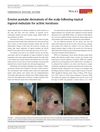
July 2017 in “Dermatologic Therapy” Two elderly men developed scalp inflammation after using a gel for skin lesions, which healed with treatment except for some permanent hair loss.
13 citations
,
January 2001 in “Skin pharmacology and physiology” Micro-Imager® helps see how drugs spread in human skin.
 July 2022 in “Media Dermato Venereologica Indonesiana”
 The combination of PRP and triamcinolone injections improved hair growth in a man with alopecia areata.
May 2025 in “Reactions Weekly”  June 2024 in “IP Indian journal of clinical and experimental dermatology”
 PRP therapy effectively treats alopecia areata and atrophic acne scars.
January 2025 in “SSRN Electronic Journal”  July 2024 in “Journal of Investigative Dermatology”
 A single medium, PRIME AIRLIFT, supports better human hair follicle formation in grafts.
11 citations
,
July 2023 in “Applied Nanoscience”  June 2025 in “ACS Biomaterials Science & Engineering”
 A new method using hydrogels and microneedle patches improves minoxidil delivery for better hair growth.
July 2014 in “Faculty Opinions – Post-Publication Peer Review of the Biomedical Literature” AA-PRP injections significantly promote hair growth but need better study design for clear efficacy.

A new topical treatment for hair loss is effective and safe with faster results.

A new topical treatment for hair loss is effective and safe with faster results.

A new topical treatment for hair loss is effective and safe with faster results.
 May 2024 in “Indian Journal of Dermatology”
 The woman has a rare skin condition called follicular Dowling-Degos disease, which has limited treatment options.
 November 2020 in “International journal of pharmaceutical compounding”
 A stable and simple finasteride suspension was developed that retains over 94.3% of its concentration for up to 90 days and doesn't significantly increase occupational exposure, but safety measures are still advised.