 October 2025 in “Indian Journal of Dermatology Venereology and Leprology”
 Augmented virtual reality can help manage chronic skin conditions.
Trichoscopy is a valuable tool for accurately diagnosing scalp conditions without invasive procedures.
 March 2025 in “Pakistan Journal of Health Sciences”
 Intralesional steroids improve Alopecia Areata, and trichoscopy effectively tracks this improvement.
 December 2024 in “Australian Journal of General Practice”
 The woman's hair loss pattern doesn't match typical conditions like alopecia areata or female pattern hair loss.

COVID-19 can cause significant hair loss.
 July 2024 in “International Journal of Dermatology Venereology and Leprosy Sciences”
 Trichoscopy is a useful, painless tool for diagnosing and monitoring children's hair and scalp issues.
 February 2024 in “Frontiers in physics”
 The new model detects hair clusters more accurately and efficiently, helping with early hair loss treatment and diagnosis.
 November 2023 in “European medical journal. Dermatology”
 Early diagnosis and new treatments are crucial to prevent permanent hair loss in scarring alopecia.
 July 2022 in “Al-Mağallaẗ al-ʻirāqiyyaẗ li-l-ṣaydalaẗ”
 Androgenetic alopecia with telogen effluvium is the most common hair loss in women with hirsutism.
 June 2022 in “Journal of the turkish academy of dermatology”
 The COVID-19 quarantine in Turkey disrupted dermatological care, increased stress-related skin issues, and showed the need for psychological support and teledermatology.
January 2020 in “International journal of scientific research” Dermoscopy shows that varying hair shaft thickness and single hair follicles are main signs of male pattern baldness, especially in the fronto-temporal region.
 November 2019 in “Journal of Aesthetic Nursing”
 The article concludes that a thorough diagnosis and treatment plan, including medications, non-invasive methods, or surgery, is important for managing hair loss, with a combination of minoxidil and finasteride being particularly effective.
 August 2017 in “Journal of evolution of medical and dental sciences”
 Trichoscopy is effective for diagnosing different types of non-scarring hair loss.
 April 2016 in “Journal of The American Academy of Dermatology”
 Dutasteride is more effective than finasteride for hair growth with similar side effects.
 April 2016 in “Journal of The American Academy of Dermatology”
 Dutasteride works better than finasteride for hair growth with similar side effects.
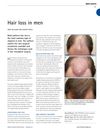 May 2013 in “Trends in Urology & Men's Health”
 Male-pattern hair loss is normal, often involves hormone effects on hair follicles, and can be treated with medication or surgery, but new treatments are being researched.
 March 2011 in “European Urology Supplements”
 CEC levels may be a useful marker for predicting prostate cancer progression.
 March 2011 in “European Urology Supplements”
 The document concludes that a new biosensor can efficiently detect prostate cancer cells and that standardized referrals help find significant cancers effectively.
 March 2011 in “European Urology Supplements”
 Blood tests for tumor cells could improve prostate cancer diagnosis and treatment; hair loss severity linked to a gene affecting prostate conditions.
 January 2021 in “Journal of cosmetology & trichology”
 The treatment improved hair growth and thickness in patients with hair loss, even 10 months after therapy without additional products.
 March 2011 in “European Urology Supplements”
 Gene variation affects prostate issues and hair loss.
 7 citations
,
January 2009 in “International Journal of Trichology”
7 citations
,
January 2009 in “International Journal of Trichology” Dermoscopy can't help doctors identify scalp irritation caused by topical minoxidil.
 June 2023 in “International journal of pharmaceutical quality assurance”
 Videodermoscopy is effective for diagnosing different types of non-scarring hair loss.
 20 citations
,
January 2015 in “Polish Journal of Pathology”
20 citations
,
January 2015 in “Polish Journal of Pathology” Reflectance confocal microscopy is a useful, non-invasive tool for diagnosing some skin diseases, with potential for future improvements.
 May 2023 in “Experimental Dermatology”
 RCM and OCT are effective for diagnosing and monitoring hair-related skin diseases but lack standardized protocols and need more research.
1 citations
,
March 2019 in “Dermatology Reports” Dermoscopy can help diagnose tinea capitis but should be used with other tests.
 178 citations
,
December 2011 in “Journal of Dermatological Case Reports”
178 citations
,
December 2011 in “Journal of Dermatological Case Reports” Trichoscopy is a useful tool for diagnosing different hair and scalp diseases by their unique visual features.
 96 citations
,
January 2013 in “International Journal of Trichology”
96 citations
,
January 2013 in “International Journal of Trichology” Trichoscopy is a useful, non-invasive way to diagnose different types of hair loss.
 67 citations
,
February 2009 in “Journal of Dermatology”
67 citations
,
February 2009 in “Journal of Dermatology”  49 citations
,
July 2009 in “Journal of the American Academy of Dermatology”
49 citations
,
July 2009 in “Journal of the American Academy of Dermatology” Some people experienced hair loss after mesotherapy treatments for hair loss.