 1 citations
,
January 2015 in “ADMET and DMPK”
1 citations
,
January 2015 in “ADMET and DMPK” Hyaluronan is a good drug delivery material because it sticks to mucosal areas and its drug release can be improved by changing its properties.
1 citations
,
June 2014 in “Annales de Toxicologie Analytique” Hair analysis alone can't confirm long-term drug exposure in children under 1 year old.
 1 citations
,
October 2013 in “The Journal of Dermatology”
1 citations
,
October 2013 in “The Journal of Dermatology” Hair loss in a drug reaction case involved both a common shedding phase and an immune attack on hair follicle stem cells.
 1 citations
,
July 2005 in “Informa Healthcare eBooks”
1 citations
,
July 2005 in “Informa Healthcare eBooks” Hair follicles could be used for targeted drug delivery, with liposomal systems showing promise for this method.
 1 citations
,
February 1993 in “Nursing Standard”
1 citations
,
February 1993 in “Nursing Standard” Many drugs, not just chemotherapy, can cause reversible hair loss.
 1 citations
,
March 1989 in “The BMJ”
1 citations
,
March 1989 in “The BMJ” A woman's hair grew back while she was taking sulphasalazine for arthritis.

Treatments for acute leukaemia lead to high remission rates, but relapses occur, requiring ongoing advancements in care.

Certain drugs can worsen hair loss in people prone to androgenetic alopecia.
 November 2023 in “Bioorganic Chemistry”
 Drugs targeting the Androgen Receptor are effective for treating prostate cancer and other androgen-related conditions.
 October 2022 in “Portuguese Journal of Dermatology and Venereology”
 The document's conclusion cannot be determined.

Scalp cooling is recommended to prevent chemotherapy-induced hair loss, but no effective drugs are available.
 January 2009 in “Side effects of drugs annual”
 Some blood-thinning medications can increase the risk of bleeding, and certain factors like genetics and other health conditions affect their safety and effectiveness.
 August 1994 in “Drugs & Therapy Perspectives”
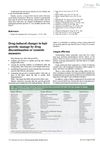
 Some drugs can cause hair loss or growth, but hair usually returns to normal after stopping the drug.
 August 1994 in “Drugs & Therapy Perspectives”
 The document concludes that H2-antagonists and proton pump inhibitors are highly effective for ulcers, eradicating Helicobacter pylori is important to prevent recurrence, and misoprostol helps with NSAID-related ulcers.

Different hair growth phases affect how follicles respond to X-rays, and hormones like testosterone and dihydrotestosterone play a key role in baldness; transplanted hair can grow on bald scalp areas.
January 1989 in “Handbook of experimental pharmacology” Drugs can change hair growth and this is important because it can upset people.
July 2026 in “The Bioscan.” Drug repurposing speeds up drug development and addresses unmet medical needs.
 July 2026 in “International Journal of Drug Delivery Technology”
 New drug delivery systems show promise for better alopecia treatment but need more safety tests and standardization.
 June 2026 in “International Journal of Drug Delivery Technology”
 New drug delivery systems can better target hair follicles to treat hair loss effectively.
 May 2026 in “Drug Delivery and Translational Research”
 Nanocarriers with spironolactone and 2-deoxy-D-ribose may improve hair loss treatment by targeting hair follicles directly.
 April 2026 in “Zenodo (CERN European Organization for Nuclear Research)”
 Hair follicles can be used to deliver drugs effectively, especially with nanoparticles, for treating skin conditions.
 April 2026 in “Clinical Journal of Gastroenterology”
 Upadacitinib can cause hypersensitivity that worsens ulcerative colitis symptoms.

Certain medications, especially nervous system drugs, can cause insomnia, with risks varying by age and gender.
 April 2026 in “Journal of Pharmaceutical and BioTech Industry”
 AI-enhanced smart patches can personalize drug delivery for better treatment outcomes.
April 2026 in “Therapeutic Advances in Drug Safety” Finasteride is high-risk for cognitive disorders, while Carbidopa/Levodopa, Topiramate, and Clonazepam are moderate-risk.
 March 2026 in “Preprints.org”
 DRDE-07 shows promise for treating skin diseases due to its favorable properties.
March 2026 in “Skin Appendage Disorders” Belatacept may be a promising treatment for alopecia areata.
 February 2026 in “Pharmaceuticals”
 KRDQN effectively predicts adverse drug reactions with high accuracy and clear explanations.
 February 2026 in “Frontiers in Bioengineering and Biotechnology”
 Liposome-based systems improve skin wound healing effectively.
 January 2026 in “Frontiers in Pharmacology”
 Certain drugs can cause male infertility, so fertility counseling and sperm preservation are advised.