2 citations
,
May 1989 in “JAMA” Minoxidil can help hair growth but may not always look cosmetically good.
 12 citations
,
November 2011 in “International Journal of Dermatology”
12 citations
,
November 2011 in “International Journal of Dermatology” A woman developed a scalp condition from using minoxidil, which improved with a different treatment but left scarring.
 22 citations
,
July 2006 in “Indian Journal of Pharmaceutical Sciences”
22 citations
,
July 2006 in “Indian Journal of Pharmaceutical Sciences” Minoxidil gels with higher concentrations are more stable and effective for treating hair loss.
April 2022 in “UNESP Institutional Repository (São Paulo State University)” Using both topical minoxidil and oral biotin together significantly boosts hair growth and density.
1 citations
,
July 2024 in “JAAD International” Low-dose oral minoxidil is effective for alopecia even with other medications.
 March 2024 in “Journal of the Dermatology Nurses’ Association”
 Low-dose oral minoxidil is being revisited as a promising hair loss treatment.
 17 citations
,
November 2002 in “Australasian Journal of Dermatology”
17 citations
,
November 2002 in “Australasian Journal of Dermatology” Saw palmetto causes allergic reaction, minoxidil causes skin irritation; use cautiously for hair loss.
 2 citations
,
December 2019 in “Biomedical dermatology”
2 citations
,
December 2019 in “Biomedical dermatology” Minoxidil works faster, but ketoconazole is a safer alternative for female hair loss.

Most dermatologists use and find oral minoxidil effective and tolerable for hair loss treatment.
 4 citations
,
May 2011 in “Current Drug Discovery Technologies”
4 citations
,
May 2011 in “Current Drug Discovery Technologies” A new liposomal system for applying dutasteride to the skin was developed, showing better skin absorption and stability, potentially improving treatment for hair loss.
 17 citations
,
October 2016 in “Artificial Cells Nanomedicine and Biotechnology”
17 citations
,
October 2016 in “Artificial Cells Nanomedicine and Biotechnology” Using tiny fat particles to deliver arginine to hair follicles could be a new way to treat hair loss.
 18 citations
,
January 1997 in “British Journal of Dermatology”
18 citations
,
January 1997 in “British Journal of Dermatology” 5% topical minoxidil can cause severe body hair growth, which disappears after stopping treatment.
March 2023 in “Reactions Weekly”  2 citations
,
April 2008 in “Journal of Dispersion Science and Technology”
2 citations
,
April 2008 in “Journal of Dispersion Science and Technology” Shampoos with more than 0.6% of cationic minoxidil particles can promote hair growth.
 March 2025 in “Archives of Dermatological Research”
 Combining stem cell secretome and minoxidil leads to the best hair growth in androgenetic alopecia.
 March 2023 in “International Journal of Trichology”
 Using both minoxidil and finasteride together is more effective for male hair loss than using either one alone.
 71 citations
,
January 2004 in “Dermatology”
71 citations
,
January 2004 in “Dermatology” Oral finasteride works better than topical minoxidil for hair growth, both are safe.
 28 citations
,
March 1987 in “Journal of The American Academy of Dermatology”
28 citations
,
March 1987 in “Journal of The American Academy of Dermatology” Minoxidil may help hair growth after transplant surgery.
1 citations
,
January 2017 in “Hair therapy & transplantation” Topical zinc-thymulin is safe and effective for treating male pattern baldness.
August 2022 in “DOAJ (DOAJ: Directory of Open Access Journals)” 0.5 mm microneedling with minoxidil effectively and safely treats male hair loss.
 September 1997 in “JEADV. Journal of the European Academy of Dermatology and Venereology/Journal of the European Academy of Dermatology and Venereology”
 The document concludes that treatments like oral anti-androgens, minoxidil, and topical spironolactone can be effective for hair loss in men and women.
2 citations
,
April 2024 in “Journal of Dermatological Science” Necrosulfonamide helps hair grow by blocking a protein linked to hair loss.

Oral minoxidil can be more comfortable and effective than topical, but treatment should be personalized.
 August 2025 in “Indian Dermatology Online Journal”
 Combining minoxidil with phototherapy improves vitiligo treatment better than phototherapy alone.
February 2023 in “Seven Editora eBooks” Oral minoxidil has more side effects but can be more effective than topical minoxidil.
 May 2026 in “Revista Ensaios Pioneiros”
 A topical solution with minoxidil and rosemary oil may help treat hair loss.
May 2025 in “UNESP Institutional Repository (São Paulo State University)” The 5 mg dose of oral minoxidil is not more effective than the 2.5 mg dose for treating male hair loss.
 January 2011 in “Kufa Medical Journal”
 Minoxidil solution applied on skin can effectively promote hair growth and increase hair thickness in male mice.
6 citations
,
December 1989 in “Journal of the American Academy of Dermatology” Minoxidil lotion can cause hair discoloration.
 8 citations
,
July 2007 in “International Journal of Dermatology”
8 citations
,
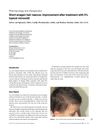
July 2007 in “International Journal of Dermatology” Using 5% topical minoxidil improved and normalized the hair growth in a girl with short anagen hair naevus.