 4 citations
,
May 2025 in “Frontiers in Immunology”
4 citations
,
May 2025 in “Frontiers in Immunology” JAK inhibitors effectively and safely treat alopecia areata with few serious side effects.
 8 citations
,
October 2022 in “Dermatology practical & conceptual”
8 citations
,
October 2022 in “Dermatology practical & conceptual” Tofacitinib and ruxolitinib are effective and safe for treating various autoimmune skin and joint disorders.
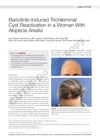
Baricitinib may reactivate trichilemmal cysts in people with a history of these cysts.
 10 citations
,
June 2024 in “American Journal of Clinical Dermatology”
10 citations
,
June 2024 in “American Journal of Clinical Dermatology” Hedgehog pathway inhibitors for advanced basal cell carcinoma can cause side effects, but managing them helps maintain treatment.
 223 citations
,
September 2018 in “Rheumatology”
223 citations
,
September 2018 in “Rheumatology” JAK inhibitors are effective in treating various immune-related diseases, not just rheumatoid arthritis.
 20 citations
,
January 2018 in “Expert opinion on emerging drugs”
20 citations
,
January 2018 in “Expert opinion on emerging drugs” JAK inhibitors may soon be a safe and effective treatment for alopecia areata.
 14 citations
,
November 2016 in “Annals of Internal Medicine”
14 citations
,
November 2016 in “Annals of Internal Medicine” Tofacitinib, an arthritis drug, helped hair growth in alopecia universalis but long-term safety needs more research.
 11 citations
,
January 2013 in “Revista Brasileira De Terapia Intensiva”
11 citations
,
January 2013 in “Revista Brasileira De Terapia Intensiva” Eating pacu-manteiga fish can cause Haff disease, leading to severe muscle damage.
 1 citations
,
October 2023 in “Dermatology and therapy”
1 citations
,
October 2023 in “Dermatology and therapy” Some treatments for severe hair loss work but often have side effects, with baricitinib showing the most promise.
 April 2026 in “Clinical Journal of Gastroenterology”
 Upadacitinib can cause hypersensitivity that worsens ulcerative colitis symptoms.
 November 2024 in “Open Repository of the University of Porto (University of Porto)”
 Pharmacists play a crucial role in safe medication use and interdisciplinary collaboration is key to reducing antimicrobial resistance.
 March 2024 in “Clinical, cosmetic and investigational dermatology”
 Upadacitinib may effectively treat alopecia areata without side effects.
 August 2025 in “Scientific Electronic library online (Sciences Carlos III Health Institute)”
 Tofacitinib can help regrow hair in about 50% of people with moderate-severe alopecia areata.
 July 2026 in “Quality in Sport”
 New treatments for alopecia areata focus on targeted drugs and regenerative therapies, but challenges remain.
74 citations
,
January 2014 in “Journal of Investigative Dermatology” High kallistatin levels in diabetics worsen wound healing by blocking important cell signals.
March 2026 in “Immunological Medicine” Janus kinase inhibitors help some people with severe alopecia areata regrow hair, but not everyone responds, and relapses can happen.
8 citations
,
July 2024 in “Journal of Advanced Research” CDK inhibitors may help treat ARDS and psoriasis but need more testing for safety and effectiveness.
1 citations
,
December 2023 in “Molecules/Molecules online/Molecules annual” JAK inhibitors show promise for treating various skin diseases.
140 citations
,
January 2021 in “Journal of the International Society of Sports Nutrition” Creatine is safe, not a steroid, and boosts muscle and performance without causing kidney damage or hair loss.
4 citations
,
January 2025 in “JAAD reviews.” Janus kinase inhibitors are promising for treating scarring alopecia, but more research is needed for safety and personalized treatments.
 December 2024 in “Journal of the International Society of Sports Nutrition”
 Creatine monohydrate is safe and effective for muscle recovery and performance, especially for those with low creatine levels.
63 citations
,
July 2024 in “Journal of the American Academy of Dermatology” Deuruxolitinib effectively promotes hair regrowth in adults with alopecia areata.
6 citations
,
October 2024 in “Journal of Family Medicine and Primary Care” Primary care doctors need to monitor JAK and TYK-2 inhibitors carefully for skin conditions.
 4 citations
,
January 2023 in “The journal of allergy and clinical immunology/Journal of allergy and clinical immunology/The journal of allergy and clinical immunology”
4 citations
,
January 2023 in “The journal of allergy and clinical immunology/Journal of allergy and clinical immunology/The journal of allergy and clinical immunology” Biologics, especially Dupilumab, are effective and safe for treating severe childhood eczema.
January 2026 in “Medicina” JAK inhibitors show promise for treating various skin disorders effectively and safely.
 June 2026 in “Wiener klinische Wochenschrift”
 New treatments for alopecia areata show promise but need ongoing use and have infection risks.
 May 2021 in “Journal of the Endocrine Society”
 A patient produced cortisol after adrenalectomy, possibly due to residual tissue or other body parts making steroids.
 July 2023 in “IntechOpen eBooks”
 New treatments for alopecia areata show promise, but more research is needed to confirm their effectiveness.
 6 citations
,
May 2023 in “Drugs”
6 citations
,
May 2023 in “Drugs” Baricitinib helps regrow hair in adults with severe alopecia better than a placebo and is approved for treatment, but long-term effects are still unknown.
 January 2023 in “Indian Dermatology Online Journal”
 No single ideal JAK inhibitor for alopecia areata has been determined; JAK3 inhibitors may be promising with fewer side effects.