 4 citations
,
January 2011 in “Current problems in dermatology”
4 citations
,
January 2011 in “Current problems in dermatology” At-home laser and light devices can safely reduce acne and hair growth when used correctly but are less effective than professional treatments.
 15 citations
,
June 2015 in “Lasers in Medical Science”
15 citations
,
June 2015 in “Lasers in Medical Science” The 830-nm wavelength was most effective at promoting hair growth in rats using low-level laser therapy.
675 nm laser therapy effectively improves hair growth in Indian patients with androgenetic alopecia.
 2 citations
,
July 2004 in “Proceedings of SPIE, the International Society for Optical Engineering/Proceedings of SPIE”
2 citations
,
July 2004 in “Proceedings of SPIE, the International Society for Optical Engineering/Proceedings of SPIE” Near-infrared laser therapy with Indocyanine Green dye improves acne by reducing inflammation without side effects.
 4 citations
,
August 2022 in “Lasers in medical science”
4 citations
,
August 2022 in “Lasers in medical science” Both 1565-nm laser and 1064-nm laser safely and effectively reduce enlarged facial pores, with the 1064-nm laser causing fewer side effects.
 1 citations
,
January 2018 in “Journal of Cosmetic and Laser Therapy”
1 citations
,
January 2018 in “Journal of Cosmetic and Laser Therapy” The editorial introduces various topics on laser and cosmetic treatments in a medical journal.
5 citations
,
August 2022 in “Mediators of Inflammation” Combining Pulsed Dye Laser with Pingyangmycin is effective and safe for treating acne scars.
 January 2000 in “Optics Letters”
 Laser treatment can inhibit hair growth and different hair colors reach different temperatures when lasered.
47 citations
,
March 1987 in “The Journal of dermatologic surgery and oncology” Carbon dioxide laser treatment effectively removed facial hair cysts without scarring or them coming back.
 January 2019 in “Springer eBooks”
 PRP and LLLT can improve hair growth in AGA, but more research needed.
4 citations
,
June 2025 in “Journal of Cosmetic Dermatology” The triple-wavelength diode laser effectively and safely reduces hair and improves skin appearance in people with darker skin.
115 citations
,
January 2002 in “American Journal of Clinical Dermatology”  February 2025 in “Journal of Biophotonics”
 Dual-wavelength laser therapy promotes better hair regrowth than single-wavelength treatments.
53 citations
,
October 2012 in “Journal of dermatological treatment” The laser treatment effectively and safely improved melasma in Asian patients.
 December 2020 in “Actas Dermo-Sifiliográficas”
 LLLT increases hair density and growth in AGA patients.
 16 citations
,
November 2016 in “Journal of Cosmetic and Laser Therapy”
16 citations
,
November 2016 in “Journal of Cosmetic and Laser Therapy” Laser and light therapies, especially the 308 nm excimer laser, are effective and safe for treating alopecia areata, but more research is needed.
February 2020 in “Journal of Physics Conference Series” 755 nm laser at 10-15 J/cm² is best for light skin, 4.5-10 J/cm² at 755-1064 nm for dark skin.
 September 2025 in “PubMed”
 Thulium laser therapy is a safe and effective short-term treatment for hair regrowth in androgenic alopecia patients.
14 citations
,
May 2006 in “Clinical obstetrics and gynecology” Laser hair removal shows promising short-term results but isn't yet permanent.
October 2025 in “Dermatologica Sinica” Combining laser therapy with other treatments effectively increases hair density and thickness for hair loss.
 2 citations
,
March 2019 in “Lasers in surgery and medicine”
2 citations
,
March 2019 in “Lasers in surgery and medicine” Higher light doses cause more damage to hair follicles, predicting better hair removal results.
 10 citations
,
July 1997 in “Dermatologic Clinics”
10 citations
,
July 1997 in “Dermatologic Clinics” Laser hair transplantation can be effective but should be limited to small areas and requires more training to ensure safety and effectiveness.
 108 citations
,
December 2003 in “Lasers in surgery and medicine”
108 citations
,
December 2003 in “Lasers in surgery and medicine” ICG-enhanced NIR laser therapy may be a promising acne treatment with improvement and no side effects.
69 citations
,
August 1995 in “Annals of Plastic Surgery” The ultrapulse carbon dioxide laser can effectively resurface skin without scarring.
11 citations
,
January 2022 in “Journal of Healthcare Engineering” The combined treatment is more effective and safer for improving sunken acne scars.
Laser therapy is effective for treating vascular lesions with the right light settings and trained professionals.
2 citations
,
March 2010 in “Cosmetic Dermatology” Laser hair removal uses lasers to target and damage hair follicles to reduce hair growth.
4 citations
,
August 2015 in “JEADV. Journal of the European Academy of Dermatology and Venereology/Journal of the European Academy of Dermatology and Venereology” Both fixed and incremental laser treatments effectively reduced underarm hair, but the fixed method was less painful.
 May 2023 in “Photobiomodulation, photomedicine, and laser surgery”
 The 675 nm laser treatment significantly increased hair density and reduced symptoms of androgenetic alopecia in both men and women, with no side effects.
 11 citations
,
June 2005 in “Journal of Cosmetic Dermatology”
11 citations
,
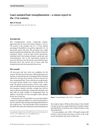
June 2005 in “Journal of Cosmetic Dermatology” Lasers in hair transplantation show promise but are not yet standard, with current methods causing some side effects and needles still being preferred for creating recipient sites.