 118 citations
,
January 2016 in “Current Topics in Developmental Biology”
118 citations
,
January 2016 in “Current Topics in Developmental Biology” The document concludes that while significant progress has been made in understanding skin biology and stem cells, more research is needed to fully understand their interactions with their environment.
 111 citations
,
June 2002 in “The EMBO Journal”
111 citations
,
June 2002 in “The EMBO Journal” Too much Smad7 can cause serious changes in skin tissues, including problems with hair growth, thymus shrinkage, and eye development issues.
 101 citations
,
December 2010 in “The journal of investigative dermatology/Journal of investigative dermatology”
101 citations
,
December 2010 in “The journal of investigative dermatology/Journal of investigative dermatology” Scientists turned mouse stem cells into skin cells that can grow into skin layers and structures.
96 citations
,
September 1996 in “PubMed” Desmocollin 1 and 3 have distinct patterns in human tissues, with Dsc1 in specific skin and hair layers and Dsc3 in various epithelial layers.
94 citations
,
October 1994 in “The Journal of Cell Biology” Too much keratin 16 in mice skin causes abnormal skin thickening and structure.
87 citations
,
September 2016 in “Journal of Controlled Release” Nanoparticles can improve drug delivery to hair follicles but struggle to penetrate deeper skin layers.
 86 citations
,
October 2005 in “Experimental Dermatology”
86 citations
,
October 2005 in “Experimental Dermatology” The Foxn1 gene mutation causes hairlessness and immune system issues, and understanding it could lead to hair growth disorder treatments.
83 citations
,
May 2011 in “European Journal of Dermatology” Corneodesmosin is crucial for skin and hair health, and its dysfunction can cause skin and hair disorders.
83 citations
,
February 1991 in “Development” Fos protein is crucial for cell transition to cornification in keratinized tissues.
 81 citations
,
June 2014 in “Cold Spring Harbor perspectives in medicine”
81 citations
,
June 2014 in “Cold Spring Harbor perspectives in medicine” Skin has specialized touch receptors that can tell different sensations apart.
 76 citations
,
May 2011 in “Cell death and differentiation”
76 citations
,
May 2011 in “Cell death and differentiation” A20 protein is crucial for normal skin and hair development.
67 citations
,
September 2017 in “Cell Reports” Caloric restriction improves skin and fur structure but can cause muscle loss and movement issues.
64 citations
,
April 2005 in “Journal of Investigative Dermatology” Topical oligonucleotide therapy targets hair follicles effectively.
64 citations
,
April 1992 in “Differentiation” Sciellin is a protein that helps form protective layers in skin, hair, and nails.
 62 citations
,
October 2010 in “Journal of biomedical nanotechnology”
62 citations
,
October 2010 in “Journal of biomedical nanotechnology” Nanoparticles can enter the skin, potentially causing toxicity, especially in damaged skin.
 62 citations
,
July 1993 in “Journal of Investigative Dermatology”
62 citations
,
July 1993 in “Journal of Investigative Dermatology” Hair growth is influenced by interactions between skin layers, growth factors, and hormones, but the exact mechanisms are not fully understood.
61 citations
,
March 1966 in “Archives of Dermatology” Nevoid basal cell carcinomas start in the skin and hair follicles.
60 citations
,
August 1969 in “British Journal of Dermatology” Germicides mostly stay on the skin's surface, but some penetrate deeper depending on the product used.
 57 citations
,
May 2007 in “Nature”
57 citations
,
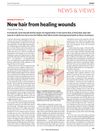
May 2007 in “Nature” Adult mice can grow new hair from skin wounds.
 57 citations
,
February 1994 in “Experimental dermatology”
57 citations
,
February 1994 in “Experimental dermatology” Melatonin affects mouse skin and may regulate skin functions.
 57 citations
,
November 1987 in “Pediatric Dermatology”
57 citations
,
November 1987 in “Pediatric Dermatology” Children's hair grows in different types from before birth through puberty, with growth rates and characteristics varying by age, sex, and race.
57 citations
,
January 1987 in “Journal of Biological Chemistry” Different keratins have unique expression patterns in mouse skin cells.
 55 citations
,
December 2014 in “Dermatologica sinica/Zhōnghuá pífūkē yīxué zázhì”
55 citations
,
December 2014 in “Dermatologica sinica/Zhōnghuá pífūkē yīxué zázhì” Keratinocytes control how melanocytes work.
52 citations
,
March 2015 in “Tissue Engineering Part C Methods” 3D images of skin show collagen is evenly spread, but elastic fibers are fewer near hair follicles.
 50 citations
,
September 2014 in “Stem cell reports”
50 citations
,
September 2014 in “Stem cell reports” BLIMP1 is essential for skin maintenance but not for defining sebaceous gland progenitors.
49 citations
,
May 2021 in “Medicine” Understanding skin, hair, and nails is crucial due to their complexity and impact on health.
49 citations
,
April 2006 in “Journal of Investigative Dermatology” TRPV1 helps regulate hair growth cycles.
48 citations
,
March 1993 in “The Laryngoscope” Cholesteatoma shows abnormal and increased EGF receptor expression, indicating its rapid growth.
 47 citations
,
November 2012 in “Pharmaceutical research”
47 citations
,
November 2012 in “Pharmaceutical research” Surface-modified nanoparticles mainly use non-follicular pathways to enhance skin permeation of ibuprofen and could improve treatment for inflammatory skin diseases.
 46 citations
,
December 2010 in “The journal of investigative dermatology/Journal of investigative dermatology”
46 citations
,
December 2010 in “The journal of investigative dermatology/Journal of investigative dermatology” Disrupting Acvr1b in mice causes severe hair loss and thicker skin.