 81 citations
,
August 2014 in “Lasers in Surgery and Medicine”
81 citations
,
August 2014 in “Lasers in Surgery and Medicine” Red light therapy is safe and effectively increases hair growth in women with hair loss.
11 citations
,
January 2013 in “Veterinary dermatology” Keratinocytes from dog hair follicles can create a functional skin layer in a lab model, useful for dog skin therapy.
16 citations
,
December 2022 in “Expert Opinion on Drug Delivery” AFL is safe and effective for topical drug delivery but needs larger studies and cheaper devices for wider use.
 1 citations
,
March 2019 in “Lasers in Surgery and Medicine”
1 citations
,
March 2019 in “Lasers in Surgery and Medicine” The conference reported improvements in muscle volume, skin cancer diagnosis, facial and vaginal rejuvenation, and hair growth using various laser treatments.
 1 citations
,
January 2018 in “Journal of Cosmetic and Laser Therapy”
1 citations
,
January 2018 in “Journal of Cosmetic and Laser Therapy” The editorial introduces various topics on laser and cosmetic treatments in a medical journal.
1 citations
,
January 2016 PRP is a promising non-surgical option for skin and hair rejuvenation.
 April 2018 in “Journal of Investigative Dermatology”
 IL-17C is important in inflammatory skin diseases and could be a target for treatment.
 April 2018 in “Journal of Investigative Dermatology”
 Cutaneous lupus patients have higher levels of certain immune cells in their blood and skin.
 4 citations
,
September 2019 in “Journal of The American Academy of Dermatology”
4 citations
,
September 2019 in “Journal of The American Academy of Dermatology” Platelet-rich plasma combined with other treatments improves acne scars better than those treatments alone.
 April 2018 in “Journal of Cosmetic and Laser Therapy”
 The editorial introduces studies on various cosmetic and laser treatments, their effectiveness, and posttreatment care.
 2 citations
,
June 2022 in “Cosmoderma”
2 citations
,
June 2022 in “Cosmoderma” Regenerative medicine shows promise for improving hair and skin but needs more research for standard use.
 December 2024 in “Anti-Aging Eastern Europe”
 PRP is effective for skin rejuvenation, hair restoration, and acne scar treatment.
1 citations
,
April 2023 in “The Egyptian Journal of Hospital Medicine” Microneedling with PRP effectively improves atrophic acne scars.
 178 citations
,
August 2016 in “Advances in wound care”
178 citations
,
August 2016 in “Advances in wound care” New effective scar treatments are urgently needed due to the current options' limited success.
Tailored nonsurgical cosmetic procedures are crucial for safely treating diverse skin types, especially skin of color.
 April 2021 in “Journal of Cosmetic Dermatology”
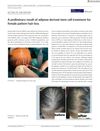
 Stem cell treatment improved hair density in female hair loss patient.
 July 2025 in “The Egyptian Journal of Hospital Medicine”
 Preparing scars with PRP or CO₂ laser improves hair transplant success.
 1 citations
,
April 2018 in “Lasers in Surgery and Medicine”
1 citations
,
April 2018 in “Lasers in Surgery and Medicine” New treatments and technologies in laser medicine show promise for improving skin conditions, fat reduction, cancer treatment, wound healing, and hair restoration.
5 citations
,
August 2022 in “Mediators of Inflammation” Combining Pulsed Dye Laser with Pingyangmycin is effective and safe for treating acne scars.
 31 citations
,
May 2019 in “Nature communications”
31 citations
,
May 2019 in “Nature communications” Single Blimp1+ cells can create functional sebaceous gland organoids in the lab.
 January 2025 in “Medicina”
 Advanced techniques and technologies can improve burn wound healing, but more research is needed.
 January 2024 in “Journal of Tissue Engineering”
 A new ethical skin model using stem cells offers a reliable alternative for dermatological research.
 January 2026 in “Physical Education Health and Social Sciences”
 Combining probiotics, clotrimazole gel, and laser therapy improves treatment for recurrent yeast infections.
 June 2023 in “Dermatology and Therapy”
 Using fractional CO2 laser with halometasone cream works better for chronic hand eczema than just the cream, improving symptoms and quality of life with fewer relapses.
 27 citations
,
August 2014 in “Journal of Cosmetic and Laser Therapy”
27 citations
,
August 2014 in “Journal of Cosmetic and Laser Therapy” Different lasers and radiofrequency affect skin differently, important for dermatologists to choose the right treatment.
 January 2021 in “Dermatologic Therapy”
 Channels stay open for 24 hours, making laser treatment potentially effective for hair loss.
January 2025 in “Dermatologic Therapy” Combining fractional CO2 laser with type III collagen improves acne scar treatment.
October 2022 in “Dermatologic Therapy” Both treatments for resistant alopecia areata were equally effective.
August 2022 in “Dermatologic Therapy”  1 citations
,
June 2024 in “International Journal of Clinical & Experimental Dermatology”
1 citations
,
June 2024 in “International Journal of Clinical & Experimental Dermatology” Surgery can help treat vitiligo when other treatments don't work.