 January 2023 in “Skin appendage disorders”
 Two Hispanic women developed Plica neuropathica, a condition causing tangled hair, possibly due to hair damage and various risk factors.
53 citations
,
June 2019 in “JEADV. Journal of the European Academy of Dermatology and Venereology/Journal of the European Academy of Dermatology and Venereology” Frontal fibrosing alopecia mainly affects postmenopausal women and may be linked to thyroid hormones.
2 citations
,
January 2017 Hair movement can indicate hair quality and health.
8 citations
,
July 2020 in “Clinical, cosmetic and investigational dermatology” Excessive sun protection might cause frontal fibrosing alopecia by disrupting skin immune balance.
July 2025 in “International Journal of Trichology” A 6-year-old boy's leg hair loss was due to friction from sitting cross-legged, and it usually resolves on its own.
 January 2025 in “Indian Journal of Dermatology”
 Frontal fibrosing alopecia is a challenging hair loss condition with no known cause or definitive treatment.
 January 2018 in “Jaypee Brothers Medical Publishers (P) Ltd. eBooks”
 Telogen effluvium is a condition that causes temporary hair loss due to stress or shock to the body.
 January 2014 in “Jaypee Brothers Medical Publishers (P) Ltd. eBooks”
 Telogen effluvium is a condition that causes temporary hair loss due to stress or shock to the body.
 January 1998 in “Jaypee Brothers Medical Publishers (P) Ltd. eBooks”
 Telogen effluvium is a condition that causes temporary hair loss due to stress or shock to the body.
 61 citations
,
January 2019 in “American Journal of Clinical Dermatology”
61 citations
,
January 2019 in “American Journal of Clinical Dermatology” The cause of Frontal Fibrosing Alopecia is unclear, diagnosis involves clinical evaluation and various treatments exist, but their effectiveness is uncertain.
 December 2023 in “Journal of molecular structure”
 Hair treatments and dehydration affect hair's lipid and protein behavior, influencing its flexibility and appearance.
 1 citations
,
December 2020 in “Medicinskij alfavit”
1 citations
,
December 2020 in “Medicinskij alfavit” Telogen effluvium is a condition that causes temporary hair loss.
 68 citations
,
May 2016 in “Experimental dermatology”
68 citations
,
May 2016 in “Experimental dermatology” FFA's causes may include environmental triggers and genetic factors.
 2 citations
,
January 2017 in “Przegla̧d dermatologiczny”
2 citations
,
January 2017 in “Przegla̧d dermatologiczny” Two trichoscopic patterns found in hair loss: diffuse fibrotic and androgenetic alopecia, affecting treatment choice and regrowth chances.
2 citations
,
July 2013 in “Acervo Digital da Universidade Estadual Paulista (Universidade Estadual Paulista)” The shampoo effectively defines and models curls while reducing frizz and volume.
 6 citations
,
January 2017 in “British Journal of Dermatology”
6 citations
,
January 2017 in “British Journal of Dermatology” Frontal fibrosing alopecia is a scarring hair loss condition mainly affecting older women, with no known cause and treatments that may help stabilize hair loss.
 July 2018 in “Elsevier eBooks”
 Frontal Fibrosing Alopecia is a type of hair loss affecting mostly older women, with no agreed best treatment.
 March 2005 in “International Journal of Cosmetic Science”
 A new method helps understand hair shine and various products improve hair care.
 October 2020 in “International Journal of Research in Dermatology”
 The review suggests more research is needed to understand Frontal fibrosing alopecia, a condition causing hairline recession in postmenopausal women.
 12 citations
,
November 1987 in “Pediatric dermatology”
12 citations
,
November 1987 in “Pediatric dermatology” Four children had unmanageable pale blond hair due to uncombable-hair syndrome.
1 citations
,
September 2024 in “Veterinary Dermatology” Trichography is important for diagnosing hair fragility in Pomeranian dogs with hair cycle issues.
 May 2015 in “Journal of The American Academy of Dermatology”
 A woman with Parry-Romberg syndrome developed new curly hair on one side of her scalp, a condition not previously linked to the syndrome.
 March 2003 in “CRC Press eBooks”
 Telogen effluvium is hair loss caused by many hairs stopping growth suddenly, often due to stress or illness, but sometimes it's normal and not due to disease.
 November 2023 in “The journal of investigative dermatology/Journal of investigative dermatology”
 Early treatment and multidisciplinary care are key to managing Frontal Fibrosing Alopecia and preventing further hair loss.
1 citations
,
January 2015 in “Bulletin of the Russian Academy of Sciences Physics” Hair tissue can help monitor environmental and public health risks.
 23 citations
,
November 2018 in “Journal of the European Academy of Dermatology and Venereology”
23 citations
,
November 2018 in “Journal of the European Academy of Dermatology and Venereology” The study concluded that severity of Frontal fibrosing alopecia is not linked to how long someone has it, can start before menopause, and eyebrow loss may be an early sign.
Hair dysplasias involve various hair disorders causing fragility, breakage, and poor hair adhesion.
 July 2024 in “Journal Archives of Health”
 Woolly hair is a rare genetic condition with no effective treatments.
2 citations
,
July 2019 in “Cosmetics” Beautiful hair is flexible and elastic due to its unique double-layered structure and can be enhanced with succinic acid treatment.
 8 citations
,
February 2005 in “British Journal of Haematology”
8 citations
,
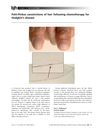
February 2005 in “British Journal of Haematology” Chemotherapy caused the patient's hair to have alternating thick and thin segments.