 1 citations
,
January 2024 in “Scientific reports (Nature Publishing Group)”
1 citations
,
January 2024 in “Scientific reports (Nature Publishing Group)” Human hair was used to make biodegradable plastic films that could be useful for packaging and disposable products.
 1 citations
,
December 2018 in “IntechOpen eBooks”
1 citations
,
December 2018 in “IntechOpen eBooks” Human hair shows promise for non-invasive medical testing, but more research is needed to standardize its use.
 June 2023 in “GSC Advanced Research and Reviews”
 Hutchinson-Gilford Progeria Syndrome causes rapid aging from a genetic mutation, with no cure but ongoing research into potential treatments.
 June 2026 in “Zenodo (CERN European Organization for Nuclear Research)”
 The herbal antidandruff shampoo effectively fights dandruff and improves scalp health.
 May 2026 in “Zenodo (CERN European Organization for Nuclear Research)”
 The serum with microneedling effectively treats alopecia areata by enhancing drug delivery and is safe and patient-friendly.

Optimized liposomes can improve drug delivery and effectiveness.
December 2025 in “Biopolymers” Heat worsens damage in chemically treated hair, especially bleached and straightened hair.

A natural, eco-friendly treatment using casein and tannic acid strengthens hair by 21% while keeping it elastic.
 September 2024 in “Journal of Cosmetic Dermatology”
 Quercetin-loaded nanoparticles protect human hair from UV-B damage.
 September 2024 in “Heliyon”
 Repeated hair dyeing significantly damages hair.
 August 2024 in “Cosmetics”
 K18® and Olaplex® both effectively repair bleached hair, improving its strength, smoothness, and overall health.
July 2023 in “International Journal of Molecular Biology and Biochemistry” The hair oil made with Arnica montana, castor, and mustard oils is effective.
 December 2022 in “theses.fr (ABES)”
 Microplastics in the Lebanese Mediterranean carry harmful pollutants, posing environmental and health risks.
January 2016 in “Belarusian State Pedagogical University repository (Belarusian State Pedagogical University)” A 6-group geometric classification of human scalp hair is more reliable and objective for testing than an 8-group system.
10 citations
,
June 2019 in “International Journal of Pharmaceutics” Hair removal methods damage the skin barrier and affect substance penetration.
6 citations
,
August 2022 in “Molecules” A hair test shows promise for early mood disorder diagnosis.
 January 2025 in “The Analyst”
 Calcium oxalate was found in human hair and could help detect certain health conditions.
February 2022 in “Fibers” Scientists created a non-toxic, sugar-based hair product that can style hair without damage.
 April 2018 in “Journal of Investigative Dermatology”
 Resveratrol activates the Nrf2 pathway in human skin, significantly increasing the production and distribution of the antioxidant glutathione.
 7 citations
,
April 2018 in “Cosmetics”
7 citations
,
April 2018 in “Cosmetics” Lipids in Japanese hair help maintain glossiness and structure.
1 citations
,
July 2024 in “International Journal of Cosmetic Science” Infrared techniques reveal glycogen, unsaturated lipids, and calcium compounds in hair.
65 citations
,
April 2007 in “Chemistry and Physics of Lipids” Steroid hormones change the size, charge, and stability of DPPC liposomes.
29 citations
,
August 2011 in “PubMed” Polymeric pretreatments can significantly reduce hair breakage and damage from hot flat irons.
 4 citations
,
August 2018 in “International Journal of Current Microbiology and Applied Sciences”
4 citations
,
August 2018 in “International Journal of Current Microbiology and Applied Sciences” Eclipta prostrata leaves contain various compounds with medicinal properties.
 2 citations
,
October 2021 in “Egyptian Journal of Chemistry”
2 citations
,
October 2021 in “Egyptian Journal of Chemistry” Iron nanoparticles made from pumpkin extract effectively treated burns and promoted healing in mice.
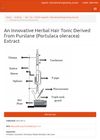
Portulaca-based hair tonics are promising eco-friendly and effective cosmetic alternatives.
October 2024 in “UNESP Institutional Repository (São Paulo State University)” Straightening and dyeing damage hair structure.
December 2014 in “CVR Journal of Science & Technology” Bhringaraj plant may help in wastewater treatment and improving drinking water quality.
69 citations
,
January 2009 in “Advances in Materials Science and Engineering” Wool keratin is reactive, biocompatible, biodegradable, and can model keratin from other sources.
28 citations
,
January 2019 in “IRAQI JOURNAL OF AGRICULTURAL SCIENCES” Silica nanoparticles made with cold plasma method best stop bacteria growth.