83 citations
,
November 2006 in “European Journal of Neuroscience” Progesterone protects rat brain cells by enhancing GABA A receptor activity.
 December 2021 in “Research Square (Research Square)”
 S100A4 and NMIIA promote tumor growth in glioblastoma by enhancing blood vessel functions.
 37 citations
,
March 2006 in “Regulatory Peptides”
37 citations
,
March 2006 in “Regulatory Peptides” Mice skin has components that could help with hair growth and might be used for diabetes treatment.
May 2023 in “The Journal of Immunology” Alopecia areata involves unique activation of certain immune cells.
 April 2023 in “The journal of investigative dermatology/Journal of investigative dermatology”
 EGFR deficiency causes significant changes in skin cells and hair follicles.
 8 citations
,
December 2017 in “Journal of The American Academy of Dermatology”
8 citations
,
December 2017 in “Journal of The American Academy of Dermatology” The authors updated the criteria for diagnosing frontal fibrosing alopecia, making it easier to diagnose without a biopsy.
Frontal Fibrosing Alopecia mainly affects postmenopausal women and is linked to thyroid disease, hyperlipidemia, and anemia.
 31 citations
,
November 2014 in “Investigative Ophthalmology & Visual Science”
31 citations
,
November 2014 in “Investigative Ophthalmology & Visual Science” A natural steroid in the body may protect against eye damage in glaucoma.
 6 citations
,
June 2016 in “Experimental Dermatology”
6 citations
,
June 2016 in “Experimental Dermatology” Frontal Fibrosing Alopecia is a poorly understood condition that is hard to treat and causes distressing hair loss.
9 citations
,
October 2020 in “bioRxiv (Cold Spring Harbor Laboratory)” Microglia are essential for zebrafish brain repair by controlling inflammation.
January 2019 in “DSpace@MIT (Massachusetts Institute of Technology)” Higher PHGDH levels cause unusual melanin buildup in hair follicles.
 June 2025 in “Dermatologic Surgery”
 GFC improves hair quickly, while PRP offers longer-lasting benefits; using both sequentially is recommended.
 October 2024 in “Archives of Dermatological Research”
 Higher GPER-1 levels are linked to more severe and shorter-duration androgenetic alopecia, suggesting GPER-1 as a potential treatment target.
1 citations
,
November 1975 in “PubMed” GRF is not safe for tubal occlusion.
1 citations
,
October 2025 in “Journal of Investigative Dermatology” Delgocitinib cream may help treat frontal fibrosing alopecia.
July 2024 in “Journal of Investigative Dermatology” Certain substances can help skin cells become anti-inflammatory, aiding in tissue repair.
 April 2023 in “The journal of investigative dermatology/Journal of investigative dermatology”
 The research identified unique metabolic activities in immune cells associated with hair loss in Alopecia Areata.
 39 citations
,
March 2008 in “Journal of biological chemistry/The Journal of biological chemistry”
39 citations
,
March 2008 in “Journal of biological chemistry/The Journal of biological chemistry” GLI2 increases follistatin production in human skin cells.
94 citations
,
March 1996 in “Journal of Investigative Dermatology” TGF-β1 and 2 in hair follicles may be linked to hair loss in AGA.
 2 citations
,
January 2017 in “Przegla̧d dermatologiczny”
2 citations
,
January 2017 in “Przegla̧d dermatologiczny” Two trichoscopic patterns found in hair loss: diffuse fibrotic and androgenetic alopecia, affecting treatment choice and regrowth chances.
 11 citations
,
April 2013 in “Journal of Proteomics”
11 citations
,
April 2013 in “Journal of Proteomics” Found different proteins in balding and non-balding cells, giving insight into hair loss causes.
69 citations
,
October 2014 in “Stem Cells” PDGF-D boosts stem cell growth and movement, enhancing hair regeneration.
 154 citations
,
November 2017 in “Development”
154 citations
,
November 2017 in “Development” Fibroblast Growth Factors (FGFs) are important for tissue repair and regeneration, influencing cell behavior and other factors involved in healing, and are crucial in processes like wound healing, bone repair, and hair growth.
September 2004 in “Experimental Dermatology” Stress increases nerve growth factor, causing hair loss in mice.
2 citations
,
March 2025 in “Cancer Gene Therapy” Targeting Sirt1 can reduce androgen levels and slow glioblastoma growth.
August 2025 in “BMC Pharmacology and Toxicology” The LTF gene may help predict and manage nonspecific orbital inflammation.
May 2022 in “Journal of Cosmetic Dermatology” CGF treatment effectively and safely improves hair loss in androgenic alopecia patients.
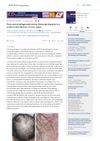 March 2023 in “Journal of Cosmetic Dermatology”
 A woman's progressive hair loss was correctly diagnosed as a rare condition called fibrosing alopecia in a pattern distribution after initially being mistaken for a more common type.
2 citations
,
October 2001 in “Mycoses” A cat had a rare fungal infection caused by Microsporum gypseum.