28 citations
,
March 2011 in “Journal of Investigative Dermatology” Hair follicles help guide nerve growth, improving touch recovery in skin grafts.
 November 2023 in “Pakistan Journal of Medical & Health Sciences”
 Careful technique and planning lead to successful, natural-looking eyebrow transplants.
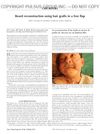 January 2011 in “Plastic Surgery”
 Hair grafts successfully restored a realistic beard and hid scars, satisfying the patient.
39 citations
,
January 2020 in “Frontiers in Genetics” PDGFC gene may help select goats with desirable curly wool traits.
 June 2023 in “JAAD case reports”
 A rare scalp condition, cutis verticis gyrata, was found in a woman with primary scarring alopecia.
 1 citations
,
March 2024 in “Skin research and technology”
1 citations
,
March 2024 in “Skin research and technology” A new AI model diagnoses hair and scalp disorders with 92% accuracy, better than previous models.
1 citations
,
June 1999 in “The American Journal of Cosmetic Surgery” The simplified eyebrow transplant technique is safe, effective, and looks natural.
8 citations
,
November 2024 in “Journal of Cosmetic Dermatology” Injections are effective and safe for rejuvenating neck, chest, and hands.
16 citations
,
December 2021 in “Journal of Integrative Neuroscience” miR-325-3p can slow down brain tumor growth by targeting FOXM1.
 1 citations
,
December 2024 in “Qeios”
1 citations
,
December 2024 in “Qeios” Hair loss affects attractiveness but can suggest intelligence, and face perception is complex, involving factors like age and smile.
GPC1 is important for blood vessel growth in hair follicles and could help treat hair loss.
2 citations
,
May 2018 in “Dermatologic Surgery” 
Type II spiral ganglion neurites avoid high concentrations of laminin and fibronectin.
January 1990 in “대한피부과학회지” Peanut agglutinin staining helps differentiate malignant melanoma from nevocellular nevus.
 January 2008 in “Journal of Clinical Dermatology”
 Integrin alpha-6 and p63 proteins may play a role in hair loss and are important for hair growth and maintenance.
 4 citations
,
January 2004 in “Biological and Pharmaceutical Bulletin”
4 citations
,
January 2004 in “Biological and Pharmaceutical Bulletin” AgK114 protein helps in hamster skin injury recovery.
2 citations
,
June 2023 in “Clinical and Experimental Neuroimmunology” Thymoma may link myasthenia gravis, nail dystrophy, and alopecia areata.
30 citations
,
August 2008 in “The journal of investigative dermatology/Journal of investigative dermatology” TGase 3 helps build hair structure by forming strong bonds between proteins.
 September 2023 in “Journal of the European Academy of Dermatology and Venereology”
 The Gabrin sign may help identify COVID-19 patients at high risk who also have hair loss due to male hormones.
 1 citations
,
February 2014 in “Hair therapy & transplantation”
1 citations
,
February 2014 in “Hair therapy & transplantation” A baby boy had two types of temporary hair loss at birth, which might be two forms of newborn hair loss combined.
 11 citations
,
May 1998 in “Child's nervous system”
11 citations
,
May 1998 in “Child's nervous system” A baby had a rare condition with abnormal blood vessels in the brain and unusual skin and hair growth, possibly a new syndrome.
December 2025 in “Zenodo (CERN European Organization for Nuclear Research)” Microneedling may help eyebrow hair growth, but more research is needed.
September 2023 in “Journal of the American Academy of Dermatology” Current guidelines may overlook beard and sideburn involvement in diagnosing frontal fibrosing alopecia in men.
 5 citations
,
November 2012 in “Actas Dermo-Sifiliográficas”
5 citations
,
November 2012 in “Actas Dermo-Sifiliográficas” Comma hairs are a new sign for identifying scalp fungal infections.
3 citations
,
September 2008 in “Current signal transduction therapy” Drugs that block GSK-3 show promise for treating various diseases.
7 citations
,
December 1991 in “Annals of the New York Academy of Sciences” Dermal papillae are crucial for hair growth and maintenance.
April 2023 in “Journal of Investigative Dermatology” TGFβ-2 may cause hair loss in androgenetic alopecia.
4 citations
,
July 2020 in “Journal of proteomics” Hair protein composition is similar across different races and shapes.
1 citations
,
September 2023 in “World Journal of Clinical Cases” Eyebrow intradermal nevi were effectively removed with shearing, electrocautery, and curettage, leaving no scars or recurrence.
 14 citations
,
January 2006 in “Australasian journal of dermatology”
14 citations
,
January 2006 in “Australasian journal of dermatology” Alopecia areata can look like frontal fibrosing alopecia, making diagnosis hard.