 10 citations
,
March 2015 in “Journal of dermatology”
10 citations
,
March 2015 in “Journal of dermatology” The boy's severe skin disorder is caused by two new mutations in his TGM1 gene.
103 citations
,
February 1972 in “Proceedings of the National Academy of Sciences” A unique enzyme in guinea pig hair follicles helps form protein cross-links in hair.
288 citations
,
January 2001 in “Journal of Biological Chemistry” Tgm2 helps stabilize dying cells and aids fibroblast attachment to the extracellular matrix.
November 2024 in “Journal of Investigative Dermatology” Dermal IgA deposition without symptoms is rare in Dermatitis herpetiformis risk groups.
 July 2022 in “The journal of investigative dermatology/Journal of investigative dermatology”
 A patient with a PLEC mutation has epidermolysis bullosa, muscular dystrophy, and myasthenia gravis, which improved with steroid treatment.
April 2009 in “The FASEB Journal” Keratin biomaterials from human hair help nerve regeneration by activating Schwann cells.
 April 2017 in “Journal of Investigative Dermatology”
 Certain mutations in the KLHL24 gene cause a skin disorder by breaking down an important skin protein.
 January 2026 in “Frontiers in Medicine”
 PP-PTKL may help treat hair greying, but more testing is needed.
118 citations
,
June 1993 in “Journal of Biological Chemistry” Human and mouse TGase3 enzymes are similar but differ near the activation site, crucial for their function in skin and hair development.
Poly-L-lactic acid injections can cause hair loss and skin issues.
12 citations
,
May 2021 in “The journal of investigative dermatology/Journal of investigative dermatology” Laminin 332 is essential for normal skin cell behavior and structure.
 59 citations
,
August 2021 in “Frontiers in Endocrinology”
59 citations
,
August 2021 in “Frontiers in Endocrinology” GLP-1 receptor agonists, like Dulaglutide, Liraglutide, and Semaglutide, have potential benefits beyond the pancreas, including neuroprotection, pain suppression, cardiovascular protection, obesity management, and cancer treatment, but there are concerns about pancreatitis and pancreatic cancer risks.
2 citations
,
June 2013 in “Journal of Clinical Pathology” The LMNA mutation affects skin structure even in asymptomatic carriers.
 July 2026 in “Journal of the American Academy of Dermatology”
 GLP-1 and GLP-1/GIP agonists may increase the risk of hair loss.
 1 citations
,
November 2024 in “Cutis”
1 citations
,
November 2024 in “Cutis” PLLA injections can cause hair loss and skin issues.
 October 2023 in “International Journal of Science and Research (IJSR)”
 Early diagnosis of GLPLS is crucial to prevent complications, but scarring alopecia is irreversible.
 April 2026 in “Open MIND”
 GLP-1 medications can cause skin and muscle issues, but treatments like ultrasound and PRP can help.
 16 citations
,
January 2021 in “International Journal of Medical Sciences”
16 citations
,
January 2021 in “International Journal of Medical Sciences” Injectable gelatin microspheres with platelet-rich plasma speed up wound healing.
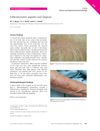 May 2014 in “Clinical and Experimental Dermatology”
 A 70-year-old woman with a rare skin condition improved after treatment with topical steroids and acitretin.
September 2020 in “Research Square (Research Square)” Enhanced stem cells from the placenta can reduce fat buildup in eye tissue for Graves' disease.
6 citations
,
December 2023 in “Journal of Molecular Cell Biology” Removing Gsdma1/2/3 genes reduces skin cell overgrowth by blocking a specific cell pathway.

PlacMA hydrogels from human placenta are versatile and useful for cell culture and tissue engineering.
April 2016 in “The journal of investigative dermatology/Journal of investigative dermatology” Laminin-511 is involved in psoriasis development and can be regulated by cannabinoid receptor type 1.
64 citations
,
April 1992 in “Differentiation” Sciellin is a protein that helps form protective layers in skin, hair, and nails.
March 2026 in “ACS Applied Materials & Interfaces” MCP@G improves diabetic wound healing by reducing stress and promoting tissue repair.
4 citations
,
April 2012 in “The journal of investigative dermatology/Journal of investigative dermatology” Krt16-deficient mice help understand skin disorders like PC and FNEPPK.
A rash from semaglutide may be due to propylene glycol, not the drug itself.
3 citations
,
March 2013 in “Journal of the Society of Cosmetic Scientists of Korea” Transglutaminase can repair damaged hair, making it stronger and shinier.
32 citations
,
August 1982 in “Journal of the American Academy of Dermatology” GLPLS and LPP are variants of lichen planus.
 3 citations
,
January 2021 in “ScienceAsia”
3 citations
,
January 2021 in “ScienceAsia” Using an enzyme and keratin treatment can significantly repair and strengthen damaged hair.