 January 2007 in “Sen'i Gakkaishi”
 Mf-rich hair degrades more than Ma-rich hair, especially with Proteinase K.
 October 2001 in “Dermatologic Surgery”
 Cutting and implanting hair follicles can create finer, more natural-looking hairlines, with about half of the implanted hairs growing back.

Single-born goats produce more and finer cashmere than twin-born goats.
 2 citations
,
January 2013
2 citations
,
January 2013 Hair can help solve crimes by revealing personal and chemical information.
20 citations
,
December 2012 in “Journal of molecular structure” The study found that thioglycolic acid breaks down hair bonds more consistently than l-cysteine, which is less damaging to hair.
 2 citations
,
February 2016 in “Journal of sol-gel science and technology”
2 citations
,
February 2016 in “Journal of sol-gel science and technology” A small molecule can strengthen fine hair, making it more resistant and natural-feeling.
 21 citations
,
July 2005 in “European Journal of Emergency Medicine”
21 citations
,
July 2005 in “European Journal of Emergency Medicine” Hair-tourniquet syndrome can cause serious toe injuries in infants but can be treated if found early.
 4 citations
,
March 2020 in “Scientific Reports”
4 citations
,
March 2020 in “Scientific Reports” Scientists created a colored thread-like material containing a common hair loss treatment, which slowly releases the treatment over time, potentially offering an effective, neat, and visually appealing solution for hair loss.
 January 2014 in “Journal of Pigmentary Disorders”
 Women's hair gets thinner and grayer as they age, with treatments available for hair loss and graying.
 30 citations
,
May 2018 in “Experimental Dermatology”
30 citations
,
May 2018 in “Experimental Dermatology” The conclusion is that future hair loss treatments should target the root causes of hair thinning, not just promote hair growth.
 12 citations
,
February 2006 in “Lipids”
12 citations
,
February 2006 in “Lipids” Hair texture changes with age due to varying levels of lipids.
 3 citations
,
February 2009 in “Chinese Journal of Traumatology (english Edition)”
3 citations
,
February 2009 in “Chinese Journal of Traumatology (english Edition)” Human hair cells can be used to grow new hair on rat ears, suggesting a possible treatment for hair loss.
 191 citations
,
November 1959 in “Annals of the New York Academy of Sciences”
191 citations
,
November 1959 in “Annals of the New York Academy of Sciences” Hair and wool have complex microscopic structures with microfibrils and varying cystine content.
 11 citations
,
August 2017 in “American Journal of Dermatopathology”
11 citations
,
August 2017 in “American Journal of Dermatopathology” EVG staining helps tell apart follicular scars from follicular streamers, aiding in diagnosing different types of hair loss.
 40 citations
,
December 2011 in “British Journal of Dermatology”
40 citations
,
December 2011 in “British Journal of Dermatology” Women's hair generally gets thinner and less dense starting in their mid-thirties, with hair loss becoming more common as they age due to both genetics and environment.
 20 citations
,
May 2020 in “Experimental Dermatology”
20 citations
,
May 2020 in “Experimental Dermatology” Aging scalp skin contributes to hair aging and loss, and more research is needed to develop better hair loss treatments.
 48 citations
,
July 1993 in “The journal of investigative dermatology/Journal of investigative dermatology”
48 citations
,
July 1993 in “The journal of investigative dermatology/Journal of investigative dermatology” Hair growth is controlled by specific gene clusters and proteins, and cysteine affects hair gene expression in sheep.
 42 citations
,
April 2008 in “Acta materialia”
42 citations
,
April 2008 in “Acta materialia” Different ethnicities and treatments affect human hair strength and structure.
 20 citations
,
September 2018 in “Journal of colloid and interface science”
20 citations
,
September 2018 in “Journal of colloid and interface science” Modified keratin binds better to hair, especially bleached hair.
 19 citations
,
May 2016 in “Clinical, cosmetic and investigational dermatology”
19 citations
,
May 2016 in “Clinical, cosmetic and investigational dermatology” FGF-2&D/P nanoparticles can help treat hair loss.
 April 2025 in “Ukrainian Journal of Veterinary and Agricultural Sciences”
 Adding a water-soluble fatty acid complex to sheep diets improves wool growth by increasing primary hair follicle size and density.
 January 2017 in “Clinical approaches and procedures in cosmetic dermatology”
 Cosmetic procedures can harm hair, but damage can be minimized with knowledge and care; however, once hair is damaged, it cannot be reliably repaired.
 68 citations
,
December 1991 in “Annals of the New York Academy of Sciences”
68 citations
,
December 1991 in “Annals of the New York Academy of Sciences” Hair growth can be induced by certain cells found at the base of hair follicles, and these cells may also influence hair development and regeneration.
 47 citations
,
July 1967 in “Science”
47 citations
,
July 1967 in “Science” Not eating enough protein can cause hair roots to shrink and lose color, and hair to become thinner.
 20 citations
,
May 2007 in “Asian-Australasian Journal of Animal Sciences”
20 citations
,
May 2007 in “Asian-Australasian Journal of Animal Sciences” KAP8.2 gene variations affect cashmere quality in goats.
 14 citations
,
April 2000 in “Animal Science/Animal science”
14 citations
,
April 2000 in “Animal Science/Animal science” Nutrients like vitamins, copper, zinc, and amino acids are crucial for healthy hair and wool growth.
 8 citations
,
February 2005 in “British Journal of Haematology”
8 citations
,
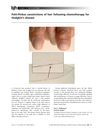
February 2005 in “British Journal of Haematology” Chemotherapy caused the patient's hair to have alternating thick and thin segments.
 17 citations
,
January 2011 in “Skin Research and Technology”
17 citations
,
January 2011 in “Skin Research and Technology” Hair from people with seborrheic dermatitis is thicker scaled, more damaged, and thinner than healthy hair, and atomic force microscopy can help monitor the condition.
 4 citations
,
August 2014 in “Journal of molecular structure”
4 citations
,
August 2014 in “Journal of molecular structure” Chemical treatments on bleached black hair change its internal structure by breaking and reforming bonds, and treatments with hydrolyzed eggwhite protein help repair it.
 54 citations
,
January 2013 in “Journal of Biological Macromolecules”
54 citations
,
January 2013 in “Journal of Biological Macromolecules” A new method effectively separates keratin-associated proteins and keratin from human hair.