 5 citations
,
February 2019 in “Oral and Maxillofacial Surgery”
5 citations
,
February 2019 in “Oral and Maxillofacial Surgery” Hair loss can be reversed or even cured using advanced hair restoration techniques, with rare complications like swelling and bleeding.
 5 citations
,
October 2013 in “Clinics in Plastic Surgery”
5 citations
,
October 2013 in “Clinics in Plastic Surgery” Hair transplant improves with regenerative medicine and FUE technique.
4 citations
,
January 2018 in “Annals of dermatology/Annals of Dermatology” Hair transplantation successfully treated hair loss in a patient with Trichorhinophalangeal syndrome.
4 citations
,
January 2017 in “Journal of dermatological treatment” Hair transplantation improved hair loss in a coup de sabre patient.
 4 citations
,
February 2008 in “Dermatologic Surgery”
4 citations
,
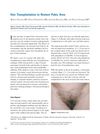
February 2008 in “Dermatologic Surgery” Hair transplant surgery successfully restored a woman's pubic hair, improving her appearance and satisfaction.
 4 citations
,
May 2005 in “Seminars in Plastic Surgery”
4 citations
,
May 2005 in “Seminars in Plastic Surgery” Carlos Oscar Uebel developed a hair transplant method that looks natural, has low risk, and shows full growth in 6-12 months.
 4 citations
,
April 2020 in “Facial Plastic Surgery Clinics of North America”
4 citations
,
April 2020 in “Facial Plastic Surgery Clinics of North America” Hair loss in women is complex to diagnose and treat, and hair restoration should be done by experts. Using minoxidil before surgery can help manage post-surgery hair shock loss. The Follicular Unit Transplantation method is recommended for women due to its speed, no need for shaving, and better graft quality. Strategies like L, T, and reverse L patterns can help restore central hair density, and regenerative methods can improve graft survival in hair transplants.
 4 citations
,
August 2017 in “JAMA Dermatology”
4 citations
,
August 2017 in “JAMA Dermatology” Norman Orentreich pioneered hair transplantation, improving techniques over time for more natural results.
 4 citations
,
November 2006 in “Dermatologic Surgery”
4 citations
,
November 2006 in “Dermatologic Surgery” Transplanted transected hair follicles can survive but grow at unsatisfactory rates and are thinner, suggesting limited potential for unlimited donor hair supply.
 3 citations
,
October 2021 in “Indian Journal of Plastic Surgery”
3 citations
,
October 2021 in “Indian Journal of Plastic Surgery” Strip harvest hair transplants produce natural-looking results and have a high success rate with minimal damage to hair follicles.
 3 citations
,
August 2002 in “Current Opinion in Otolaryngology & Head and Neck Surgery”
3 citations
,
August 2002 in “Current Opinion in Otolaryngology & Head and Neck Surgery” Hair transplantation, especially follicular unit micrografting, was the top treatment for male pattern baldness, with a focus on natural results and ongoing improvements in both surgical and medical management.
3 citations
,
June 2023 in “Plastic & Reconstructive Surgery” The 2-step surgery effectively treats stable follicular vitiligo with high patient satisfaction and no major complications.
 3 citations
,
May 2021 in “Indian Dermatology Online Journal”
3 citations
,
May 2021 in “Indian Dermatology Online Journal” FUE is a versatile hair transplant technique with many uses and good outcomes when performed with skill.
 3 citations
,
April 2020 in “Facial Plastic Surgery Clinics of North America”
3 citations
,
April 2020 in “Facial Plastic Surgery Clinics of North America” Beard hair transplantation is generally satisfying, requires 250-800 grafts, uses FUE to avoid scars, needs careful planning, has some risks, and hair regrowth starts after 4-6 months.
 3 citations
,
December 2004 in “Aesthetic Surgery Journal”
3 citations
,
December 2004 in “Aesthetic Surgery Journal” Hair restoration, especially at the hairline and frontal hair volume, can improve facial balance and attractiveness, with follicular unit transplantation being a successful method.
 2 citations
,
January 2022 in “Hair transplant forum international”
2 citations
,
January 2022 in “Hair transplant forum international” The FUE-LE technique combines two hair transplant methods to harvest more hair with minimal visible scarring, especially for patients with advanced hair loss.
 2 citations
,
November 2016 in “PubMed”
2 citations
,
November 2016 in “PubMed” Robotic hair restoration is efficient, minimally invasive, reduces scarring, and leads to quick healing with high patient satisfaction.
2 citations
,
May 2002 in “PubMed” Micro-graft hair transplantation is an effective, simple, and painless method for permanent hair restoration in men and women.
2 citations
,
October 2023 in “Aesthetic Plastic Surgery” Females, especially over 40, are more likely to experience temporary hair loss after hair restoration surgery.
 2 citations
,
April 2018 in “Journal of Cosmetic Dermatology”
2 citations
,
April 2018 in “Journal of Cosmetic Dermatology” Tumescent fluid increases scalp hair angles, which may improve hair transplant results and reduce surgeon fatigue.
2 citations
,
January 2014 in “Journal of clinical and diagnostic research” Emerging therapies like stem cell and laser treatments show promise for hair regeneration.
 2 citations
,
September 2013 in “Journal of Cosmetic Dermatology”
2 citations
,
September 2013 in “Journal of Cosmetic Dermatology” Hair restoration combines drugs and follicular unit grafting for natural, long-lasting results.
 2 citations
,
May 2010 in “Hair transplant forum international”
2 citations
,
May 2010 in “Hair transplant forum international” Different hair restoration techniques like follicular unit extraction, scalp reduction, and body hair transplantation can improve results for patients unhappy with their initial surgery, but they also have potential risks.
 2 citations
,
September 2002 in “Dermatologic Surgery”
2 citations
,
September 2002 in “Dermatologic Surgery” Each group of hair follicles on the scalp shares one muscle that helps control hair movement.
 1 citations
,
January 2021 in “Dermatological reviews”
1 citations
,
January 2021 in “Dermatological reviews” Hair transplantation improves androgenetic alopecia with high patient satisfaction.
1 citations
,
January 2020 FUE is a preferred hair restoration method because it avoids large scars and offers less pain.
1 citations
,
December 2007 The micropunctiform technique for hair restoration is safe, simple, and creates a natural hairline.
 1 citations
,
January 2020 in “The Egyptian Journal of Plastic and Reconstructive Surgery”
1 citations
,
January 2020 in “The Egyptian Journal of Plastic and Reconstructive Surgery” PRP or nanofat injections improve scar tissue quality but don't significantly boost hair transplant results for scarring hair loss.
 1 citations
,
March 2019 in “Hair transplant forum international”
1 citations
,
March 2019 in “Hair transplant forum international” Both hair transplant methods, FUE and FUT, show similar stress responses and growth abilities in hair cells.
 1 citations
,
May 2018 in “Hair transplant forum international”
1 citations
,
May 2018 in “Hair transplant forum international” Hair transplant techniques and scalp micropigmentation can effectively hide scars and hair loss after cranial surgery.