38 citations
,
November 2005 in “The journal of investigative dermatology. Symposium proceedings/The Journal of investigative dermatology symposium proceedings” Understanding normal hair follicle development helps analyze abnormalities in mutant mice.
 40 citations
,
June 2013 in “Scientific Reports”
40 citations
,
June 2013 in “Scientific Reports” A gene variant in KRT71 causes the curly fur in Selkirk Rex cats.
1 citations
,
June 2023 in “Turkish Journal of Surgery” A rare case linked complete hair loss to both pancreas and gallbladder cancer.
8 citations
,
April 2017 in “Journal of The Royal Society Interface” Giant axonal neuropathy changes the structure of keratin in human hair.
September 2014 in “Journal of the American Academy of Dermatology” The girl likely has Loose anagen hair syndrome, which may improve on its own or with minoxidil.
1 citations
,
March 2017 in “Roczniki Naukowe Polskiego Towarzystwa Zootechnicznego” Domestic cat hair varies in thickness and length, with guard hairs being longest and thickest, and all hair types mainly contain keratin.
 January 2025 in “Turkish Journal of Cerebrovascular Diseases”
 CARASIL can cause different symptoms even with the same genetic mutation.
 3 citations
,
December 2013 in “Journal of Dermatology”
3 citations
,
December 2013 in “Journal of Dermatology” Scanning electron microscopy revealed four distinct hair root shapes in alopecia areata, suggesting a less invasive diagnostic method.
11 citations
,
February 2011 in “The Journal of Dermatology” Mutations in the hairless gene cause a rare form of permanent hair loss.
18 citations
,
August 2009 in “Skin Research and Technology” OCT can identify hair structures, but chemical treatments can damage them.
 2 citations
,
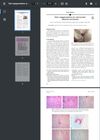
March 2023 in “JAAD case reports”
2 citations
,
March 2023 in “JAAD case reports” Hair repigmentation can indicate malignancy and should be investigated.
1 citations
,
April 2019 in “PubMed” The medulla in Asian scalp hair has a tubular structure that allows ions and large molecules to flow through it.
 7 citations
,
November 2018 in “International Journal of Research -GRANTHAALAYAH”
7 citations
,
November 2018 in “International Journal of Research -GRANTHAALAYAH” Human hair's biomagnetic fields can affect blood cell clumping and coagulation.
7 citations
,
January 2011 in “Biochemistry Research International” Hard α-keratin has a universal molecular structure with a specific superlattice arrangement.
21 citations
,
January 2010 in “International journal of trichology” Trichoscopy can diagnose monilethrix, a genetic hair defect causing hair thinning and loss.
 34 citations
,
August 1966 in “Experimental cell research”
34 citations
,
August 1966 in “Experimental cell research” Keratin fibrils in hair form and stop growing at specific points in the follicle.
3 citations
,
December 2013 in “American Journal of Dermatopathology” A rare skin growth in a baby was successfully removed without coming back.
8 citations
,
May 2008 in “Applied surface science” Mummy hair from the Taklamakan desert has calcium and phosphorus inside.
October 1984 in “Kidney international” The patient had complex urinary tract issues and ambiguous genitalia, with physical features suggesting a hormonal imbalance.
5 citations
,
September 2006 in “Natural medicines/Journal of natural medicines” Microscopic hair features can identify different Cauda Cervi species.
 March 2023 in “International Journal of Dermatology”
 COVID-19 can cause hair to become progressively kinked.
1 citations
,
January 2017 in “International Journal of Trichology” A new mutation caused a rare hair disorder in a Polish girl, not inherited from her family.
2 citations
,
April 2008 in “PubMed” A gene mutation causes monilethrix in a Chinese family.
 4 citations
,
January 2014 in “International Journal of Trichology”
4 citations
,
January 2014 in “International Journal of Trichology” A 12-year-old boy with a rare genetic condition has progressive hair loss with no effective treatment.
Tricholemmoma is linked to Cowden syndrome and can be benign or malignant.
8 citations
,
March 2007 in “The journal of investigative dermatology/Journal of investigative dermatology” The near-naked hairless mutation causes hair loss but is not due to a mutation in the hairless gene itself.
 1 citations
,
January 2016 in “Journal of cosmetology & trichology”
1 citations
,
January 2016 in “Journal of cosmetology & trichology” Trichoscopy helped diagnose and treat a child's fungal scalp infection by spotting specific hair shapes.
January 2022 in “Clinical Cases in Dermatology” A 4-year-old boy has a rare type of hair loss in a line pattern on his scalp.
Giant axonal neuropathy changes the structure of keratin in human hair, making it stiffer and stronger.
83 citations
,
July 1993 in “Journal of the American Veterinary Medical Association” Diagnosis of adrenal issues in ferrets should use symptoms, ultrasound, and surgery, not ACTH tests.