
Follicular atopic dermatitis in dark skin can look different, making diagnosis harder.
34 citations
,
February 2012 in “International Journal of Dermatology” Dermatoscopy can help identify hydroquinone-induced skin issues, avoiding invasive biopsies.
 1 citations
,
December 2016 in “Journal of Evolution of Medical and Dental Sciences”
1 citations
,
December 2016 in “Journal of Evolution of Medical and Dental Sciences” Hemodialysis patients often experience skin issues like dryness and itching, linked to certain blood chemical levels.
23 citations
,
January 1964 in “Archives of Dermatology” Treatment with vitamin A did not improve the child's skin condition.
17 citations
,
July 1984 in “British journal of dermatology/British journal of dermatology, Supplement” The four patients have a unique type of ichthyosis affecting hair follicles.
 January 2019 in “Global Dermatology”
 Genetic hair shaft abnormalities can be seen with microscopes and often affect scalp hair.
30 citations
,
January 1963 in “PubMed”  26 citations
,
September 1969 in “The American journal of medicine”
26 citations
,
September 1969 in “The American journal of medicine” Cronkhite-Canada Syndrome often leads to death within 6-18 months.
 15 citations
,
January 2013 in “European Journal of Pediatrics”
15 citations
,
January 2013 in “European Journal of Pediatrics” Patients with Shwachman-Diamond syndrome often get misdiagnosed due to a wide range of symptoms, including immune system problems and bone abnormalities.
 13 citations
,
June 2010 in “Journal of The American Academy of Dermatology”
13 citations
,
June 2010 in “Journal of The American Academy of Dermatology” A man with Cronkhite-Canada syndrome had all 20 nails detach but improved with treatment.
April 1980 in “Archives of Dermatology” Zinc deficiency didn't cause visible hair changes in the patient.
29 citations
,
June 2016 in “Experimental Dermatology” MCHR2 gene duplications may be linked to alopecia areata.
1 citations
,
December 2018 in “Veterinary dermatology” The hair coat disorder in Schipperkes is similar to Alopecia X and involves increased androstenedione levels and hair cycle arrest.
January 2020 in “Revista Dermatológica Centro Uraga” Recognizing trichoscopic features is crucial for diagnosing various hair loss conditions.
13 citations
,
February 2012 in “International Journal of Dermatology” A new genetic mutation in the CDH3 gene causes hair loss and eye problems in young people.
1 citations
,
January 2018 in “Jornal Brasileiro de Patologia e Medicina Laboratorial” Monilethrix causes brittle hair and hair loss, and it runs in families.
January 2019 in “DSpace@MIT (Massachusetts Institute of Technology)” Higher PHGDH levels cause unusual melanin buildup in hair follicles.
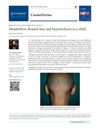 January 2026 in “Cosmoderma”
 A 9-year-old girl has a rare hair disorder causing beaded, sparse hair.
January 2025 in “Figshare” Stress can cause sudden hair whitening in children, but it may reverse on its own.
January 2025 in “Figshare” Stress can cause sudden hair whitening in children, but it may reverse on its own.
 14 citations
,
June 2013 in “Anais Brasileiros de Dermatologia”
14 citations
,
June 2013 in “Anais Brasileiros de Dermatologia” Follicular red dots may be a normal feature seen in people with less skin pigmentation, not necessarily indicating a scalp disorder.
 January 2012 in “Iraqi postgraduate Medical Journal”
 Serum ferritin is a better indicator than hemoglobin for detecting low iron in women with chronic hair loss.
 60 citations
,
October 2010 in “Molecular Imaging and Biology”
60 citations
,
October 2010 in “Molecular Imaging and Biology” Increased skin pigmentation in mice reduces bioluminescent signal accuracy.
 April 2017 in “Journal of Investigative Dermatology”
 Deep phenotyping helps distinguish between xeroderma pigmentosum and trichothiodystrophy, aiding in diagnosis and treatment.
 11 citations
,
March 2001 in “Clinics in Dermatology”
11 citations
,
March 2001 in “Clinics in Dermatology” Hair microscopy is useful for diagnosing hair disorders, but clear definitions are needed for accurate genetic analysis.
9 citations
,
August 1980 in “Journal of Cutaneous Pathology” Rhodamin B stain is inconsistent for keratin in skin samples.
January 2017 in “프로그램북(구 초록집)” Iron deficiency anemia can cause hair breakage.
June 2025 in “British Journal of Dermatology” Topical minoxidil may help improve hair growth in rare congenital hypotrichosis.
 2 citations
,
March 1977 in “Journal of animal science/Journal of animal science ... and ASAS reference compendium”
2 citations
,
March 1977 in “Journal of animal science/Journal of animal science ... and ASAS reference compendium” Defective mink guard hairs have split tips and missing cuticle cells, causing a metallic sheen.
2 citations
,
August 1987 in “Archives of Dermatology” Langerhans' cells are not responsible for depigmentation in this mouse model.