 8 citations
,
September 2011 in “European Journal of Dermatology”
8 citations
,
September 2011 in “European Journal of Dermatology” Most treatments for Frontal Fibrosing Alopecia are ineffective, but early anti-inflammatory therapy may help and the condition may stabilize over time.
 7 citations
,
August 2021 in “Journal of the European Academy of Dermatology and Venereology”
7 citations
,
August 2021 in “Journal of the European Academy of Dermatology and Venereology” Early treatment of fibrosing alopecia in a pattern distribution may improve outcomes.

Low-dose oral isotretinoin improved hair loss and facial bumps in patients with a specific type of hair loss.
 7 citations
,
September 2017 in “Scientific Reports”
7 citations
,
September 2017 in “Scientific Reports” Mice with too much sPLA₂-IIA have hair loss and poor wound healing due to abnormal hair growth and stem cell depletion.
 6 citations
,
January 2019 in “Medical Hypotheses”
6 citations
,
January 2019 in “Medical Hypotheses” Frontal Fibrosing Alopecia might be an autoimmune disease.
 5 citations
,
June 2019 in “Dermatopathology”
5 citations
,
June 2019 in “Dermatopathology” Histopathology is not reliable for detecting early fibrosis in traction alopecia or for showing how severe it is.
 5 citations
,
September 2010 in “Cancer Prevention Research”
5 citations
,
September 2010 in “Cancer Prevention Research” The research suggests new treatments for skin cancer could target specific cell growth pathways.
 4 citations
,
October 2013 in “Clinics in Dermatology”
4 citations
,
October 2013 in “Clinics in Dermatology” Experts don't fully agree on how to diagnose certain hair growth disorders and more research is needed to understand them better.
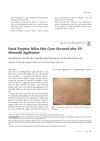 3 citations
,
January 2018 in “Annals of Dermatology”
3 citations
,
January 2018 in “Annals of Dermatology” A woman developed facial hair cysts after using a 3% minoxidil solution for hair loss, which disappeared after stopping the treatment and removing the cysts surgically.
 2 citations
,
January 2020 in “American Journal of Clinical Research and Reviews”
2 citations
,
January 2020 in “American Journal of Clinical Research and Reviews” All skin diseases might start in hair follicles.
 1 citations
,
January 2026
1 citations
,
January 2026 Use personalized cosmeceuticals for safe, effective hair and scalp treatment.
 1 citations
,
November 2024 in “Archives of Dermatological Research”
1 citations
,
November 2024 in “Archives of Dermatological Research” Early and accurate diagnosis of posterior scalp hair loss is crucial for effective treatment and better outcomes.
 1 citations
,
May 2024 in “Dermatology and Therapy”
1 citations
,
May 2024 in “Dermatology and Therapy” Frontal Fibrosing Alopecia needs better diagnostics and treatments, with dutasteride showing promise.
 1 citations
,
October 2018 in “InTech eBooks”
1 citations
,
October 2018 in “InTech eBooks” The document concludes that treatments for cicatricial alopecia are not well-supported by evidence, but hair transplantation shows more predictable and satisfactory results.
 April 2026 in “Ankara Eğitim ve Araştırma Hastanesi Tıp Dergisi”
 Severe acne patients have higher inflammatory markers than healthy people.
 February 2026 in “Dermatology Reports”
 Trichoscopy helps diagnose and treat dissecting cellulitis early, preventing scarring.
 January 2026 in “International Journal of Dermatology Venereology and Leprosy Sciences”
 Metformin may improve acanthosis nigricans by reducing insulin resistance.
 December 2025 in “Frontiers in Medicine”
 Biofibre ® 4.0 hair implants are safe and satisfy most patients with hair loss.

Steatocystomas are harmless skin cysts that can vary in size and may sometimes cause itching or pain.

Histopathological confirmation is crucial for accurately diagnosing challenging alopecia areata cases.

COVID-19 can cause significant hair loss.
 July 2024 in “Romanian Journal of Veterinary Sciences”
 Cyclosporine improved skin condition in dogs with sebaceous adenitis.
 June 2024 in “International journal of nanomedicine”
 Azelaic acid micro/nanocrystals, especially with ultrasound and salicylic acid, greatly improve acne treatment.
 May 2024 in “International Seven Journal of Multidisciplinary”
 More research is needed to better understand and treat Fibrosing Frontal Alopecia.

Genetic testing can help diagnose skin conditions but needs more research for full effectiveness.
 January 2024 in “bioRxiv (Cold Spring Harbor Laboratory)”
 A specific enzyme is essential for proper hair follicle stem cell development and healthy skin.
 October 2023 in “Journal of Drug Delivery and Therapeutics”
 SANG5 niosomal gel effectively treats acne.

A rare case of a woman having both lichen planus pigmentosus and classic lichen planopilaris at the same time.
 January 2023 in “Pesquisa Veterinária Brasileira”
 A KRT71 mutation in Hereford cattle in Uruguay causes thin, curly hair and scaly skin.
 November 2022 in “Research Square (Research Square)”
 Using facial sunscreen and moisturizer may increase the risk of frontal fibrosing alopecia.